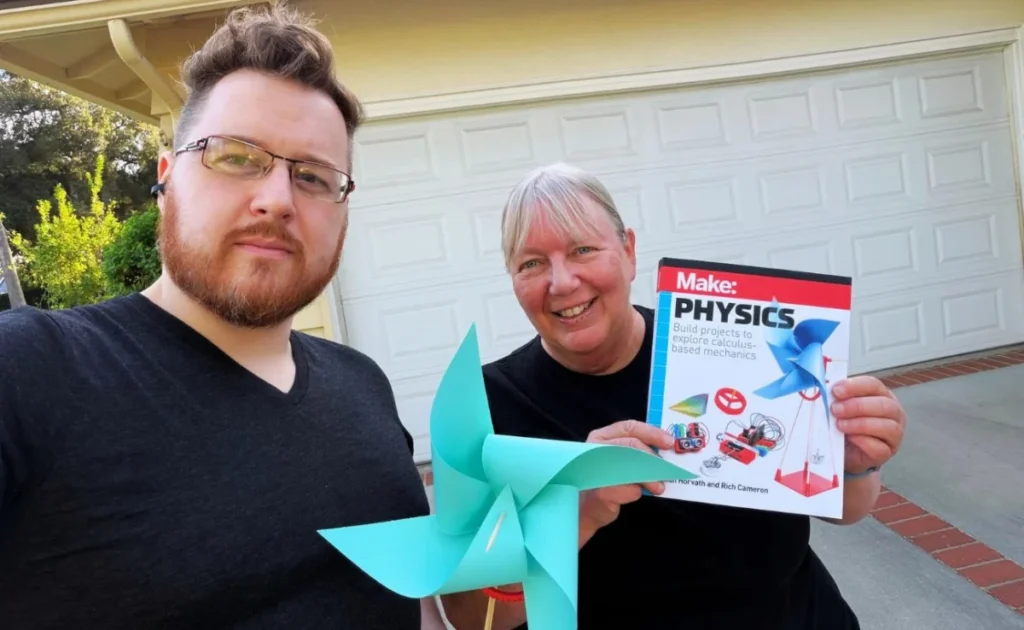
The Maker Movement continues to expand its influence into formal education as the upcoming Make: Live session, scheduled for Friday, July 24, 2026, at 1 PM Pacific Time, prepares to host a panel of experts to discuss the intersection of DIY technology and classical mechanics. Led by Dale Dougherty, the founder of Make: magazine and a pioneer of the global Maker Movement, the broadcast will feature authors Joan Horvath and Rich Cameron. The primary focus of the discussion will be their latest publication, Make: Physics, a comprehensive guide designed to modernize the way advanced high school students, undergraduate engineering majors, and adult learners engage with the fundamental laws of the physical world.
The session arrives at a critical juncture in STEM (Science, Technology, Engineering, and Mathematics) education, where traditional instructional methods are increasingly being supplemented—or replaced—by hands-on, project-based learning. Make: Physics represents a significant addition to the Maker Media library, aiming to demystify complex topics such as kinematics, energy, momentum, and rotational dynamics through the use of accessible maker-grade hardware like the BBC micro:bit and 3D-printed components.
A New Framework for Scientific Literacy
For decades, the teaching of physics has relied heavily on a "lecture-first" model, where students are introduced to abstract mathematical formulas before ever witnessing the physical phenomena those formulas describe. Joan Horvath and Rich Cameron, who have spent more than ten years training educators and scientists in the application of maker technologies, argue that this approach often alienates students who might otherwise excel in scientific fields.
In Make: Physics, the authors propose a "learn-by-doing" methodology. By constructing their own experimental apparatuses, students gain an intuitive understanding of how variables interact in a system. For instance, rather than simply solving for velocity on a chalkboard, a student using the Horvath-Cameron method might program a micro:bit—a low-cost, pocket-sized computer—to act as a precision timer for a 3D-printed cart on an inclined plane. This process requires the student to engage with the hardware, the software, and the physical laws of gravity and friction simultaneously.
The book is specifically structured to bridge the gap between high school algebra-based physics and university-level calculus-based physics. By using real-world data collected from student-built sensors, the text illustrates how calculus is not merely an academic hurdle but a vital tool for describing the changing rates of motion and energy transfer in the real world.
The Panel: Diverse Perspectives on Pedagogy and Accessibility
The Make: Live event will not only feature the authors but will also include voices from the front lines of education and advocacy. Dr. Simon Huss, the STEAM (Science, Technology, Engineering, Arts, and Mathematics) Director at the Windward School, will provide an educator’s perspective on the implementation of these projects in a classroom setting. Dr. Huss has been a vocal proponent of integrating "making" into the core curriculum, moving it out of extracurricular clubs and into the daily academic experience.
"The challenge in modern science education is maintaining engagement once the material becomes mathematically rigorous," Dr. Huss has noted in previous educational forums. His participation in the session is expected to highlight the measurable outcomes of hands-on learning, such as increased student retention of complex concepts and a higher degree of comfort with troubleshooting and iterative design.
Equally significant is the inclusion of Dr. Mina Sun, a scientist and prominent advocate for blind and non-visual learners. Dr. Sun’s involvement underscores a growing movement within the STEM community to ensure that science is accessible to everyone, regardless of physical ability. In many traditional physics labs, experiments rely heavily on visual observation of dials or computer screens. However, the maker-centric approach advocated in Make: Physics lends itself to tactile and auditory feedback.
Dr. Sun is expected to discuss how the physical nature of 3D-printed models and the programmable haptic or auditory outputs of devices like the micro:bit can empower non-visual learners. By focusing on the "making" of the experiment, science becomes a multi-sensory experience, breaking down barriers that have historically excluded students with visual impairments from pursuing careers in physics and engineering.
The Evolution of Maker Technology in the Classroom
The reliance on tools like the BBC micro:bit and 3D printing in Make: Physics reflects a broader trend in educational technology. Over the past decade, the cost of precision manufacturing and data collection tools has plummeted, allowing schools to outfit labs with equipment that was once the exclusive province of well-funded research universities.
The BBC micro:bit, originally launched in the United Kingdom to encourage coding among children, has become a global standard for educational electronics. Its built-in accelerometers, compasses, and Bluetooth connectivity make it an ideal "black box" for physics experiments. When paired with 3D printing—a technology that Horvath and Cameron have written about extensively in previous works—students can create custom-fit parts for experiments that require high degrees of repeatability and precision.
Chronologically, this development follows the "Desktop Revolution" of the 2010s. If the previous decade was about learning how to use the tools (3D printers, CNC machines, and laser cutters), the current decade is about applying those tools to master specific academic disciplines. Make: Physics is positioned as a cornerstone of this transition, moving beyond "making for the sake of making" toward "making for the sake of understanding."
Analysis of Educational Implications
The shift toward the "maker-physics" model has several long-term implications for the workforce and the economy. As industries increasingly demand "T-shaped" professionals—those with deep expertise in one area and a broad ability to collaborate across disciplines—the experiential learning model provided by Horvath and Cameron becomes essential.

- Bridging the Skill Gap: By teaching students to build their own tools, educators are fostering a generation of "citizen scientists" who are not dependent on proprietary, expensive equipment. This fosters an innovative mindset essential for startups and R&D environments.
- Calculus Retention: One of the primary reasons students drop out of engineering programs is the perceived difficulty of calculus. By grounding calculus in the physical reality of a maker project, Make: Physics helps demystify the math, potentially reducing attrition rates in first-year college programs.
- Democratization of Science: Low-cost materials mean that high-quality physics education is no longer restricted to elite institutions. A micro:bit and a spool of 3D printer filament cost a fraction of traditional lab setups, allowing rural and underfunded schools to provide world-class STEM experiences.
Looking Ahead: The Future of Maker Media
The Make: Live session on July 24 is part of a broader strategy by Maker Media to provide "living" documentation for their publications. By allowing readers and educators to interact directly with authors and experts, the organization creates a feedback loop that informs future editions and new projects.
Joan Horvath and Rich Cameron have a prolific history with Maker Media, having authored numerous books that serve as bridges between technical complexity and beginner-level accessibility. Their collaborative work often focuses on the "why" as much as the "how," a philosophy that has earned them a dedicated following among both hobbyists and professional educators.
As the session concludes, participants will be encouraged to join the Make: community on platforms like Discord to continue the discussion. This community-driven approach to science ensures that the learning does not end when the book is closed or the live stream terminates. Instead, it fosters an ongoing dialogue where students and teachers can share their own modifications to the projects, further enriching the collective knowledge of the maker community.
In an era where scientific literacy is more important than ever, Make: Physics and the upcoming Make: Live event serve as a reminder that the best way to understand the universe is to try to build a piece of it yourself. Whether it is a student in a high-tech lab at the Windward School or a lifelong learner in a home garage, the tools and techniques discussed by Horvath, Cameron, and their guests are designed to empower the next generation of thinkers, builders, and innovators.
The event will be recorded and made available for those unable to attend the live broadcast, ensuring that the insights shared by Dr. Huss, Dr. Sun, and the authors remain a resource for the global educational community. With Make: Physics now available through the Maker Shed and other major retailers, the transition toward a more hands-on, inclusive, and technologically integrated science curriculum appears to be well underway.