A recent study published by a team of cosmologists suggests that the universe may not be as uniform and isotropic as widely believed, presenting a significant challenge to the prevailing standard cosmological model. The findings indicate that the cosmos could be "lopsided" or asymmetric, meaning its properties are not the same in every direction. This revelation stems from an investigation into the "cosmic dipole anomaly," a persistent disagreement in astronomical data that questions the very foundational assumptions of modern cosmology. The implications of this anomaly, should it be confirmed and understood, are profound, potentially necessitating a fundamental re-evaluation of our understanding of the universe’s structure, dynamics, and evolution.
The Foundational Pillars of Modern Cosmology
For decades, the bedrock of modern cosmology has been the "standard cosmological model," often referred to as the Lambda-CDM model. This model describes the dynamics and structure of the entire cosmos based on several key assumptions, most notably the Cosmological Principle. This principle posits that the universe is, on sufficiently large scales, both isotropic (looks the same in all directions) and homogeneous (looks the same from every location). These assumptions vastly simplify the complex equations of Albert Einstein’s theory of general relativity, leading to the Friedmann–Lemaître–Robertson–Walker (FLRW) metric. The FLRW metric provides a mathematical framework for describing an expanding universe that is spatially flat, homogeneous, and isotropic.
The Lambda-CDM model, built upon the FLRW framework, incorporates two enigmatic components: Lambda (Λ), representing dark energy, responsible for the accelerated expansion of the universe, and Cold Dark Matter (CDM), a hypothetical form of matter that interacts weakly with ordinary matter and light, explaining observed gravitational effects in galaxies and clusters. This model has been remarkably successful in explaining a vast array of cosmological observations, from the abundance of light elements formed in the Big Bang to the large-scale structure of galaxies and the precise temperature fluctuations in the Cosmic Microwave Background (CMB).
The Cosmic Microwave Background, the relic radiation left over from the Big Bang, serves as a cornerstone of the Lambda-CDM model. Discovered in 1964 by Arno Penzias and Robert Wilson, the CMB is a faint glow of microwave radiation permeating the entire sky. Its extraordinary uniformity, to within one part in a hundred thousand, across the celestial sphere, provided compelling evidence for the early universe’s hot, dense, and remarkably smooth state, thus strongly supporting the assumption of an isotropic and homogeneous universe. Cosmologists have relied on this uniformity to model the universe using the maximally symmetric description of spacetime inherent in Einstein’s theory.
Emerging Cracks: The Era of Cosmological Tensions
Despite the impressive successes of the Lambda-CDM model, several "tensions" or disagreements in the data have emerged over recent years, posing significant challenges to the idea of a perfectly uniform universe. These tensions highlight discrepancies between measurements derived from different epochs of the universe or using different observational probes.
One of the most widely debated of these is the Hubble Tension. Named after Edwin Hubble, who in 1929 first provided observational evidence that the universe is expanding, this tension concerns the universe’s expansion rate, quantified by the Hubble Constant (H₀). The discrepancy began to emerge in the early 2000s and has been solidified by recent data from instruments like the Hubble Space Telescope and the Gaia satellite, as well as earlier measurements from the Planck satellite. Measurements of the expansion rate derived from observations of the early universe (e.g., through the CMB and Baryon Acoustic Oscillations, BAO) consistently yield a value around 67-68 kilometers per second per megaparsec (km/s/Mpc). In stark contrast, direct measurements of the local, more recent universe, using "standard candles" like Type Ia supernovae and Cepheid variable stars, yield a higher value, typically around 73-74 km/s/Mpc. This approximately 9% difference, far exceeding statistical uncertainties, suggests either unknown new physics or systematic errors in our measurements, challenging the completeness of the Lambda-CDM model.
However, the recent study emphasizes an even more fundamental challenge: the cosmic dipole anomaly. While it has received considerably less attention than the Hubble tension, its implications for our understanding of the cosmos are arguably more profound.
The Cosmic Dipole Anomaly: A Direct Challenge to Isotropy
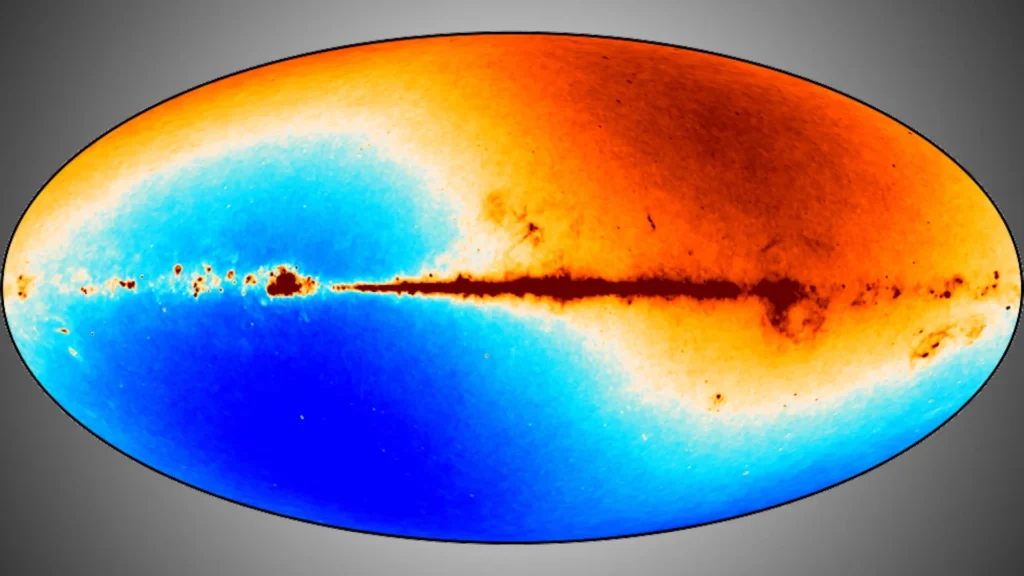
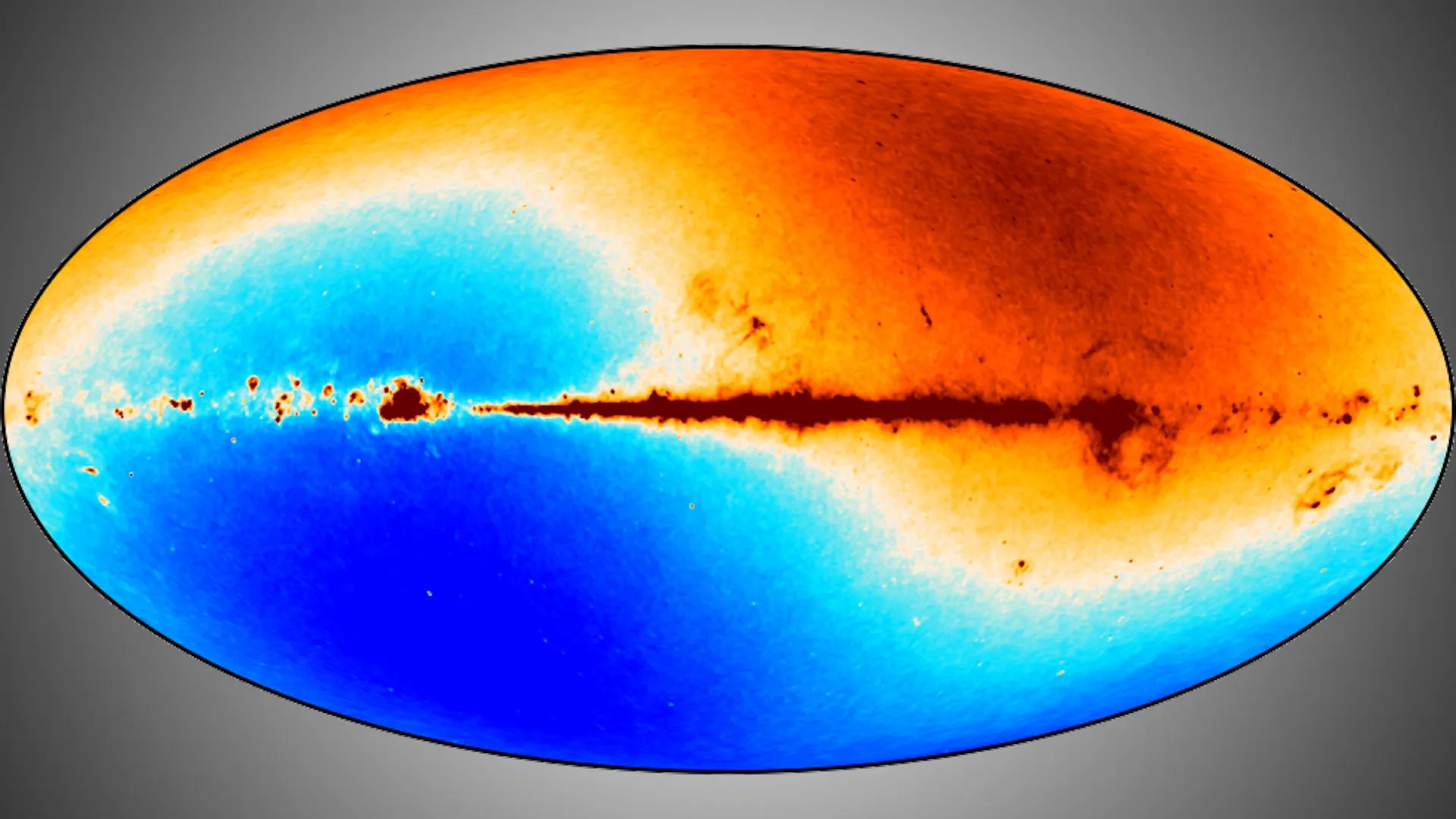
The cosmic dipole anomaly arises from a specific variation observed in the Cosmic Microwave Background. While the CMB is exceptionally uniform overall, a prominent feature known as the CMB dipole anisotropy is present. This is the largest temperature difference in the CMB, manifesting as one side of the sky being slightly hotter and the opposite side slightly cooler, by about one part in a thousand. This dipole is widely understood to be caused by our own local motion – the Solar System, along with the Milky Way galaxy, is moving at a significant velocity (approximately 370 km/s) relative to the CMB’s rest frame. This motion creates a Doppler shift, making the CMB appear blueshifted (hotter) in the direction of our motion and redshifted (cooler) in the opposite direction.
Crucially, this CMB dipole, by itself, does not challenge the Lambda-CDM model. It is a local kinematic effect, an artifact of our peculiar motion within an otherwise isotropic universe. However, if the universe truly adheres to the Cosmological Principle – being isotropic on large scales – then this local motion should induce a corresponding, observable dipole in the distribution of all other distant astronomical sources. In other words, if we are moving through a truly isotropic universe, then all distant objects should also appear slightly boosted or compressed in the direction of our motion, creating a measurable anisotropy in their observed number density or brightness.
The Ellis-Baldwin Test: Probing Universal Symmetry
The concept of testing this expectation was formalized by astronomers George Ellis and John Baldwin in 1984. They proposed what is now known as the Ellis-Baldwin test. Their question was simple yet profound: Does a similar variation, or "dipole anisotropy," exist in the sky distribution of distant astronomical sources such as radio galaxies and quasars? The key requirement was that these sources must be very distant to ensure that any observed dipole is cosmological in origin and not merely due to local clustering effects within our immediate cosmic neighborhood.
The prediction was clear: if the "symmetrical universe" FLRW assumption is correct, then the dipole variation observed in the distribution of distant astronomical sources should be directly determined by, and consistent with, the observed kinematic dipole in the CMB. This means the direction of the matter dipole should align with the CMB dipole, and its magnitude should be directly predictable from our known peculiar velocity. Consistency between these two dipoles – one from the relic radiation of the Big Bang and the other from the distribution of matter in the present-day universe – would strongly support the standard Lambda-CDM model and the FLRW description. Conversely, discord would directly challenge these fundamental tenets.
Performing the Ellis-Baldwin test with sufficient precision has been a significant observational challenge. It requires vast, deep, and uniform sky surveys of very distant objects, a data catalogue that has only become available relatively recently with advanced telescopes and satellite missions. Previous studies hinted at discrepancies, but lacked the statistical power to draw definitive conclusions.
The Test Results: A Universe That Fails
The recent publication by the research team presents compelling evidence that the universe fails the Ellis-Baldwin test. The variation observed in the distribution of distant matter, particularly in surveys of radio galaxies and quasars, does not match that predicted by the CMB dipole. Specifically, the direction and magnitude of the observed matter dipole are inconsistent with what would be expected if our local motion were the sole cause and the universe were truly isotropic on large scales.
This result is particularly robust because it has been obtained using independent datasets and different observational techniques. The anomaly has been consistently observed with terrestrial radio telescopes, which probe sources emitting at radio wavelengths, and with satellites observing at mid-infrared wavelengths. The consistency of the results across different instruments and wavelengths, each with distinct potential sources of error, significantly strengthens the claim that the observed discrepancy is a genuine cosmological phenomenon rather than an instrumental artifact or systematic bias.
The cosmic dipole anomaly has thus established itself as a major challenge to the standard cosmological model. The original article notes that the astronomical community has "chosen to largely ignore it," likely due to the sheer difficulty and profound implications of such a finding. Overturning a widely accepted paradigm like Lambda-CDM requires overwhelming evidence and a viable alternative.
Implications for the Standard Model and Beyond
The failure of the Ellis-Baldwin test strikes at the very heart of modern cosmology. It implies that the universe, when averaged on large scales, may not be isotropic after all. This is not merely a problem for the Lambda-CDM model; it challenges the more fundamental FLRW description itself. If the universe possesses a preferred direction or exhibits inherent anisotropy, then the mathematical framework currently used to describe its evolution and structure would be fundamentally flawed.
Such a discovery would force cosmologists to go "back to square one," requiring a complete rethinking of fundamental physics. It would necessitate exploring alternative cosmological models that incorporate anisotropy or preferred directions, potentially leading to modifications of Einstein’s general relativity on cosmological scales or entirely new theories of spacetime. The implications could extend to our understanding of dark energy, dark matter, and even the initial conditions of the universe following the Big Bang. For instance, some theories propose that early universe physics might have imprinted a preferred direction that persists to this day, or that the vacuum energy (dark energy) itself might be anisotropic.
The reluctance of the scientific community to immediately embrace such a radical conclusion is understandable. The Lambda-CDM model is incredibly successful and well-tested in many other respects. Disproving its foundational assumptions would be akin to challenging the very laws of physics we understand. However, the growing body of evidence from various "tensions" suggests that the current model, while a powerful approximation, might be incomplete.
The Future of Cosmological Discovery
The coming years promise an "avalanche of data" from a new generation of sophisticated astronomical observatories, which could either solidify these anomalies or provide new insights that resolve them. Missions like the European Space Agency’s Euclid satellite, launched in 2023, are designed to precisely map the distribution of galaxies and dark matter over vast cosmic distances, offering unprecedented insights into the universe’s large-scale structure and the nature of dark energy. NASA’s SPHEREx (Spectro-Photometer for the History of the Universe, Epoch of Reionization, and Ices Explorer), planned for launch in 2025, will conduct the first all-sky near-infrared spectral survey, providing detailed information on the composition and distribution of galaxies.
On the ground, the Vera C. Rubin Observatory, with its Legacy Survey of Space and Time (LSST), will conduct a decade-long survey of the southern sky, creating a dynamic map of billions of celestial objects. Its immense data output will be invaluable for studying large-scale structure and transient phenomena. Similarly, the Square Kilometre Array (SKA) Observatory, currently under construction in Australia and South Africa, will be the world’s largest radio telescope, capable of surveying the universe with unparalleled sensitivity and resolution, potentially providing definitive data on the distribution of distant radio sources relevant to the Ellis-Baldwin test.
These colossal datasets will also fuel advancements in computational cosmology, particularly through the application of artificial intelligence (AI) and machine learning (ML). AI algorithms can process and analyze astronomical data on scales previously unimaginable, identify subtle patterns, and potentially uncover hidden correlations that human researchers might miss. Machine learning could be instrumental in testing complex, non-FLRW cosmological models against observational data, or even in helping to construct entirely new theoretical frameworks that account for the observed anisotropies.
The cosmic dipole anomaly, alongside the Hubble tension, signals a potentially revolutionary era in cosmology. The prospect of abandoning cherished models and "going back to square one" might seem daunting, but it also represents an extraordinary opportunity for groundbreaking discoveries. If the universe truly is asymmetric, the impact on fundamental physics and our understanding of the cosmos would be truly immense, ushering in a new chapter of scientific inquiry that could redefine our place in a truly lopsided universe.