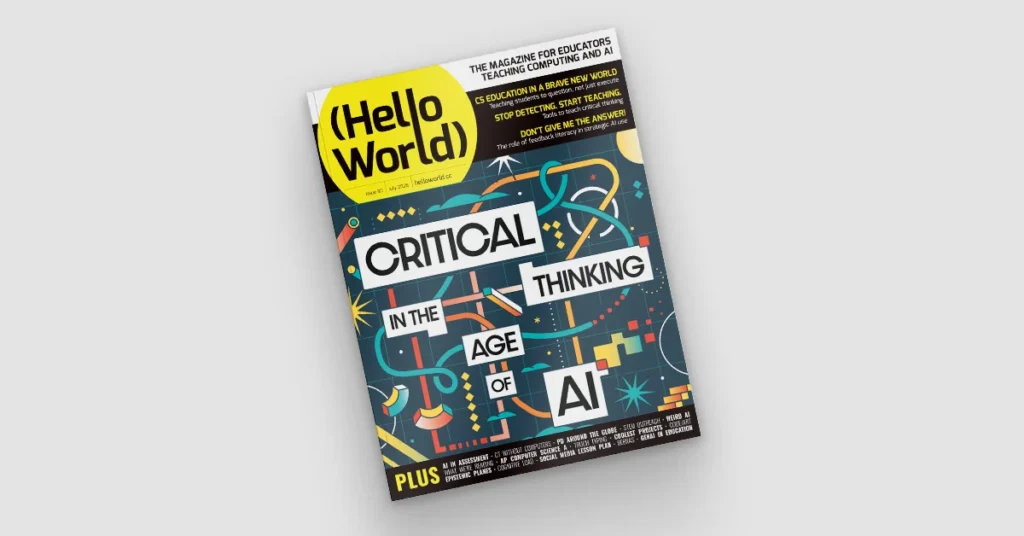
The rapid integration of data-driven tools and generative artificial intelligence into the fabric of daily life has fundamentally altered the way individuals process information, communicate, and make decisions. As these technologies become more sophisticated, they offer a level of convenience that often results in the "outsourcing" of cognitive tasks once considered essential to human development. In response to this shifting landscape, the Raspberry Pi Foundation has announced the release of the 30th issue of Hello World, a publication dedicated to educators and computer science professionals. This landmark issue, accompanied by a new podcast mini-series, focuses specifically on the theme of critical thinking in the age of AI, providing a comprehensive framework for teaching the next generation how to navigate a world increasingly governed by algorithms.
The contemporary digital environment is characterized by predictive features that streamline personal and professional tasks. Predictive text and autocorrect functions allow users to compose messages with minimal effort, effectively outsourcing word choice to a machine. Recommendation engines on streaming platforms curate music and film selections based on past behavior, thereby outsourcing personal taste. Most significantly, the rise of large language models (LLMs) and AI chatbots has enabled users to receive instant, confident answers to complex queries, leading to what many experts describe as the outsourcing of thinking itself. While these tools offer undeniable efficiency, they also present a challenge: the erosion of the "digital friction" that historically required individuals to exercise judgment, compare sources, and engage in trial-and-error problem-solving.
The Context of the AI Revolution in Education
The release of Hello World Issue 30 comes at a time when the global education sector is grappling with the implications of the "Generative AI boom" that began in late 2022. Following the public release of ChatGPT, educational institutions worldwide initially reacted with a mixture of apprehension and restriction. However, as the technology matured throughout 2023 and 2024, the conversation shifted from banning these tools to integrating them responsibly. The central challenge identified by the Raspberry Pi Foundation and its contributors is the preservation of critical thinking.
Historically, critical thinking was developed through manual processes—navigating a city using a physical map, researching information in a library, or manually comparing insurance policies to understand the nuances of coverage. These acts required a level of cognitive engagement that modern AI products aim to eliminate in the name of user experience. The new issue of Hello World argues that because AI can now generate content and provide answers at "supersonic speed," the role of the human must evolve from a creator of basic content to an evaluator of complex output.
Chronology of Educational Adaptation to AI
The timeline of AI integration in the classroom has moved with unprecedented velocity. In the pre-2020 era, AI in education was largely relegated to backend administrative tools or niche adaptive learning platforms. By 2021, predictive text and basic translation tools became standard. The turning point occurred in November 2022 with the democratization of high-level generative AI. By mid-2023, major educational bodies, including the Computer Science Teachers Association (CSTA) in the United States, began revising their standards to reflect the reality of automated code generation and synthetic media.
Issue 30 of Hello World serves as a formal documentation of this transition. It features insights from educators who have spent the last two years observing the effects of AI on student engagement. These educators are now moving beyond the technical "how-to" of AI and focusing on the philosophical "why." The magazine addresses a critical gap in professional development: while many teachers feel confident in using AI tools to create lesson plans, there is a recognized need to build their capacity for critical analysis of the tools themselves.
The New CSTA K-12 Standards and Human Judgment
A primary highlight of the latest issue is an analysis of the newly rewritten CSTA K-12 Standards. These standards serve as a research-backed framework designed to prepare students for a future where the boundary between human and machine labor is increasingly blurred. Contributors Amanda O’Mara, Smita Kolhatkar, and Tiffany Jones emphasize that while AI can generate answers instantly, the evaluation of those answers remains a human responsibility.
The updated standards suggest that computer science education must find a new equilibrium. Instead of focusing solely on the mechanics of coding or data entry—tasks that AI can now perform with high proficiency—students must learn to direct AI. This involves understanding the biases inherent in training data, recognizing the limitations of algorithmic logic, and maintaining the agency to override automated decisions. The consensus among the CSTA team is that without a foundation in critical thinking, students risk being directed by technology rather than acting as its masters.
Key Research Areas and Pedagogical Strategies
Hello World Issue 30 delves into several specific areas of research that are vital for modern educators. One of the featured topics is the management of cognitive load. In educational psychology, cognitive load theory suggests that the human brain has a limited capacity for processing information at any given time. AI can either reduce this load, allowing students to focus on higher-level conceptual thinking, or it can create a "cognitive bypass" where the student avoids the necessary struggle required for deep learning.
The issue also explores:
- AI Systems in Assessment: How can educators fairly evaluate student work when AI is a primary collaborator? The magazine discusses moving toward process-based assessment rather than product-based assessment.
- Promoting Human Decision-Making: Strategies for ensuring that students do not become overly reliant on "confident" AI answers, which may contain hallucinations or factual inaccuracies.
- Whose Knowledge Shapes AI?: A critical look at the data sets used to train AI models and the cultural or geographic biases they may propagate.
In addition to these theoretical discussions, the issue provides practical resources for the classroom. This includes "Flatgames," a low-barrier method for teaching game design that encourages non-linear thinking, and "Predictive Classroom Systems," which examine how data-driven tools can assist—or hinder—the teaching process. Another notable feature is a cross-disciplinary project that combines physics with technology, demonstrating how critical thinking is applied when physical laws meet digital simulations.
Supporting Data and Global Perspectives
The push for critical thinking in AI education is supported by a growing body of data. According to recent surveys by organizations such as the World Economic Forum, "analytical thinking" and "creative thinking" are the two most important skills for workers in 2024 and beyond. Furthermore, reports from UNESCO have highlighted that while AI can bridge certain educational gaps, it also risks widening the "digital divide" if students in underserved communities are taught only how to consume AI output rather than how to critically deconstruct it.
The involvement of Oracle as a sponsor for this issue underscores the interest of the private sector in ensuring a literate and capable future workforce. Tech industry leaders have increasingly noted that the value of an employee is no longer in their ability to produce rote code or text, but in their ability to troubleshoot, audit, and ethically guide the deployment of automated systems.
Broader Implications for Society and Education
The implications of the themes explored in Hello World Issue 30 extend far beyond the classroom. As AI becomes more integrated into healthcare, legal systems, and civic governance, the ability of the general public to think critically about algorithmic output becomes a matter of democratic health. If individuals lose the habit of questioning "confident" answers, they become more susceptible to misinformation and algorithmic bias.
The Raspberry Pi Foundation’s initiative suggests that computing education is uniquely situated to address these societal risks. By teaching students how AI models are built, where the data comes from, and how to test for errors, educators are providing them with the "cognitive armor" necessary for the 21st century. The magazine encourages a mindset of "active engagement" rather than "passive consumption."
The release of Issue 30, along with the accompanying podcast series, provides a roadmap for this transition. It acknowledges that while the convenience of AI is a permanent fixture of modern life, the "accidental delights" of human exploration and the satisfaction of independent problem-solving must be intentionally preserved. By fostering a culture of critical inquiry, the education community can ensure that technology serves as a tool for human empowerment rather than a substitute for human thought.
As the world continues to move at what the CSTA describes as "supersonic speed," resources like Hello World serve as a vital anchor, reminding educators and students alike that the most powerful processor in the room remains the human mind. The foundation invites the global community of educators to engage with these resources, share their findings, and contribute to the ongoing dialogue about the future of learning in an automated age.