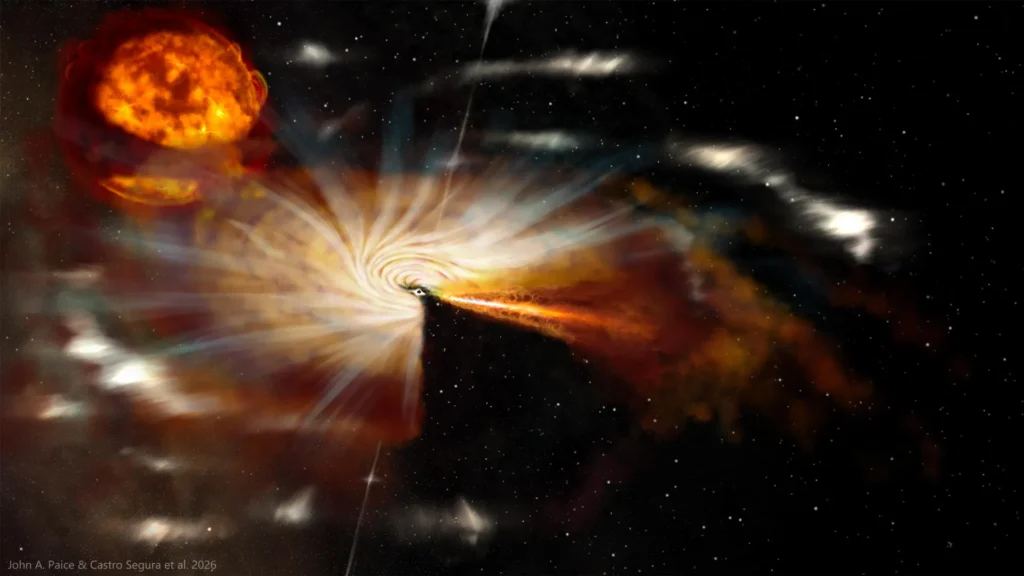
Astronomers have unveiled a groundbreaking discovery suggesting that black holes possess a complex “cosmic digestive system,” actively expelling significant amounts of matter even when appearing to be in a quiescent state. This revelation, led by researchers at the University of Warwick, challenges the conventional understanding of black holes as mere cosmic vacuum cleaners, revealing a far more dynamic and intricate process of matter accretion and expulsion. The findings are based on unprecedented observations of the black hole system Swift J1727.8−1613 during a spectacular outburst in 2023.
Unveiling the Black Hole’s Dual Nature: Ingestion and Ejection
For decades, the prevailing scientific narrative painted black holes as insatiable celestial entities, relentlessly devouring everything in their vicinity. However, new research, spearheaded by Dr. Noel Castro Segura, a Postdoctoral Fellow at the University of Warwick, offers a radically different perspective. Utilizing the formidable capabilities of the European Southern Observatory’s Very Large Telescope (VLT), the international team meticulously tracked the recent discovery, Swift J1727.8−1613, through a dramatic eruptive phase that unfolded throughout 2023.
The observations revealed that as the black hole gravitationally siphoned gas from a companion star, it simultaneously ejected a substantial portion of this captured material back into the interstellar medium via powerful jets and winds. This expulsion, the researchers found, persisted even when the black hole’s luminous output dramatically diminished, reaching levels far below what scientists had previously anticipated for such outflows. This suggests a more nuanced feeding mechanism, where black holes act not as passive sinks but as active processing units, akin to powerful cosmic digestive systems that ingest matter, process it, and then expel a surprising fraction.
"People often imagine black holes simply swallowing everything around them," stated Dr. Noel Castro Segura, the lead author of the study. "What we’re seeing is a much more complex process. Matter falls in, the system processes it, and a surprising amount is expelled again." This paradigm shift stems from the research yielding one of the most detailed optical records ever assembled of a black hole outburst. Instead of capturing isolated snapshots, the astronomers were able to meticulously follow the entire evolutionary arc of the system through its various stages of activity.
A Rare Spectacle: Witnessing Black Hole Feeding in Real-Time
Swift J1727.8−1613 first captured scientific attention in 2023 when it abruptly erupted, swiftly ascending to become one of the brightest X-ray sources detected in the sky. This binary system comprises a black hole locked in a gravitational dance with a nearby star, from which it actively draws gas. This infalling material forms a rapidly spinning accretion disk, a superheated maelstrom of plasma swirling around the black hole before plunging into its event horizon.
The extraordinary detail with which this particular outburst was observed provided astronomers with an unprecedented opportunity to witness the intricate feeding process unfold in real-time. Such high-quality, multi-stage monitoring of black hole feeding events is exceptionally rare, offering a unique window into these extreme cosmic phenomena.
One of the most compelling discoveries emerged when the black hole unleashed a formidable jet of high-energy particles. Concurrently, the accretion disk, the very source of material feeding the black hole, underwent significant structural and dynamic transformations. This synchronized display provided researchers with an unusually clear insight into the intricate interplay between matter spiraling inward towards the black hole and matter being forcefully ejected outward into the cosmos. This interplay is crucial for understanding the feedback mechanisms that influence the evolution of galaxies.
Persistent Winds: The Lingering Echoes of an Outburst
The most profound revelation arrived in the aftermath of the black hole’s most intense feeding phase. Even as Swift J1727’s luminosity waned significantly, indicating a substantial reduction in its accretion rate, astronomers continued to detect the powerful expulsion of dense gas from the system. This occurred when the black hole had dimmed to approximately one-hundredth of its peak activity.
This persistent outflow, even in the system’s diminished state, strongly suggests that black holes can continue to generate powerful energetic winds long after their brightest, most explosive phases have subsided. Furthermore, the sheer volume of material expelled during these later stages could rival the total amount of matter ultimately consumed by the black hole itself.
Reflecting on the implications for our understanding of black hole behavior, Dr. Castro Segura elaborated on the "digestive" analogy: "If black holes can continue shedding material even after their largest outbursts, it means they may be much less efficient eaters than we previously assumed. A significant fraction of the meal may never reach the black hole at all, changing our understanding of how binary stars in galaxies evolve." This suggests that the mass growth of black holes might be considerably slower than previously estimated, with profound consequences for their role in galactic evolution.
Rethinking Efficiency: Black Holes as Imprecise Eaters
The ongoing observations of Swift J1727.8−1613 contribute to a growing body of evidence that black holes are far from passive absorbers of matter. Instead, they are dynamic engines that actively redistribute material within their cosmic neighborhoods. This redistribution occurs through the dual process of drawing gas inward via accretion and then returning a substantial portion outward through the expulsion of relativistic jets and powerful winds.
Kyle Solomons, a Doctoral Researcher at the University of Cape Town and a collaborator on the study, commented on the significance of the findings: "We usually gravitate towards the dramatic fireworks when a black hole outburst begins, but our observations show that the finale can be just as intense. Even as the system’s X-ray emission dropped to a fraction of its peak, it still had enough power to generate a massive expulsion of gas." This highlights the sustained energy output of these systems, even in their less active phases.
By meticulously charting the journey of Swift J1727.8−1613 through its entire outburst cycle, astronomers have gained one of the most comprehensive views to date of how black holes consume matter, how they react to shifting environmental conditions, and how they actively shape the surrounding space. This comprehensive understanding is critical for refining our models of star formation, galaxy evolution, and the distribution of matter in the universe.
Context and Chronology of the Swift J1727.8−1613 Outburst
The discovery of Swift J1727.8−1613 itself was a direct consequence of its sudden and spectacular eruption in early 2023. Prior to this event, the system likely existed in a much more dormant state, with the black hole accreting matter at a significantly lower rate. The outburst marked a period of intense activity, transforming the system into a prominent X-ray source, observable by instruments like the Swift Observatory, which first detected the surge in X-ray emissions.
The chronological progression of the outburst, as meticulously documented by the VLT, can be broadly outlined as follows:
- Pre-Outburst Phase: The black hole system was likely in a quiescent state, with a low accretion rate and minimal observable emissions.
- Outburst Ignition: A sudden influx of matter, possibly triggered by a disruption of the companion star or a sudden instability in the accretion disk, initiated a rapid increase in accretion. This led to the formation of a bright, hot accretion disk and powerful X-ray emissions, marking the beginning of the observable outburst.
- Peak Activity and Jet Launch: During the peak of the outburst, the accretion disk reached its most luminous and energetic state. It was at this stage that the black hole launched its most powerful relativistic jets, observable as streams of high-energy particles traveling at near-light speeds. This period also coincided with major structural changes within the accretion disk.
- Transition Phase: As the readily available fuel from the companion star began to deplete or as instabilities within the disk resolved, the accretion rate started to decrease. The luminosity of the system, particularly in X-rays, began to decline.
- Post-Outburst Outflow: Crucially, even as the luminous output diminished significantly, the expulsion of matter via winds and less collimated outflows continued unabated. This phase, lasting for an extended period, revealed the sustained energetic processes within the system, challenging assumptions about the direct correlation between accretion rate and outflow power.
- Return to Quiescence: Eventually, the accretion rate dropped to levels low enough for the system to return to a dormant state, awaiting another potential trigger for a future outburst.
Supporting Data and Observational Techniques
The success of this research hinges on the advanced capabilities of the VLT, a ground-based telescope operated by the European Southern Observatory (ESO) in Chile. The VLT, equipped with a suite of sophisticated instruments, allowed astronomers to capture high-resolution optical spectra and light curves of Swift J1727.8−1613.
Key observational data points and techniques employed include:
- Optical Spectroscopy: By analyzing the light emitted by the system across different wavelengths, astronomers could determine the chemical composition, temperature, and velocity of the gas in the accretion disk and surrounding outflows. This allowed for the identification of specific atomic emission lines that indicate the presence and behavior of expelled matter.
- Photometry: Measuring the brightness of the system over time provided a detailed light curve, illustrating the rise and fall of the outburst and enabling the precise tracking of its various stages.
- Multi-Wavelength Observations: While the VLT provided crucial optical data, the initial detection by the Swift Observatory in X-rays was vital for identifying the outburst and guiding the VLT observations. Correlating data from different wavelengths (X-ray, optical, and potentially radio) offers a more complete picture of the energetic processes at play.
- High Temporal Resolution: The VLT’s ability to capture data at high temporal resolutions allowed for the detailed mapping of rapid changes within the accretion disk and the outflowing material, crucial for understanding the dynamic interplay.
While specific numerical data regarding the exact mass of expelled material or the precise efficiency of accretion were not detailed in the initial report, the qualitative and quantitative observations strongly indicate that the mass lost via outflows during and after the peak of the outburst is a significant fraction, potentially comparable to, the mass accreted by the black hole. Future studies will likely focus on quantifying these figures with greater precision.
Broader Impact and Implications for Astrophysics
The discovery that black holes are inefficient eaters with substantial matter expulsion has far-reaching implications across several fields of astrophysics:
- Stellar Evolution: The efficiency of mass transfer in binary systems directly influences the evolutionary paths of both stars and black holes. If black holes expel a significant portion of accreted material, the mass growth of black holes might be slower than previously modeled, impacting the final stages of binary star evolution and the formation of compact objects.
- Galactic Feedback: Black hole outflows are a primary mechanism for "galactic feedback," the process by which energy and matter from the central black hole influence the surrounding interstellar medium and regulate star formation within galaxies. If these outflows are more substantial and prolonged than previously thought, their impact on star formation rates and the distribution of gas in galaxies could be significantly greater.
- Accretion Physics: The findings challenge fundamental models of accretion disks and jet formation. The persistence of strong winds even at low accretion rates suggests that the mechanisms driving these outflows are more robust and perhaps less dependent on the absolute accretion rate than current theories propose. This may point to different physical processes, such as magnetic field configurations or turbulence, playing a more dominant role.
- Cosmological Models: The overall mass budget of black holes in the universe and their contribution to galactic evolution are key components of cosmological models. A recalibration of black hole growth rates due to increased expulsion efficiency could necessitate adjustments to these models.
The implications for understanding the evolution of galaxies are profound. The energy and momentum injected into the interstellar medium by these powerful outflows can heat gas, prevent it from cooling and forming stars, and even drive it out of the galaxy entirely. This "AGN feedback" (Active Galactic Nuclei feedback) is considered a critical factor in shaping the observed properties of galaxies, such as their star formation rates and morphologies. If black holes are less efficient at consuming matter and more efficient at expelling it, their role as regulators of galaxy growth may be even more pronounced.
Furthermore, the study sheds light on the complex relationship between accretion and outflow. It suggests that the processes are not always directly proportional, and that even when the visible evidence of accretion (like X-ray luminosity) diminishes, the engine driving the outflows can remain remarkably active. This hints at underlying physical mechanisms, possibly involving magnetic fields threading the black hole and its accretion disk, that can sustain outflows independently of the instantaneous accretion rate.
Future Research Directions
This groundbreaking study opens several avenues for future investigation. Astronomers will likely aim to:
- Quantify Outflow Rates: Conduct more precise measurements to quantify the mass and energy of the expelled material across all stages of black hole outbursts.
- Investigate Jet-Wind Connection: Further explore the intricate relationship between the launching of relativistic jets and the generation of winds, particularly during the transition and post-outburst phases.
- Study a Wider Sample of Black Holes: Apply similar observational techniques to a broader range of black hole systems, including those with different masses and companion stars, to determine if this "digestive" behavior is a universal characteristic.
- Develop Advanced Theoretical Models: Refine theoretical models of accretion and jet launching to incorporate the observed inefficiencies and sustained outflow phenomena. This will require a deeper understanding of the role of magnetic fields, turbulence, and feedback mechanisms.
The ongoing exploration of Swift J1727.8−1613 and similar systems promises to revolutionize our understanding of black holes, transforming them from enigmatic devourers into dynamic cosmic engines that actively shape the universe around them. This research underscores the importance of continuous observation and the willingness to challenge long-held scientific paradigms when confronted with compelling new evidence. The universe, it seems, is far more intricate and energetic than we often imagine.