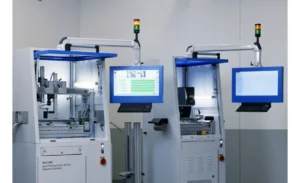
BIRMINGHAM, Mich. – Echodyne, a leading innovator in high-performance radar systems, has officially inaugurated its new $40 million manufacturing facility in Birmingham, Michigan. This significant investment is strategically designed to dramatically scale the production of the company’s advanced electronically scanned radar systems, elevating its annual capacity to more than 30,000 units. The expansion marks a pivotal moment for Echodyne, positioning it to meet surging global demand for sophisticated radar solutions across critical sectors.
A Strategic Move to Address Escalating Demand
The newly established facility spans an impressive 86,350 square feet, meticulously designed to consolidate and streamline Echodyne’s manufacturing operations. Of this extensive footprint, approximately 74,350 square feet are dedicated to state-of-the-art manufacturing processes, complemented by 12,000 square feet of optimized warehousing space. This integrated production hub is engineered to support sustained growth and innovation across Echodyne’s diverse radar product portfolio, which serves applications in defense, critical infrastructure protection, and autonomous systems.
The decision to invest $40 million in this new facility underscores a broader industry trend towards advanced sensing technologies and Echodyne’s commitment to a manufacturing strategy centered on commercial-scale production. This approach stands in stark contrast to traditional low-volume defense manufacturing models, reflecting a strategic shift to deliver high-performance radar systems with unprecedented efficiency and affordability. The company anticipates that the facility, once fully operational, will generate more than 200 new jobs, providing a substantial economic boost to the Birmingham community and the broader Michigan technology sector. This job creation will encompass a range of roles, from skilled manufacturing technicians and engineers to logistics and quality assurance personnel, fostering a new hub of innovation and employment.
Eben Frankenberg, CEO of Echodyne, articulated the driving force behind this ambitious expansion: “Our global customer base is demanding more radar to be delivered as fast as possible. The only way to defend against mass is with mass. That requires not just high-performance economical radars, but the ability to manufacture them at scale.” This statement highlights the urgent need for scalable, cost-effective radar solutions in an increasingly complex global security landscape, where the proliferation of various threats necessitates widespread and rapid deployment of defensive capabilities.
Technological Foundation: The Power of MESA Radar
At the heart of Echodyne’s innovative capabilities is its patented Metamaterials Electronically Scanned Array (MESA) radar architecture. This groundbreaking technology represents a significant departure from conventional radar designs, which often rely on bulky, mechanically scanned antennas or complex, high-cost active electronically scanned arrays (AESAs). MESA technology leverages metamaterials – engineered structures that possess properties not found in naturally occurring materials – to create a radar system that is not only highly performant but also inherently simpler and more economical to manufacture.
Unlike traditional radar systems that physically move an antenna to scan an area, MESA radars electronically steer their beams with remarkable speed and precision. This capability offers superior situational awareness, faster target acquisition, and enhanced tracking capabilities, particularly crucial in dynamic environments. The design philosophy behind MESA focuses on simplifying manufacturing processes by utilizing standard materials and adopting scalable commercial production methods. This strategic choice allows Echodyne to avoid the bespoke, labor-intensive production typical of many advanced defense technologies, paving the way for mass production without compromising performance.
The modular manufacturing approach inherent in MESA technology is a cornerstone of the new facility’s design. This modularity enables Echodyne to expand production efficiently across multiple product lines, adapting quickly to evolving market demands and supporting the seamless introduction of future product innovations. This flexibility is vital in a rapidly advancing technological landscape, ensuring that Echodyne can maintain its leadership position by continually delivering cutting-edge solutions. The ability to produce over 2,500 radar systems each month once the facility is fully operational underscores the sheer scale and efficiency that the MESA architecture and the new manufacturing hub are designed to achieve.
A New Paradigm in Manufacturing: Commercial Scale for Critical Systems
Echodyne’s investment in commercial-scale production for advanced radar systems signals a broader shift within the defense and critical infrastructure sectors. Historically, defense manufacturing has been characterized by bespoke, low-volume production runs tailored to specific government contracts. While effective for highly specialized equipment, this model often leads to higher unit costs, longer lead times, and limited scalability. Echodyne’s strategy directly challenges this paradigm by applying commercial best practices—such as standardized components, streamlined assembly lines, and high-volume output—to create sophisticated sensing technology.
This strategic pivot is not merely about cost reduction; it’s about enabling a new level of accessibility and resilience for critical applications. By producing high-performance radars at scale, Echodyne can equip a wider range of users—from military forces needing widespread C-UAS capabilities to private entities protecting vital infrastructure—with affordable, robust, and readily available solutions. The ability to deploy "mass" to counter "mass," as CEO Frankenberg emphasized, requires an industrial base capable of rapid, efficient manufacturing, which this new facility directly addresses.

The design of the 86,350-square-foot facility reflects this philosophy. Its layout optimizes material flow, integrates automated processes where appropriate, and maximizes efficiency across all production stages. The distinction between 74,350 square feet for manufacturing and 12,000 square feet for warehousing highlights a lean manufacturing approach, minimizing inventory holding costs while ensuring a steady supply chain for components. This integrated approach, from raw material intake to final product shipment, is meticulously engineered to support the ambitious annual production target of over 30,000 units.
Economic and Regional Impact: A Hub of Innovation and Employment
The opening of Echodyne’s $40 million facility represents a significant economic boon for Birmingham, Michigan, and the surrounding region. The creation of over 200 new jobs is a substantial contribution to local employment, bringing skilled manufacturing and engineering opportunities to the community. These jobs are not just numbers; they represent stable, high-tech employment that can attract talent, stimulate local economies, and foster a vibrant technological ecosystem. The ripple effect extends to local businesses, services, and educational institutions, which may see increased demand and opportunities for collaboration.
Michigan has a rich history in manufacturing, and this investment by Echodyne reinforces the state’s position as a hub for advanced industrial capabilities. The state’s existing skilled workforce and robust supply chain infrastructure likely played a role in Echodyne’s decision to locate its facility here. The presence of a cutting-edge radar manufacturing plant can also serve as a magnet for other technology companies, potentially catalyzing further investment and innovation in the region. This aligns with broader efforts to diversify Michigan’s economy, moving beyond traditional automotive manufacturing into high-tech sectors like defense, aerospace, and advanced sensing.
Local and state officials are likely to view this expansion as a testament to Michigan’s favorable business environment and its capacity to support high-growth technology companies. The long-term implications include increased tax revenues, enhanced economic stability, and the cultivation of a highly skilled labor pool capable of driving future technological advancements.
Partner Ecosystem and Market Validation
The growing demand for Echodyne’s radar technology is driven by its integration into systems developed by a prestigious roster of industry leaders. The article specifically names companies such as Anduril, Axon, Moog, and Northrop Grumman as partners utilizing Echodyne’s radar technology. This level of endorsement from established players in defense, security, and aerospace serves as powerful validation of Echodyne’s technology and market position.
Anduril Industries, known for its advanced autonomous defense systems, likely integrates Echodyne’s radars for enhanced situational awareness and target detection in its perimeter security and counter-drone solutions. Axon, a leader in public safety technology, might leverage Echodyne’s compact and high-performance radars for specialized surveillance or security applications. Moog, a global designer and manufacturer of high-performance motion control and fluid power systems, could be incorporating Echodyne’s radar into complex weapon systems or robotic platforms requiring precise sensing capabilities. Northrop Grumman, one of the world’s largest defense contractors, likely finds Echodyne’s MESA technology valuable for its next-generation defense platforms, particularly where size, weight, power, and cost (SWaP-C) are critical considerations.
These partnerships not only expand the reach of Echodyne’s technology but also demonstrate its versatility and adaptability across a wide array of mission-critical applications. The trust placed in Echodyne by these major integrators underscores the reliability, performance, and scalability of its radar systems, further solidifying the rationale for the new high-volume manufacturing facility.
Looking Ahead: Echodyne’s Vision for the Future of Radar
The opening of the Birmingham facility is not merely an expansion of manufacturing capacity; it is a declaration of Echodyne’s long-term vision to democratize access to advanced radar technology. By making high-performance, economical radars available at scale, Echodyne aims to equip a broader range of users with the tools necessary to enhance security, improve operational efficiency, and enable new autonomous capabilities.
The applications driving recent demand – including counter-unmanned aircraft systems (C-UAS), critical infrastructure protection, border security, and autonomous operations – represent some of the most pressing challenges and opportunities of the 21st century. The threat posed by drones to military installations, public gatherings, and critical infrastructure has made C-UAS capabilities an urgent priority globally. Echodyne’s radar systems offer a precise and reliable solution for detecting, tracking, and classifying these aerial threats. Similarly, for critical infrastructure like power plants, airports, and data centers, continuous and accurate surveillance is paramount, a role perfectly suited for MESA radar. In border security, the ability to monitor vast and often challenging terrains for illicit activities benefits immensely from wide-area, high-resolution radar coverage. Finally, in the burgeoning field of autonomous systems, from self-driving vehicles to robotic platforms, radar provides essential all-weather sensing capabilities that complement other sensors like cameras and LiDAR, ensuring robust navigation and obstacle avoidance.
With this new facility, Echodyne is poised to solidify its leadership in these burgeoning markets and explore new frontiers. The modular design of its manufacturing process suggests a future where new radar products can be brought to market swiftly and efficiently, maintaining Echodyne’s innovative edge. The company’s commitment to scaling production signifies a belief that advanced radar, once a niche and expensive technology, is becoming an indispensable component across a multitude of commercial and defense applications, much like other sensor technologies have become ubiquitous. This strategic expansion by Echodyne is therefore not just about building more radars; it’s about building the future of sensing.