The humble material found in the core of every common pencil is revealing a hidden, complex life at the quantum level, as researchers at the Massachusetts Institute of Technology (MIT) have identified that natural graphite can host a diverse array of superconducting states. In a landmark study published in the journal Nature, a team led by physicists at MIT reported that rhombohedral graphene—a specific, naturally occurring microscopic structure within graphite—exhibits multiple forms of superconductivity. This discovery is particularly significant because while superconductivity has been observed in thousands of materials since its discovery in 1911, the presence of multiple distinct superconducting phases within a single, chemically simple material is an exceedingly rare phenomenon.
Superconductivity is a state of matter characterized by the complete absence of electrical resistance. When a material becomes superconducting, electrons, which usually repel one another due to their like charges, form "Cooper pairs" that glide through the atomic lattice without losing energy as heat. This property holds the potential to revolutionize power grids, transportation through maglev trains, and the development of ultra-fast quantum computers. However, most superconductors only function at temperatures near absolute zero or under extreme pressures. The MIT findings suggest that the path to understanding and eventually engineering more robust superconductors may lie within the precise manipulation of common carbon.
The Architecture of Rhombohedral Graphene
At the heart of this discovery is graphene, a single layer of carbon atoms arranged in a hexagonal, honeycomb-like lattice. While graphene has been the subject of intense study since it was first isolated in 2004, the MIT team focused on a specific arrangement known as rhombohedral graphene. In standard graphite, layers are typically stacked in an "AB" pattern (Bernal stacking). However, rhombohedral graphene consists of four or five layers stacked in a slightly offset, "ABC" or "ABCDE" staircase configuration.
"People might assume that this is a simple, boring carbon material," says Long Ju, the Lawrence C. and Sarah W. Biedenharn Associate Professor of Physics at MIT and the study’s senior author. "But we can control this material by tuning certain experimental ‘knobs,’ such as electrical voltages. This is how a simple physical material can exhibit so many different superconducting properties."
Isolating these specific rhombohedral structures is a meticulous process. Researchers utilize the "Scotch tape method"—the same technique used by Nobel laureates Andre Geim and Konstantin Novoselov—to peel away layers of graphite until they find the telltale microscopic staircase patterns of rhombohedral stacks. Once identified, these samples are isolated for high-precision electronic testing.
Experimental Methodology and the Magnetic Paradox
The MIT team, in collaboration with researchers from the University of Basel, Florida State University, and the National Institute for Materials Science in Japan, utilized a technique known as "electrical doping." By applying an external electric field, the researchers can precisely control the density of charge carriers within the graphene. In previous studies, the team added electrons to the material to induce superconductivity. In this latest effort, they reversed the process, systematically removing electrons—a process known as "hole doping"—to see how the material responded.
The samples were placed in a specialized dilution refrigerator at the University of Basel, capable of reaching temperatures just a fraction of a degree above absolute zero. As the researchers lowered the electron density, they observed the emergence of four distinct superconducting states.
The most startling revelation occurred when the team introduced a magnetic field. Traditionally, magnetic fields are the "enemy" of superconductivity. They exert force on the spins of the electron pairs, tearing them apart and restoring electrical resistance. However, in the rhombohedral graphene samples, three of the four superconducting states persisted even when exposed to a magnetic field of 9 Tesla—approximately 180,000 times stronger than the Earth’s magnetic field.
Even more surprising was the discovery that, at specific electron densities, the superconductivity did not merely survive the magnetic field; it was enhanced by it. When a perpendicular magnetic field was applied, the critical temperature—the threshold below which a material becomes a superconductor—actually rose.
"The superconductivity actually is enhanced, as in, the transition temperature goes from 55 millikelvin to probably 90 millikelvin," Ju explains. "At the same time, the material can take another 50 or 60 percent extra current before superconductivity gets destroyed. And that is very unusual."
Theoretical Implications: Aligned Spins and Unconventional Pairing
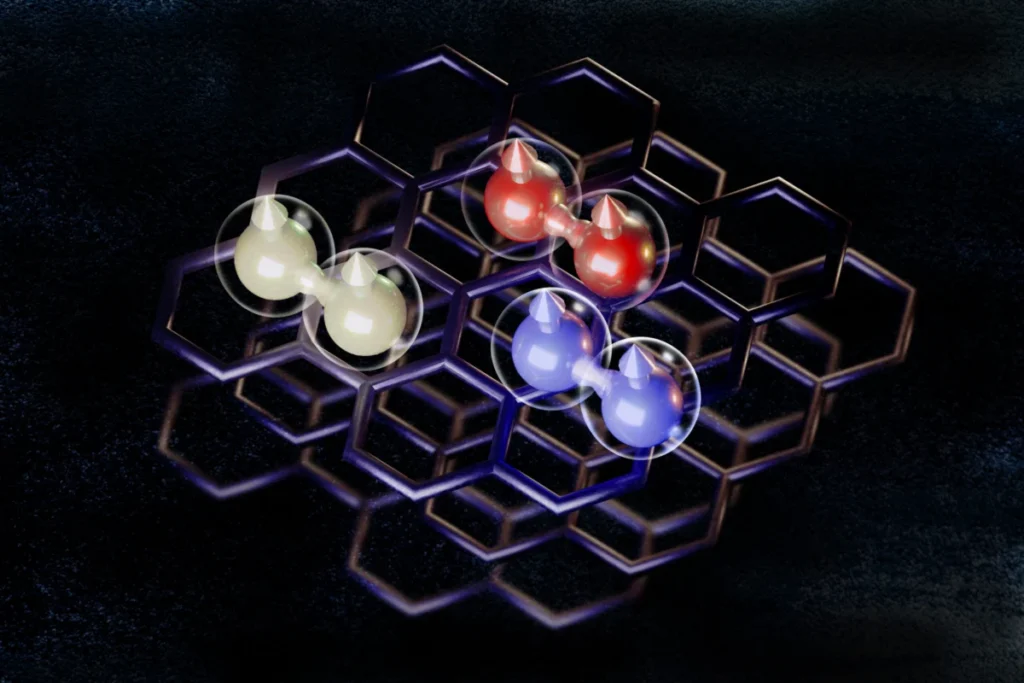
The observation of superconductivity that thrives in a magnetic field suggests that the electrons in rhombohedral graphene are pairing in an "unconventional" manner. In conventional superconductors, Cooper pairs consist of two electrons with opposite spins (one "up" and one "down"), which cancel each other out. A magnetic field forces these spins to align, which breaks the pair.
The MIT researchers propose that in rhombohedral graphene, the electrons may form "spin-triplet" pairs, where the spins are already aligned in the same direction. In such a state, a magnetic field would pull on both electrons in the same direction, potentially stabilizing the pair rather than disrupting it.
"From a fundamental physics point of view, it’s very exotic that a magnetic field doesn’t kill superconductivity, and instead it boosts it," says Ju. This finding places rhombohedral graphene in a very exclusive category of materials that challenge the standard BCS (Bardeen-Cooper-Schrieffer) theory of superconductivity.
A Brief Chronology of Graphene Superconductivity
To understand the weight of this discovery, one must look at the timeline of two-dimensional materials research:
- 2004: Graphene is first isolated at the University of Manchester, proving that stable 2D materials can exist.
- 2010: The Nobel Prize in Physics is awarded for graphene research, sparking a global race to find its electronic limits.
- 2018: "Magic-angle" twisted bilayer graphene is discovered by Pablo Jarillo-Herrero’s group at MIT. By twisting two layers of graphene at exactly 1.1 degrees, they induced superconductivity, launching the field of "Twistronics."
- 2021-2023: Researchers begin to realize that "twisting" isn’t the only way to achieve these states. Natural rhombohedral stacking is identified as a platform for exotic physics without the need for precise mechanical alignment.
- 2024: The current study reveals that rhombohedral graphene hosts not just one, but multiple superconducting phases, some of which are boosted by magnetic fields.
This chronology shows a shift in the scientific community from complex, artificially engineered structures toward finding "hidden" potential in naturally occurring configurations of carbon.
Collaborative Effort and Global Support
The complexity of the experiments required a massive international collaboration. While the device fabrication and primary conceptualization took place at MIT.nano and the MIT Department of Physics, the high-field and ultra-low temperature measurements required the expertise of Dominik Zumbuhl’s group at the University of Basel.
The study’s co-first authors, Junseok Seo and Shenyong Ye of MIT, along with Armel Cotten from Basel, led the data collection. The team also included contributors from Florida State University and the University of Florida, who assisted with theoretical modeling, and the National Institute for Materials Science in Japan, which provided the high-quality hexagonal boron nitride used to encapsulate and protect the graphene layers.
The research was supported in part by the U.S. Office of Naval Research, reflecting the military and strategic interest in high-performance electronic materials.
Future Outlook and Technological Impact
The discovery of multiple superconducting states in a single material provides a new "playground" for theoretical physicists. By studying how these states transition into one another, scientists hope to decode the fundamental mechanisms that allow superconductivity to exist at higher temperatures.
"We’re not only dealing with what nature gives us, but we’re applying additional controls to change it to something that nature does not give us, but that can exist in the same material," says lead author Junseok Seo.
While the current experiments operate at millikelvin temperatures—far too cold for everyday applications—the principles uncovered could lead to the design of new materials. If the "spin-triplet" mechanism is confirmed and understood, it could lead to the development of superconductors that are resilient to the high magnetic fields required in MRI machines and fusion reactors.
Furthermore, the ability to tune these states with a simple voltage "knob" suggests that rhombohedral graphene could be used to create "topological qubits" for quantum computing. These qubits would be much more stable than current versions, as their superconducting nature would protect them from the environmental noise that typically causes quantum decoherence.
As the scientific community absorbs the "nutrition" provided by these experimental results, the focus turns to the next phase of research: identifying if even more layers of graphene (six, seven, or more) could yield even higher transition temperatures or even more exotic quantum states. For now, the humble pencil lead has proven itself to be one of the most sophisticated materials in the modern laboratory, bridging the gap between everyday objects and the frontier of quantum discovery.