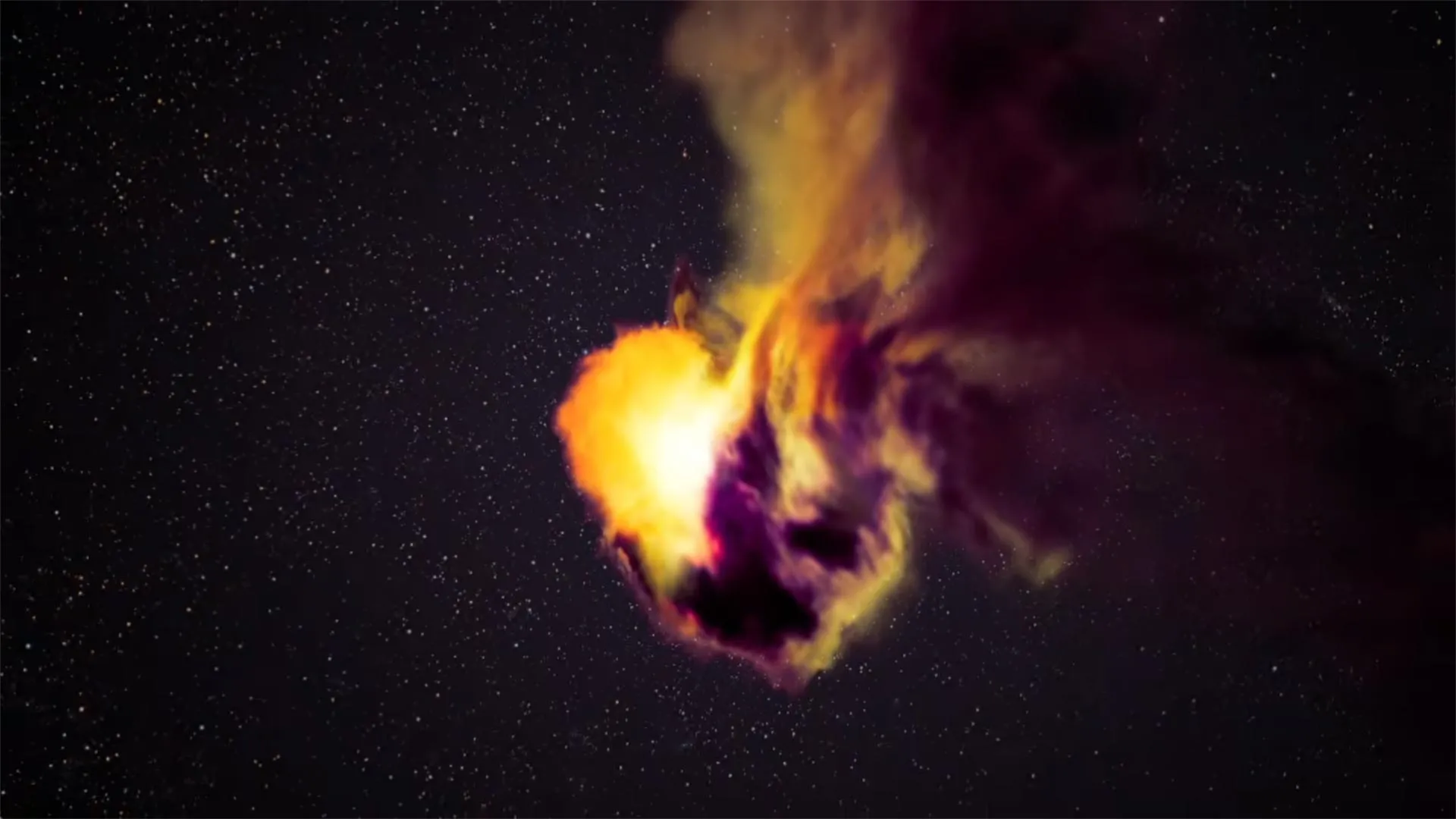
The discovery of the supernova SN 2021yfj has provided the scientific community with an unprecedented look into the final, frantic moments of a massive star’s life. In a study published in the journal Nature, an international team of researchers led by Steve Schulze of Northwestern University detailed the observation of an "extremely stripped" supernova, an event that reveals the inner chemical architecture of a star just before its catastrophic collapse. By detecting a thick shell of gas primarily composed of silicon surrounding the explosion, astronomers have gained direct evidence supporting long-held theories regarding the layered structure of massive stars and the nuclear fusion processes that forge the elements of the periodic table.
The observation represents a significant milestone in stellar archaeology. Typically, when a star explodes, its outermost layers—usually composed of hydrogen or helium—obscure the view of the heavier elements being synthesized in the core. In the case of SN 2021yfj, however, the star had been stripped of its outer envelopes with such efficiency that the silicon layer, which forms only in the final months or days of a star’s life, was visible to Earth-bound telescopes. This "cosmic peeling" allows scientists to verify the "onion-skin" model of stellar evolution, which posits that stars produce increasingly heavy elements in concentric shells as they approach their inevitable end.
The Architecture of Stellar Nucleosynthesis
To understand the significance of SN 2021yfj, one must first look at the standard lifecycle of a massive star, typically defined as one having at least eight times the mass of our Sun. These celestial bodies serve as the universe’s primary chemical factories. The process begins with the fusion of hydrogen into helium in the stellar core, a phase that lasts for millions of years and provides the outward pressure necessary to counteract the inward pull of gravity.
As the hydrogen fuel is exhausted, the core contracts and heats up, triggering the next stage of fusion. Helium atoms fuse to form carbon and oxygen. This cycle repeats with increasing speed and intensity. For a star of sufficient mass, the fusion process continues through a series of stages: neon fusion, oxygen fusion, and finally, silicon fusion. Each subsequent stage produces heavier elements and releases less energy, requiring the star to burn through its fuel at an exponential rate to maintain equilibrium.
The timescales involved in these cycles are a study in extremes. While the initial hydrogen-burning phase may last 10 million years, the final silicon-burning phase, which results in the production of iron, often lasts no more than a few days. During these final stages, the star develops a complex, layered structure. The outermost layer remains hydrogen, followed by shells of helium, carbon, neon, oxygen, and silicon, all surrounding a growing iron core. Until the observation of SN 2021yfj, the deeper layers—specifically those involving silicon—remained largely theoretical because they are usually buried deep within the star at the moment of explosion.
The Mechanism of Core-Collapse and the Birth of a Supernova
The transition from a living star to a supernova is governed by the laws of nuclear physics. Once the core of a massive star is converted into iron, the fusion process reaches a dead end. Unlike the fusion of lighter elements, which releases energy, the fusion of iron atoms consumes energy. Without the outward radiation pressure generated by fusion, the star can no longer support its own immense weight.
In a fraction of a second, gravity wins the tug-of-war. The iron core, roughly the size of Earth but with a mass greater than the Sun, collapses into a neutron star or, if the mass is great enough, a black hole. This collapse creates a massive "bounce" or shockwave that propagates outward through the remaining layers of the star. As this shockwave hits the surrounding gas, it heats the material to billions of degrees, triggering a final burst of nucleosynthesis and launching the star’s guts into interstellar space at speeds exceeding 10,000 kilometers per second.
In standard Type II supernovae, the explosion is shrouded by a massive envelope of hydrogen. In Type Ib or Ic supernovae, the hydrogen and helium layers have been lost, but the carbon and oxygen layers usually remain. SN 2021yfj is unique because it represents an "extremely stripped" scenario where even the oxygen layer was largely absent, leaving the silicon layer exposed to the shockwave.
Chronology of the SN 2021yfj Observation
The discovery and subsequent analysis of SN 2021yfj followed a rigorous timeline of detection and multi-wavelength observation. The event was first identified by automated sky surveys, which flagged it as a rapidly evolving transient.
- Initial Detection: The supernova was detected in 2021, showing an unusual light curve that peaked quickly and exhibited spectral signatures that did not match standard classifications.
- Spectroscopic Analysis: Steve Schulze and his team utilized high-resolution spectroscopy to analyze the light coming from the explosion. They identified strong emission lines corresponding to silicon, indicating that the material being illuminated by the supernova shockwave was sourced from the very deep interior of the progenitor star.
- Data Synthesis: Over several months, the team compared the observations with numerical simulations of stellar explosions. The models that best fit the data were those of a star that had lost almost all of its mass except for its innermost shells.
- Publication: The findings were finalized and published in early 2025, providing a new framework for understanding "extremely stripped" progenitors.
The data revealed that the silicon-rich material was located in a dense shell close to the star. Because silicon fusion only occurs in the final months of a star’s life, the presence of this material outside the star suggests that the stripping process was active right up until the moment of the core-collapse.
The Mystery of the Missing Layers: The Binary Star Hypothesis
The primary question facing the research team was how a star could lose so much of its mass in such a short period. Standard stellar winds—the stream of charged particles ejected from a star’s surface—are generally not powerful enough to strip a star down to its silicon layer before it explodes. Even the most massive Wolf-Rayet stars, known for their powerful winds, typically retain their carbon and oxygen shells.
The most plausible explanation, according to the study, involves a binary companion. Most massive stars do not live in isolation; they are born in pairs or small groups. If SN 2021yfj had a close companion star, the gravitational pull of that neighbor could have acted as a cosmic vacuum, siphoning off the outer layers of the dying star. This process, known as Roche lobe overflow, becomes more violent as the primary star expands during its final evolutionary phases.
In this scenario, the companion star effectively "peeled" the primary star, removing the hydrogen, helium, carbon, and oxygen layers. The gravity of the companion might have been so intense that it reached down into the silicon-forming region just as the core was preparing to collapse. This interaction would create a dense, localized cloud of silicon-rich gas, which the supernova then illuminated, providing the "glimpse" reported by Schulze’s team.
Broader Implications for Cosmic Evolution
The implications of the SN 2021yfj discovery extend far beyond the classification of a single supernova. It provides a direct link between the internal physics of stars and the chemical composition of the universe.
The "Interesting" Elements: While the Big Bang produced hydrogen and helium, almost every other element in the universe was forged inside stars. Supernovae are the primary source of oxygen, neon, magnesium, and silicon. By observing the silicon layer of SN 2021yfj, scientists can more accurately calculate the "yields" of these elements—how much of each material a single explosion contributes to its host galaxy.
Galactic History: The study of supernovae is essential for understanding the history of the cosmos. In the early universe, stars were composed almost entirely of hydrogen and helium. These early stars burned hotter and died faster, seeding the universe with the first heavy elements. Over billions of years, successive generations of stars, enriched by the remnants of their predecessors, allowed for the formation of rocky planets and, eventually, life.
Stellar Forensics: This discovery acts as a "smoking gun" for stellar evolution models. It confirms that the theoretical layers we have predicted using computer simulations actually exist in the physical world. It also highlights the importance of binary systems in shaping the observable universe, suggesting that many of the supernovae we see may be influenced by hidden companions.
Future Research and Observation
The discovery of SN 2021yfj has set the stage for a new era of "transient astronomy." With the upcoming operation of the Vera C. Rubin Observatory and the Nancy Grace Roman Space Telescope, astronomers expect to find thousands of supernovae every year. These facilities will allow researchers to identify more "extremely stripped" events, helping to determine if SN 2021yfj is a true rarity or if such events are a common, albeit brief, phase of stellar death in binary systems.
As Steve Schulze and his colleagues noted in their report, every supernova is a message from the past, detailing the conditions of the star that created it. By learning to read these messages, particularly those as clear and deep as SN 2021yfj, humanity continues to piece together the narrative of its own origins. The iron in our blood, the silicon in our technology, and the oxygen in our lungs are all direct products of the violent, beautiful processes witnessed in the death of stars. The "extremely stripped" supernova SN 2021yfj is not just a distant explosion; it is a laboratory for understanding the very fabric of our existence.