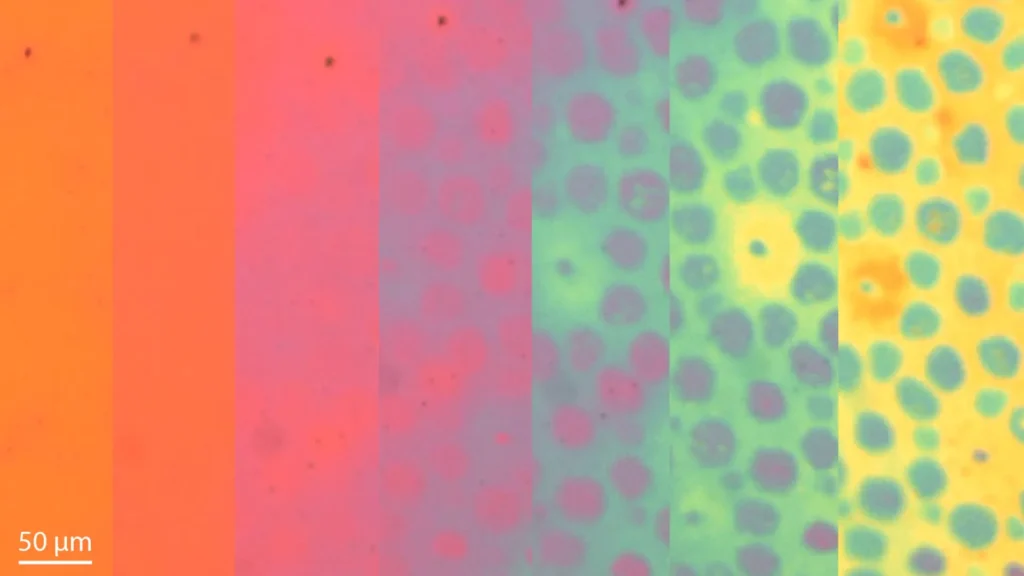
Octopuses and cuttlefish are revered in the natural world for their unparalleled mastery of disguise, an astonishing biological feat that allows them to blend seamlessly into their surroundings with breathtaking speed and precision. Their ability to instantaneously alter both the color and texture of their skin has long captivated scientists, inspiring decades of research aimed at replicating such dynamic adaptability in man-made materials. Now, a significant milestone has been achieved at Stanford University, where researchers have developed a flexible material capable of rapidly shifting its surface patterns and colors, creating features smaller than a human hair. This groundbreaking work, detailed in a study recently published in the prestigious journal Nature, marks a substantial advance in the fields of materials science, nanophotonics, and biomimicry, potentially revolutionizing everything from advanced camouflage systems to flexible electronic displays and even micro-robotics.
The Biological Imperative: Cephalopods as Nature’s Masters of Disguise
For millennia, the ocean’s most intelligent invertebrates, cephalopods like octopuses, cuttlefish, and squid, have perfected an evolutionary advantage that borders on the fantastical. Their skin is a complex, dynamic canvas, housing specialized cells called chromatophores, iridophores, and leucophores. Chromatophores, containing pigments, can expand or contract under neural control, revealing or concealing underlying colors. Iridophores reflect ambient light in iridescent hues, while leucophores scatter light to create white spots or broad white areas. This intricate interplay allows them to not only change color but also to manipulate skin texture, creating bumps, ridges, and papillae that mimic rocks, coral, or sand. This rapid transformation, often occurring in mere milliseconds, serves vital functions: evading predators, ambushing prey, and communicating with conspecifics. Scientists have long viewed this biological wonder as the ultimate blueprint for adaptive materials, yet replicating its speed, resolution, and versatility in synthetic systems has remained an elusive challenge. Existing artificial camouflage technologies, while effective in certain scenarios, typically rely on static patterns or slow-changing thermochromic or electrochromic materials, falling far short of the dynamic, multi-modal capabilities of cephalopod skin. The pursuit of "smart skin" capable of similar real-time adaptation has therefore been a holy grail for material scientists.
A New Frontier in Adaptive Materials: Stanford’s Innovation
The Stanford breakthrough introduces a novel approach to creating such adaptive surfaces. Siddharth Doshi, a doctoral student in materials science and engineering at Stanford and the lead author of the Nature paper, articulated the significance of this development: "Textures are crucial to the way we experience objects, both in how they look and how they feel. These animals can physically change their bodies at close to the micron scale, and now we can dynamically control the topography of a material – and the visual properties linked to it – at this same scale." This statement underscores the unprecedented level of control achieved, pushing the boundaries of what was previously thought possible in synthetic material design. The ability to manipulate both visual and tactile properties at the micron scale — roughly the diameter of a human hair — opens a vast array of potential applications across diverse industries.
Nicholas Melosh, a professor of materials science and engineering and a senior author on the paper, further emphasized the unique attributes of their creation: "There’s just no other system that can be this soft and swellable, and that you can pattern at the nanoscale." This highlights the material’s distinctive combination of flexibility, responsiveness, and ultra-fine patterning capability, setting it apart from other existing or experimental adaptive materials. The implications span from advanced camouflage and flexible displays for wearable technology to pioneering advancements in nanophotonics, a specialized field dedicated to controlling light at incredibly small scales for applications in electronics, secure encryption, and biological sensing.
The Mechanism Unveiled: How Dynamic Patterns Emerge
The core of this innovative material lies in a clever integration of established semiconductor manufacturing techniques with a novel water-responsive polymer film. The process begins with electron-beam lithography, a precision technique commonly employed in the fabrication of integrated circuits and microchips. This method uses a focused beam of electrons to selectively modify specific regions of the polymer film. Crucially, exposure to the electron beam alters the film’s chemical structure, making those regions either more or less absorbent to water.
The magic happens when the treated film is introduced to water. The regions that have been modified to be more absorbent swell significantly more than the less absorbent areas. This differential swelling creates intricate, three-dimensional patterns on the surface, which are only visible when the film is hydrated. This elegant yet powerful mechanism allows for dynamic control over the material’s topography. The precision of electron-beam lithography enables the creation of features with astonishing detail, far beyond what traditional patterning methods can achieve on soft, flexible substrates.
A Fortuitous Discovery: The Role of Serendipity in Science
As is often the case in scientific breakthroughs, a degree of serendipity played a crucial role in the development of this technology. Siddharth Doshi recounted how the key insight emerged unexpectedly from an earlier experiment. While examining nanostructures on a polymer film using a scanning electron microscope, Doshi opted to reuse the samples rather than discard them. During subsequent tests, he observed that the areas previously exposed to the electron beam exhibited markedly different behavior and displayed distinct colors. This subtle yet critical observation sparked the realization that electron beams could be used not just for imaging but for precisely controlling the physical properties and topography of materials at the nanoscale. "We realized that we could use these electron beams to control topography at very fine scales," Doshi explained. "It was definitely serendipitous." This moment of unexpected insight transformed what might have been a discarded sample into the foundation of a new material science paradigm.
From Flat Surfaces to Dynamic 3D Structures and Optical Control
The precision inherent in the Stanford team’s technique allows for the creation of truly remarkable details. To demonstrate this capability, the researchers famously created a miniature, three-dimensional rendition of Yosemite’s iconic El Capitan. When dry, the material’s surface remains entirely flat and featureless. However, upon the introduction of water, the intricate geological structure of El Capitan dramatically rises from the film, transforming a two-dimensional surface into a vivid three-dimensional landscape. This demonstration powerfully illustrates the material’s potential for dynamic topographical changes, a feature critical for mimicking the texture shifts seen in cephalopod skin.
Beyond mere structural changes, the team discovered they could also finely tune the material’s optical properties. By carefully adjusting the degree of swelling, they can control how the material reflects light, allowing for seamless transitions between glossy and matte finishes. This level of visual manipulation surpasses the capabilities of many current display technologies, which typically offer fixed surface characteristics. The process is also fully reversible; by introducing an alcohol-like solvent, the water is displaced, and the material returns to its original flat, unpatterned state, ready for another transformation.
The same underlying approach can also be harnessed to generate complex color patterns. By strategically layering thin metal films on both sides of the polymer, the researchers engineered structures known as Fabry-Pérot resonators. These optical devices are designed to selectively transmit or reflect specific wavelengths of light. As the polymer film expands or contracts due to water absorption, the thickness of these resonant cavities changes, causing the material to display different colors. This dynamic control over light interaction means that a seemingly plain surface can be transformed into a vibrant, shifting array of colors and patterns simply by manipulating the balance of water and solvent. Mark Brongersma, a professor of materials science and engineering and a senior author on the paper, summarized this capability: "By dynamically controlling the thickness and topography of a polymer film, you can realize a very large variety of beautiful colors and textures. The introduction of soft materials that can expand, contract, and alter their shape opens up an entirely new toolbox in the world of optics to manipulate how things look." This "new toolbox" promises to unlock unprecedented control over visual appearance in synthetic materials.
Transforming Camouflage and Robotics: Real-World Implications
The immediate and most captivating application of this technology lies in advanced camouflage systems. By combining multiple layers of these dynamic films, researchers have demonstrated the ability to independently adjust both color and texture, creating a material that can blend into its surroundings with an adaptability akin to an octopus. While the current iteration requires manual tuning of water and solvent levels to match a specific background, the potential for autonomous adaptation is immense. The Stanford team envisions integrating computer vision and artificial intelligence (AI) systems into the material. These AI-driven systems could analyze the surrounding environment in real time, identify optimal camouflage patterns, and then automatically modulate the material to achieve the desired effect without human intervention. "We want to be able to control this with neural networks – basically an AI-based system – that could compare the skin and its background, then automatically modulate it to match in real time, without human intervention," Doshi stated, outlining a future where adaptive camouflage is truly intelligent and responsive.
Such a development would have profound implications for military and defense applications, offering unprecedented concealment capabilities for personnel, vehicles, and equipment. Imagine soldiers whose uniforms dynamically adapt to changing terrains, or reconnaissance robots that become virtually invisible against varying backdrops. Beyond military uses, this technology could also find applications in civilian sectors, such as architectural facades that change appearance, smart clothing that adapts to personal preferences or environmental conditions, or even dynamic stage sets for entertainment.
Beyond Concealment: A Broader Spectrum of Possibilities
The utility of this dynamic material extends far beyond mere camouflage. The fine control over surface texture could be harnessed to regulate friction, a critical parameter in robotics. Small robots, for instance, could be equipped with this material to dynamically switch between high-friction surfaces for gripping and climbing, and low-friction surfaces for sliding or gliding across obstacles. This could revolutionize the design of soft robots, enabling them to navigate complex environments with greater dexterity and efficiency.
At the nanoscale, changes in structural topography can also profoundly influence how biological cells interact with surfaces. This opens exciting new avenues in bioengineering, potentially leading to advanced cell culture platforms that mimic dynamic biological environments, or even smart biomedical implants that can change their surface properties to better integrate with tissues or respond to biological cues. The ability to create dynamic micro-environments could accelerate research in regenerative medicine, drug discovery, and fundamental cell biology.
The creative potential of this material is also being explored, with the team actively collaborating with artists to discover novel artistic and aesthetic applications. Imagine art installations that morph and shift in color and texture, or interactive displays that respond to viewer presence with dynamic visual effects. The intersection of science and art through this technology could lead to entirely new forms of expression.
Professor Melosh encapsulated the expansive potential: "Small changes in the properties of soft materials over micron distances are finally possible, which will open up all sorts of possibilities. I think there are a lot of exciting things coming up." This sentiment reflects the widespread optimism surrounding the material’s versatility and its capacity to catalyze innovation across numerous scientific and technological domains.
Challenges and the Road Ahead
While the Stanford breakthrough represents a monumental leap, challenges remain. The current system relies on manual adjustment of water and solvent levels, which limits its real-time responsiveness for applications like active camouflage. The integration of AI and computer vision is a crucial next step to automate this process, allowing the material to perceive its environment and adapt autonomously. Further research will also focus on optimizing the material’s durability, scaling up manufacturing, and exploring new polymer compositions to enhance performance and broaden the range of achievable effects. The long-term vision includes developing fully integrated, self-contained systems that can sustain dynamic changes over extended periods in various environmental conditions.
A Collaborative Endeavor: Research Team and Support
This ambitious research project was the result of extensive collaboration and significant institutional support. In addition to Siddharth Doshi, Nicholas Melosh, and Mark Brongersma, the Stanford team included a distinguished roster of contributors: Alberto Salleo, the Hong She and Vivian W. M. Lim Professor and professor of photon science; Associate Professor Polly Fordyce; postdoctoral researchers Nicholas A. Güsken and Gerwin Dijk; Stanford Microfluidics Foundry director Jennifer E. Ortiz-Cárdenas; and graduate students Johan Carlström, Peter Suzuki, and Bohan Li.
The interdisciplinary nature of the research is further highlighted by the affiliations of the senior authors. Mark Brongersma holds courtesy professorships in applied physics and is affiliated with Stanford Bio-X, the Wu Tsai Human Performance Alliance, the Wu Tsai Neurosciences Institute, and the Precourt Institute for Energy. Nicholas Melosh is also a member of Stanford Bio-X and the Wu Tsai Neurosciences Institute, an affiliate of the Precourt Institute for Energy, and a faculty fellow of Sarafan ChEM-H.
The work received generous funding from a consortium of prestigious organizations, including a Stanford Graduate Fellowship, a Meta PhD Fellowship, the Wu Tsai Human Performance Alliance at Stanford University and the Joe and Clara Tsai Foundation, the German National Academy of Sciences Leopoldina, the Department of Energy, the Air Force Office of Sponsored Research, and the National Science Foundation. This broad base of support underscores the recognized importance and potential impact of this pioneering research. The development of this dynamic material represents not just a scientific achievement, but a testament to the power of biomimicry and interdisciplinary collaboration in pushing the boundaries of human ingenuity.