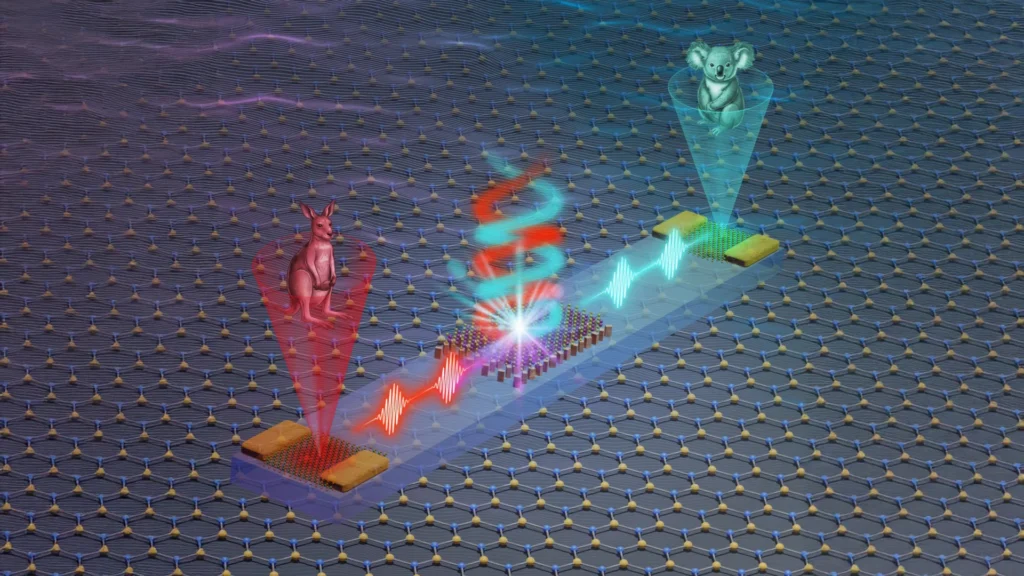
Scientists at Monash University have achieved a significant breakthrough in the burgeoning field of valleytronics, successfully developing a novel, miniature circuit capable of generating, directing, and reading information carried by light, all within the confines of a single chip. This advance, detailed in a recent publication in Nature Photonics, represents a pivotal moment for a research area poised to revolutionize computing, dramatically reduce energy consumption, and propel the development of next-generation quantum technologies.
The Dawn of Valleytronics: A New Paradigm for Information Processing
The conventional silicon-based electronics that power our modern world rely on the flow of electrons, specifically manipulating their charge. Over recent decades, researchers have explored alternative paradigms to overcome the inherent limitations of charge-based computing, such as heat dissipation and speed bottlenecks. One such promising avenue is "spintronics," which leverages the intrinsic angular momentum of electrons, known as spin, to encode information. Building upon this quest for novel information carriers, "valleytronics" emerges as an even more exotic and potentially powerful approach.
Valleytronics harnesses a quantum property called the "valley degree of freedom" in specific materials, primarily ultra-thin two-dimensional (2D) materials like transition metal dichalcogenides (TMDs). In these materials, electrons can exist in distinct energy minima (or "valleys") within their electronic band structure. These valleys are characterized by unique momentum states, and electrons residing in different valleys behave as distinct carriers. By selectively populating these valleys or inducing transitions between them, scientists can encode binary information (0s and 1s) or even more complex quantum states, offering an entirely new dimension for data processing. The inherent robustness of valley states against certain types of environmental interference makes them particularly attractive for quantum applications, where maintaining the coherence of information is paramount.
Addressing a Long-Standing Challenge: Integrated On-Chip Functionality
Despite the theoretical promise of valleytronics, a major hurdle has been the lack of a fully integrated system that can perform all essential operations on a single chip. Until now, researchers could typically generate valley-polarized light signals or detect them, but combining these functionalities with precise routing within a compact device remained elusive. This fragmented approach limited the practical scalability and efficiency required for real-world applications.
The Monash team, led by Dr. Chi Li from the School of Physics and Astronomy, has successfully overcome this challenge. Their innovative device is the first of its kind to integrate the generation, steering, and detection of these specialized light signals, converting them into electrical signals within the same compact system. This marks a significant engineering feat, bridging the gap between fundamental research and practical implementation.
"Until now, we could generate or detect these signals, but not do everything in one integrated device," Dr. Li explained, highlighting the critical nature of their achievement. "What we’ve built is a complete on-chip system that can create, route and read this information with very high precision." This integration is crucial because it eliminates the need for bulky external components, reducing signal loss, increasing speed, and enabling miniaturization – all essential factors for developing scalable and efficient computing architectures.
Technological Foundations: Nanotechnology Meets Cutting-Edge Materials
The breakthrough relies on a sophisticated fusion of advanced nanotechnology and cutting-edge materials. At the heart of the device are ultra-thin materials, merely a few atoms thick. These 2D materials, known for their exceptional electronic and optical properties, are the medium through which the valley-polarized light signals propagate. Their atomic thinness enables strong light-matter interactions and precise control over quantum properties.
These ultra-thin materials are meticulously paired with specially engineered nanostructures known as metasurfaces. Metasurfaces are sub-wavelength structures designed to manipulate light in unprecedented ways, allowing for precise control over its amplitude, phase, and polarization at extremely small scales. In this context, the metasurfaces are crucial for both generating the specific valley-polarized light signals and for steering them along designated paths within the chip.
Dr. Kaijian Xing, co-first author of the study and a Research Fellow at Monash University, elaborated on the innovative fabrication approach. "We employ a straightforward stacking approach to integrate ultra-thin materials with metasurfaces, overcoming the technical challenges of direct material growth on photonic structures, and enabling further advances in valleytronics," Dr. Xing stated. This "stacking approach" is a key practical innovation, as directly growing high-quality 2D materials on complex photonic structures can be notoriously difficult and often compromises material integrity or device performance. By circumventing these growth challenges, the team has opened a more viable pathway for the scalable manufacturing of such integrated devices.
A Game-Changer: Room-Temperature Operation
One of the most profound advantages of this new valleytronic technology is its ability to operate efficiently at room temperature. This feature is a monumental differentiator from many other advanced quantum systems, which often necessitate extremely cold, cryogenic environments – sometimes approaching absolute zero (milliKelvin temperatures). The requirement for such extreme cooling poses significant challenges in terms of cost, energy consumption, system complexity, and physical footprint, severely limiting the practicality and widespread adoption of these technologies outside specialized laboratories.
The Monash chip’s room-temperature functionality dramatically lowers the barrier to entry for practical applications. It means that future valleytronic devices could potentially be integrated into existing computing infrastructures without requiring massive, expensive cooling systems, paving the way for more compact, energy-efficient, and accessible quantum and photonic technologies.
Dr. Haoran Ren, ARC Future Fellow and leader of the Monash NanoMeta Group, emphasized this critical aspect. "This is a significant step toward scalable, chip-based technologies that use light instead of electricity to process information," Dr. Ren affirmed. The capability to operate at ambient conditions not only reduces operational costs and energy expenditure but also broadens the potential deployment scenarios, from data centers to portable devices and specialized sensors.
Processing Multiple Streams: A Glimpse into Future Computing
To underscore the chip’s remarkable capabilities, the research team conducted a compelling demonstration: they successfully encoded and processed two distinct images simultaneously. This experiment showcased the device’s inherent ability to manage multiple streams of information concurrently, a crucial feature for the demands of future computing technologies. Modern data processing, particularly in fields like artificial intelligence, machine learning, and big data analytics, thrives on parallel processing capabilities. A valleytronic chip that can handle multiple data channels simultaneously promises significant gains in computational speed and efficiency, far surpassing the limitations of sequential processing. This parallel processing potential positions the technology as a strong candidate for accelerating complex algorithms and handling the immense data loads characteristic of the digital age.
Broader Impact and Implications: Reshaping the Technological Landscape
The implications of this integrated valleytronic chip extend across numerous sectors, promising to reshape the technological landscape in profound ways. Dr. Ren outlined several key areas where this technology could make a substantial impact.
-
Faster Computing Systems: By utilizing light to carry information, valleytronic chips can overcome the speed limits of electronic circuits. Photons, traveling at the speed of light, offer significantly higher bandwidths and ultra-fast data transmission speeds, dramatically reducing latency and accelerating computational tasks. This is particularly relevant for high-performance computing, real-time data analysis, and demanding scientific simulations.
-
Reduced Energy Consumption: The energy footprint of global data centers is a growing concern, consuming vast amounts of electricity and contributing to environmental challenges. Photonic devices, including those based on valleytronics, inherently consume less power for data transmission and processing compared to their electronic counterparts, which suffer from resistive heating. This reduction in energy consumption is vital for building more sustainable and environmentally friendly computing infrastructures.
-
Quantum Computing: The "valley degree of freedom" offers a novel platform for encoding quantum information. Valley qubits could potentially provide a robust and scalable alternative or complement to other qubit technologies (like superconducting qubits or trapped ions). The room-temperature operation of this device is a significant advantage for practical quantum computing, moving it closer to real-world applications outside of highly specialized, cryogenic laboratories.
-
Secure Communications: Quantum properties can be harnessed for intrinsically secure communication protocols, such as quantum key distribution (QKD), which ensures that any attempt to eavesdrop on a communication is immediately detectable. Valleytronic photonics could provide a new pathway for developing compact, chip-based quantum communication systems, enhancing data security for sensitive information.
-
Advanced Imaging: The precise manipulation of light at the nanoscale, combined with the unique properties of valley-polarized light, could lead to breakthroughs in advanced imaging techniques. This might include higher-resolution microscopy, novel medical imaging modalities, or enhanced sensing capabilities for various industrial and scientific applications.
-
Next-Generation Optical Communication Systems: As data traffic continues to explode, the demand for higher bandwidth and faster optical communication networks intensifies. Valleytronic chips, with their ability to process multiple streams of information at high speeds, are well-positioned to contribute to the development of next-generation fiber optic networks, enabling faster internet speeds and more robust data transmission over long distances.
Professor Stefan A. Maier, Head of the School of Physics and Astronomy and Nanophotonics Laboratory at Monash University, underscored the broader significance of the research, stating, "This is an important step toward fully integrated valleytronic systems. By combining light and quantum materials on a chip, we can access new ways of encoding and processing information." His statement highlights the convergence of fundamental physics and engineering innovation, paving the way for practical technologies derived from quantum phenomena.
A Collaborative Global Endeavor
The complexity and multidisciplinary nature of this breakthrough underscore the importance of international collaboration in modern scientific research. The project brought together a diverse team of experts from leading institutions across Australia, China, Singapore, Germany, and Japan. This international synergy combined specialized expertise in nanophotonics, the intricate properties of two-dimensional materials, and advanced optoelectronics, creating a powerful research collective capable of tackling such a formidable challenge.
The core Monash University team included Dr. Chi Li, Dr. Kaijian Xing, Professor Michael S. Fuhrer, Professor Stefan A. Maier, and Dr. Haoran Ren. Additional vital contributions came from collaborators at the Singapore University of Technology and Design, LMU Munich, and the University of Technology Sydney, illustrating the global nature of scientific advancement and the shared pursuit of pushing the boundaries of human knowledge and technological capability.
Looking Ahead: The Future of Valleytronics
While this integrated valleytronic chip marks a monumental step forward, the journey for valleytronics is ongoing. Future research will likely focus on further miniaturization, enhancing the efficiency and speed of valley state manipulation, improving the scalability of fabrication processes, and exploring new materials that exhibit even more robust valley degrees of freedom. The demonstration of processing two images simultaneously is a strong proof-of-concept, but scaling this to handle massive datasets and complex computational tasks will be the next frontier.
The potential for valleytronics to complement or even surpass existing electronic and spintronic technologies is immense. By offering a new, energy-efficient, and potentially quantum-resilient pathway for information encoding and processing, Monash University’s breakthrough positions valleytronics as a key contender in the race to build the next generation of computing and communication technologies, promising a future where data flows faster, consumes less energy, and unlocks unprecedented capabilities.