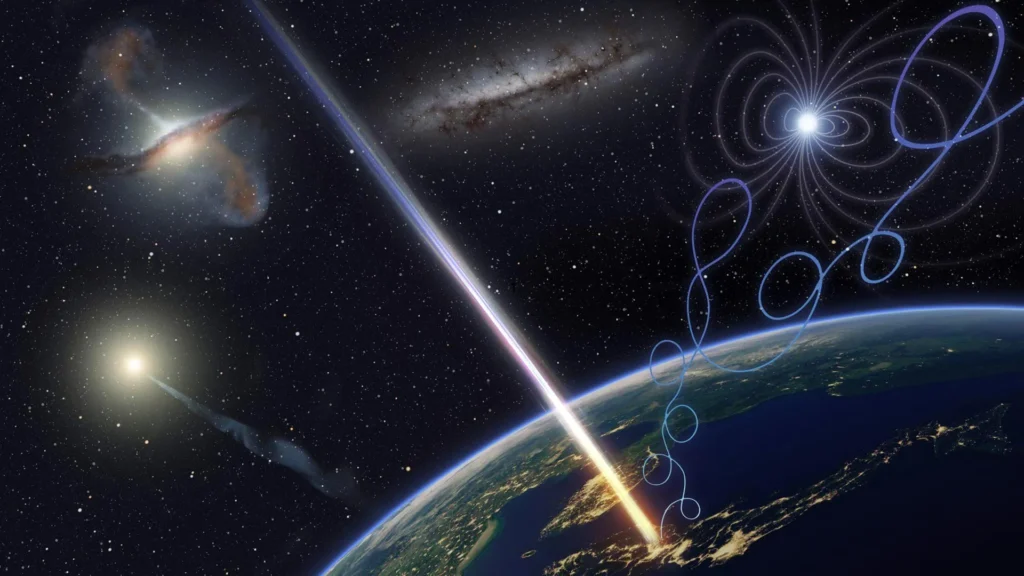
The discovery of the "Amaterasu particle" in 2021 sent shockwaves through the global astrophysical community, marking one of the most significant detections in the history of cosmic ray research. Named after the sun goddess in Japanese mythology, this single particle carried an energy level so vast that it challenged the fundamental understanding of how matter behaves and travels across the universe. Now, a groundbreaking study led by researchers at Penn State and published in the prestigious journal Physical Review Letters suggests that the key to solving this mystery lies in "ultraheavy" atomic nuclei—particles heavier than iron that may possess the unique ability to survive the treacherous journey across intergalactic space without losing their staggering potency.
For decades, scientists have been haunted by the existence of ultrahigh-energy cosmic rays (UHECRs). These are subatomic particles, typically protons or atomic nuclei, that travel at nearly the speed of light. When they strike Earth’s atmosphere, they trigger a cascade of secondary particles that can be detected by vast arrays of sensors on the ground. However, the energy levels of particles like Amaterasu are so extreme—exceeding 100 exa-electron volts (EeV)—that they defy conventional explanation. To put this in perspective, these particles are roughly 10 million times more energetic than anything the Large Hadron Collider (LHC), the most powerful human-made machine, can produce.
The Enigma of the Amaterasu Particle
The Amaterasu particle was detected on May 27, 2021, by the Telescope Array experiment, a collaborative project involving several international institutions located in the high desert of Utah. When the data was analyzed, the particle’s energy was calculated to be approximately 240 EeV. This places it in an elite and terrifyingly energetic category of cosmic events, second only to the legendary "Oh-My-God" particle detected in 1991, which was clocked at 320 EeV.
The primary mystery of the Amaterasu particle is not just its energy, but its origin. In astrophysics, high-energy particles are expected to travel in relatively straight lines through space because they are less affected by the magnetic fields that curve the paths of lower-energy particles. When scientists traced the trajectory of the Amaterasu particle back to its source, they found nothing. The path pointed directly toward the "Local Void," a vast, empty region of space bordering our Milky Way galaxy that contains almost no galaxies, stars, or known high-energy phenomena.
This "arrival direction" problem suggests one of two things: either our understanding of magnetic fields in deep space is flawed, or the particle itself is of a nature that allows it to survive much longer journeys than previously thought possible, potentially originating from a source much further away than the void would suggest.
The Science of Ultraheavy Nuclei
The new research led by Kohta Murase, a professor of physics and of astronomy and astrophysics at Penn State, offers a compelling solution. Traditionally, many models assumed that UHECRs were primarily protons or light nuclei, such as helium or carbon. However, as these particles travel through the universe, they interact with the Cosmic Microwave Background (CMB)—the afterglow of the Big Bang. These interactions cause the particles to lose energy, a phenomenon known as the GZK limit (GZK standing for Greisen, Zatsepin, and Kuzmin).
The Penn State team’s simulations, conducted alongside collaborators at the Yukawa Institute for Theoretical Physics in Japan and Virginia Tech, indicate that "ultraheavy" nuclei—specifically those heavier than iron—behave differently. Atomic nuclei are the dense cores of atoms, comprised of protons and neutrons. While they are incredibly small, they contain nearly all of an atom’s mass.
According to the team’s calculations, these ultraheavy nuclei lose energy much more slowly than their lighter counterparts when crossing the vast distances between galaxies. This "durability" allows them to maintain extreme energy levels even after traveling for millions of light-years. "Our research showed that at energies comparable to that of the Amaterasu particle, ultraheavy nuclei lose energy more slowly than protons or intermediate-mass nuclei," Murase explained. "This makes them better able to survive cosmic distances and reach Earth at extreme energies."
A Timeline of Cosmic Ray Discoveries
The quest to understand these high-energy messengers has spanned more than a century, marked by a series of escalating discoveries:
- 1912: Victor Hess discovers cosmic rays using a balloon-borne electrometer, proving that radiation increases with altitude and originates from space.
- 1962: The first ultrahigh-energy cosmic ray (above 10 EeV) is detected at the Volcano Ranch array in New Mexico.
- 1991: The "Oh-My-God" particle is detected by the High Resolution Fly’s Eye Cosmic Ray Detector in Utah. At 320 EeV, it remains the most energetic particle ever recorded.
- 2004: The Pierre Auger Observatory in Argentina begins full operations, providing the first large-scale data on UHECRs in the Southern Hemisphere.
- 2008: The Telescope Array in Utah begins operations to study the Northern Hemisphere sky.
- 2021: The Amaterasu particle is detected, registering at 240 EeV and reigniting the debate over cosmic ray origins.
- 2024: Publication of the Penn State study suggesting ultraheavy nuclei as the primary candidates for these extreme events.
Cosmic Foundries: Where Are These Particles Born?
If the Amaterasu particle and its peers are indeed ultraheavy nuclei, the next logical question is: what kind of cosmic engine is powerful enough to forge and accelerate them? The energy required to accelerate a nucleus to 240 EeV is equivalent to the kinetic energy of a professional tennis ball traveling at 60 miles per hour, all packed into a single subatomic particle.
Professor Murase and his team point toward the most violent events in the known universe as the likely culprits. These include:
- Binary Neutron Star Mergers: When two neutron stars—the collapsed cores of massive stars—spiral into each other, they release a titanic amount of energy, creating gravitational waves and potentially acting as "kilonovae." These environments are rich in heavy elements and possess the magnetic strength to accelerate nuclei to extreme velocities.
- Hypernovae and Black Hole Formation: The death of a massive star that collapses directly into a black hole can power gamma-ray bursts (GRBs). These are the brightest electromagnetic events in the universe and are capable of launching particles across the cosmos.
- Magnetars: Highly magnetized neutron stars with magnetic fields trillions of times stronger than Earth’s could serve as natural particle accelerators.
The researchers suggest that these violent phenomena are not only responsible for the particles’ energy but also for their composition. These environments are the "foundries" of the universe, where r-process nucleosynthesis occurs, creating elements heavier than iron.
Implications for Future Astrophysics
The hypothesis that the highest-energy cosmic rays are ultraheavy nuclei has significant implications for how astronomers map the universe. Currently, there is a noted discrepancy between observations in the Northern and Southern Hemispheres. The Pierre Auger Observatory in the south and the Telescope Array in the north have seen slightly different energy spectra and arrival patterns.
If ultraheavy nuclei are a major component of these rays, it could explain these discrepancies. Heavier nuclei are deflected more by galactic and intergalactic magnetic fields than protons are. This means that the "source" we see in the sky might be offset from the actual physical location of the explosion that created the particle. By adjusting models to account for the "heavy" nature of these particles, scientists may finally be able to point their telescopes at the specific galaxies or star clusters responsible for these events.
"If ultraheavy nuclei contribute significantly at the highest energies, future data should indicate a composition heavier than iron," Murase noted. This prediction provides a clear roadmap for the next generation of observatories.
The Next Generation of Observatories
The scientific community is already preparing to test these findings. Several next-generation facilities are in the planning or construction phases, designed specifically to detect the "fingerprints" of ultraheavy nuclei.
- AugerPrime: An upgrade to the Pierre Auger Observatory in Argentina, AugerPrime will use new plastic scintillator detectors and radio antennas to better distinguish between different types of cosmic ray particles (e.g., protons vs. heavy nuclei).
- Global Cosmic Ray Observatory (GCOS): A proposed next-generation facility that would provide unprecedented coverage and sensitivity, potentially detecting hundreds of particles at the Amaterasu energy scale.
- POEMMA (Probe of Extreme Multi-Messenger Astrophysics): A space-based mission designed to look down at the Earth’s atmosphere to detect the light flashes and radio signals produced by UHECRs from above.
As these facilities come online, the data they collect will either confirm the Penn State team’s ultraheavy nuclei theory or force a complete rewrite of the laws of particle physics. For now, the Amaterasu particle remains a silent messenger from the deep cosmos, a reminder of the vast, violent, and still largely misunderstood processes that shape the universe. The transition from viewing these rays as simple protons to complex, ultraheavy nuclei may be the key that finally unlocks the secrets of the "Local Void" and the extreme engines of the distant stars.