Water, the ubiquitous solvent covering over 70% of Earth’s surface, continues to present scientists with a fascinating paradox. Despite its apparent simplicity, H2O exhibits a suite of anomalous behaviors that defy the typical physical properties of most liquids. Foremost among these is its peculiar characteristic of expanding upon freezing, rather than contracting—a trait that ensures ice floats, profoundly impacting planetary geology, climate, and life itself. These unusual properties have long been theorized to stem from dynamic changes in water’s intricate microscopic structure as temperature and pressure fluctuate. However, the scientific community has historically struggled with a consistent and unified framework to accurately describe, compare, and quantify these elusive structural transformations.
A Novel Approach from Osaka University
In a significant breakthrough, researchers at the University of Osaka have leveraged the power of artificial intelligence (AI) to address this long-standing scientific challenge. Their newly developed AI system offers a standardized and comprehensive method for comparing various existing models and descriptors used to characterize the structure of supercooled water. This innovative approach is proving instrumental in pinpointing which structural descriptions most effectively capture the critical features governing water’s unique properties. The findings of this pivotal research were recently published in the esteemed journal Communications Chemistry, marking a new era in the study of the most fundamental liquid.
The "water problem"—the scientific community’s persistent struggle to fully comprehend the intricate behavior of water—has captivated physicists, chemists, and biologists for centuries. While the chemical formula H2O suggests a straightforward molecule, its behavior, particularly in its liquid and supercooled states, is anything but. From its unusually high boiling and freezing points compared to hydrides of similar molecular weight (like H2S or H2Se) to its high specific heat capacity, surface tension, and dielectric constant, water consistently stands out. The most famous anomaly, its density maximum at approximately 4°C, means that liquid water is densest just above its freezing point. This property is crucial for aquatic life, as it prevents entire bodies of water from freezing solid from the bottom up. Scientists have intuitively linked these macroscopic oddities to the molecule’s ability to form transient networks of hydrogen bonds, but a precise, universally accepted microscopic description has remained elusive.
The Enigma of Supercooled Water
For liquid water to transition into its solid, crystalline form (ice), its constituent molecules must meticulously arrange themselves into a highly ordered crystal lattice. This process typically initiates at what is known as a nucleation site—a localized surface or impurity where the initial ice crystals can begin to form and propagate. These nucleation sites can be incredibly subtle, ranging from microscopic dust particles suspended within the water to imperceptible scratches on the inner surface of a container.
However, if these crucial nucleation sites are meticulously removed or sufficiently suppressed, water can defy its normal freezing point and persist in a liquid state even when cooled significantly below 0°C. This thermodynamically metastable and highly intriguing condition is termed supercooled water. It’s a state that is notoriously difficult to study experimentally due to its inherent instability; the slightest disturbance can trigger rapid and spontaneous crystallization. Yet, it is within this supercooled regime that many of water’s most anomalous properties become even more pronounced and amplified, offering crucial insights into its fundamental nature.
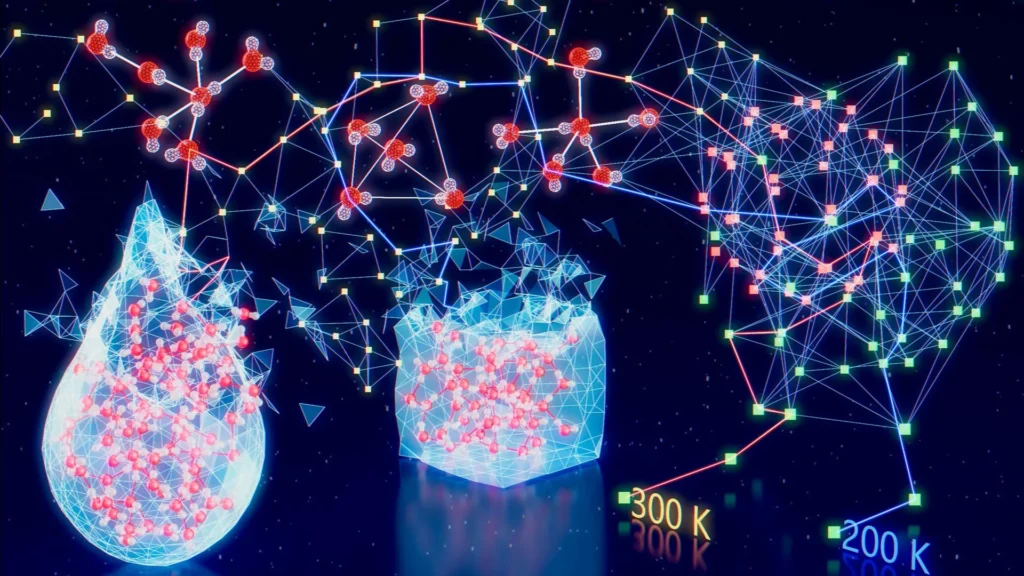
Scientists widely postulate that the amplified anomalous behaviors observed in supercooled water are intricately linked to a delicate balance between two distinct, competing forms of liquid water at the molecular level. These hypothesized forms are generally referred to as the high-density liquid (HDL) and the low-density liquid (LDL). At the most fundamental molecular scale, water molecules are in a constant, dynamic flux, continuously forming, breaking, and reforming intricate networks of hydrogen bonds. The LDL structure is characterized by an open, tetrahedral arrangement of molecules, where each water molecule is ideally hydrogen-bonded to four neighbors, creating a relatively expansive and less dense network. Conversely, the HDL structure is more compact and disordered, with molecules exhibiting a greater variety of hydrogen bond arrangements and often packing more closely together. As the temperature of supercooled water gradually rises, the more compact HDL structures progressively gain dominance and become increasingly prevalent over the more open, less dense LDL arrangements, shifting the equilibrium between these two states and thereby influencing the overall macroscopic properties.
The Historical Challenge: Describing Water’s Structure
Over decades of intensive research, numerous theoretical and computational models have been proposed to describe the local arrangement and connectivity of water molecules. These models have introduced various "structural descriptors"—quantitative metrics designed to capture specific aspects of the molecular geometry and bonding. Examples include measurements such as "tetrahedral bond order," which quantifies how perfectly a water molecule is surrounded by four neighbors in a tetrahedral fashion, or "local density," which measures the number of molecules within a specific radius around a central water molecule.
The proliferation of these descriptors, however, created a new layer of complexity. Because each structural descriptor was often developed independently by different research groups, they invariably utilized distinct mathematical formulations, employed varying scales, operated in different dimensional spaces, and focused on capturing disparate types of structural information. This lack of standardization has historically presented a significant hurdle, making it exceedingly difficult for researchers to directly compare the efficacy of these descriptors, to ascertain which ones are most robust, or to definitively determine which provide the most insightful and accurate representation of water’s dynamic molecular architecture. This fragmentation in descriptive methodologies has hampered the development of a unified theoretical framework for water.
The AI Breakthrough: Unifying Descriptors
"Past studies have shown that using machine learning to classify and understand structural data is remarkably effective," explains Professor Kang Kim, a corresponding author on the Communications Chemistry paper from Osaka University. He elaborated on the specific motivation behind their innovative approach: "We specifically wanted to incorporate a neural network model into this study to evaluate how accurate the descriptors were at capturing key structural information. Our goal was to achieve this evaluation in a way that is analogous to human cognitive processes, enabling the system to discern meaningful patterns and relationships within complex datasets."
To achieve this ambitious goal, the Osaka University researchers embarked on a rigorous training regimen for their AI system. They meticulously fed the neural network an extensive dataset of structural information, which was generated through sophisticated molecular dynamics simulations of supercooled water. Molecular dynamics (MD) simulations are powerful computational tools that model the physical movements of atoms and molecules over time. By solving Newton’s equations of motion for a system of interacting particles, MD simulations can provide atomic-level trajectories and structural details that are often inaccessible through experimental means, especially for transient and metastable states like supercooled water. This simulation data, rich in atomic positions and interaction energies over time, provided the raw material for the AI to learn from.
Through a process of repeated trial and error, characteristic of machine learning algorithms, the neural network iteratively adjusted its internal parameters. This iterative optimization allowed the system to progressively "learn" and recognize meaningful patterns and correlations within the vast and complex landscape of molecular structures present in supercooled water. Essentially, the AI was trained to develop an intuitive understanding of how water molecules arrange themselves under different conditions.
New Clues and Broader Implications
"The network then utilized the intricate knowledge it had acquired during its training phase to systematically compare how effectively 16 different structural descriptors differentiated between the low-density liquid (LDL) and high-density liquid (HDL) structures across a range of varying temperatures," reports Professor Nobuyuki Matubayasi, the senior author of the study. "Through this rigorous comparative analysis, we were able to precisely determine the most efficient and accurate descriptors—those that best capture the essential differences and transitions between these two fundamental liquid forms of water."
This breakthrough extends beyond merely identifying superior descriptors. The researchers firmly believe that their novel AI-driven framework has the profound potential to significantly enhance scientists’ understanding of the intricate relationship between microscopic structural changes in water and its macroscopic thermodynamic behaviors. By providing a clearer, more consistent picture of water’s molecular architecture, this research could illuminate the fundamental origins of water’s myriad unusual properties, thereby guiding the development of even more sophisticated and precise computational tools for studying its extraordinarily complex and dynamic molecular structure.
The implications of this research resonate across multiple scientific disciplines. In fundamental physics and chemistry, a deeper understanding of water’s structure could lead to a unified theory of the liquid state, a notoriously difficult area of condensed matter physics. It could help resolve long-standing debates regarding the existence of a "second critical point" in supercooled water, a theoretical point where the HDL and LDL phases become indistinguishable.
In materials science, knowing precisely how water molecules arrange themselves around different surfaces and solutes is critical for designing new materials with tailored properties, such as advanced membranes for desalination, more efficient catalysts that operate in aqueous solutions, or novel biomaterials.
For biology and medicine, water is the solvent of life. Its unique properties are fundamental to protein folding, enzyme activity, DNA stability, and cell membrane function. Better structural descriptors could lead to more accurate simulations of biological processes, aiding in drug discovery by understanding how pharmaceutical compounds interact with proteins in an aqueous environment, and advancing cryopreservation techniques by minimizing ice formation damage in biological tissues and organs.
In atmospheric and climate science, water in its various phases plays a crucial role. Understanding the nucleation and growth of ice crystals in clouds, for instance, is vital for accurate climate modeling and predicting weather patterns. The supercooled state is particularly relevant for cloud physics, where supercooled water droplets can exist at sub-zero temperatures, contributing to phenomena like aircraft icing.
The study also represents a significant stride in the application of artificial intelligence in scientific discovery. It demonstrates how AI, beyond merely processing data, can act as a powerful meta-tool to evaluate and refine the very methodologies scientists use to understand complex systems. This approach could be replicated to tackle similar challenges in other areas of chemistry and materials science where multiple, disparate descriptors exist for complex phenomena.
The Osaka University team’s work marks a pivotal moment in the centuries-old quest to demystify water. By providing a consistent and robust method for evaluating the myriad ways scientists describe water’s microscopic structure, they have laid a critical foundation for future research, promising to unlock deeper insights into the liquid that underpins all known life and shapes our planet. The integration of AI into this fundamental scientific inquiry not only offers powerful new analytical capabilities but also foreshadows a future where machine intelligence becomes an indispensable partner in unraveling the universe’s most enduring mysteries.