On August 12, 2026, as millions across Europe prepared to witness a rare total solar eclipse, a unique cosmic alignment unfolded high above Earth. The European Space Agency’s (ESA) Proba-3 mission, a pair of sophisticated satellites designed to artificially mimic solar eclipses, found itself in a prime position to observe not one, but a double eclipse. Hours before the Moon’s shadow traced its path across the European continent, Proba-3’s instruments captured a celestial ballet, experiencing an eclipse of unprecedented duration thanks to the natural intervention of our Moon. This extraordinary event provided scientists with invaluable data, offering a rare opportunity to calibrate and test the mission’s advanced coronagraph technology under near-perfect observational conditions.
The Proba-3 mission, comprising two distinct spacecraft – the Occulter and the Coronagraph – operates with a singular, ambitious goal: to create its own solar eclipses. Stationed in a precise formation approximately 60,000 kilometers above Earth, the Occulter spacecraft acts as an artificial Moon. By precisely positioning itself between the Sun and its companion, the Coronagraph, the Occulter effectively blocks the Sun’s blindingly bright disc. This ingenious setup allows the Coronagraph, equipped with the Advanced Coronagraph for Imaging of the Sun (ASPIICS) instrument, to achieve an unobstructed, long-duration view of the Sun’s elusive outer atmosphere, the corona. This region, normally hidden by the Sun’s glare, is a hotbed of solar activity, crucial for understanding space weather phenomena that can impact Earth.
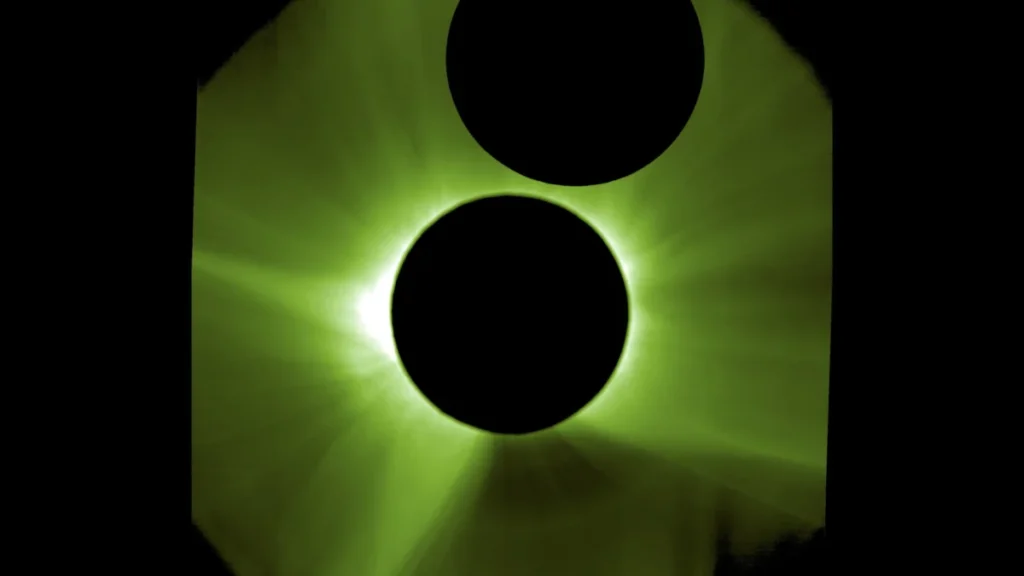
However, on August 12, 2026, the Moon itself intervened in Proba-3’s meticulously planned artificial eclipses. The mission’s coronagraph captured a series of images over a three-hour period that morning, revealing the majestic passage of Earth’s natural satellite across its field of view. This celestial interloper, the Moon, cast a shadow that was even larger than the occulting disc deliberately deployed by Proba-3’s Occulter spacecraft. The result was a rare "double eclipse," where the Moon first obscured the Sun, and then, as the Moon moved on, the Occulter continued its role, maintaining an artificial eclipse.
A Double Eclipse of Unprecedented Duration
The natural eclipse orchestrated by the Moon lasted for an impressive 8 minutes and 40 seconds. During this period, Proba-3 was not only experiencing its own planned artificial eclipse but was also under the shadow of the Moon. This extended celestial event was significantly longer than the maximum duration of totality experienced on the ground. For observers in Europe, the longest period of totality was a mere 2 minutes and 18 seconds, witnessed just off the coast of Iceland. Proba-3’s unique orbital vantage point and the Moon’s passage resulted in a double eclipse that dwarfed the terrestrial experience in terms of duration.
The extended duration of the double eclipse offered a unique scientific opportunity. Normally, when the Occulter spacecraft creates an artificial eclipse, some parasitic light can still interfere with the ASPIICS instrument. This stray light is typically caused by the diffraction of sunlight around the edges of the Occulter’s disc. However, during the nearly nine minutes of the Moon’s eclipse, the ASPIICS coronagraph was largely free from this parasitic illumination. This exceptionally clean observational window allowed scientists to precisely calibrate the optical performance of the ASPIICS instrument. Furthermore, it provided a brief but invaluable period for observing the solar corona under ideal conditions, potentially revealing subtle details of its structure and dynamics that might otherwise be obscured.
Proba-3’s Unique Opportunity: A Once-in-a-Mission Event
Such a confluence of events – an artificial eclipse coinciding with a natural solar eclipse of significant duration – is exceedingly rare for the Proba-3 mission. While Proba-3 is designed to create its own eclipses, the opportunity for a full solar disc occultation by the Moon to enhance its observations is a serendipitous occurrence. The mission is scheduled to experience two more natural solar eclipses during its operational lifetime, on August 2, 2027, and July 22, 2028. However, during these future events, the Moon is expected to pass through the ASPIICS field of view but will not fully cover the solar disc, resulting in partial eclipses rather than the complete occultation witnessed on August 12, 2026. Therefore, the double eclipse experienced by Proba-3 was a truly once-in-a-lifetime event for the mission, offering a calibration and observation window that will likely not be replicated.
The Science Behind Proba-3
The Proba (Project for On-Board Autonomy) series of satellites are a testament to ESA’s commitment to developing innovative and cost-effective space missions. Proba-3 is a prime example of this philosophy, utilizing two small, relatively inexpensive satellites to achieve a scientific objective that would typically require a much larger and more complex instrument. The mission’s precise formation flying capability is a key technological achievement. Maintaining a stable distance of 60,000 km between the two spacecraft, with sub-kilometer precision, is a significant engineering feat that enables the artificial eclipse phenomenon.
The ASPIICS instrument aboard the Coronagraph spacecraft is a state-of-the-art coronagraph designed to capture high-resolution images of the solar corona. The corona is the outermost layer of the Sun’s atmosphere, extending millions of kilometers into space. It is a region of extremely hot plasma, where temperatures can reach millions of degrees Celsius. Studying the corona is vital for understanding various solar phenomena, including:
- Solar Flares and Coronal Mass Ejections (CMEs): These are powerful outbursts of energy and plasma from the Sun that can have significant impacts on Earth, disrupting satellite communications, power grids, and even posing risks to astronauts.
- The Solar Wind: The continuous stream of charged particles emanating from the Sun that fills the solar system. Understanding its origin and evolution is crucial for space weather forecasting.
- The Sun’s Magnetic Field: The corona is shaped and driven by the Sun’s complex magnetic field. Studying its structure provides insights into the Sun’s internal processes and its overall behavior.
A Global Phenomenon and Proba-3’s Unique Perspective
The total solar eclipse on August 12, 2026, was a widely anticipated event, with millions of people across Europe preparing to witness the rare celestial alignment. From Portugal and Spain to parts of France, Germany, and Poland, the path of totality offered breathtaking views of the Sun’s corona. Numerous scientific institutions, astronomy clubs, and amateur astronomers were poised to capture this event, using a variety of ground-based telescopes and observational equipment. Several other space missions also aimed to observe the eclipse, either by tracking the Moon’s shadow on Earth or by using their instruments to study the Sun during the period of reduced solar activity.
However, Proba-3’s perspective offered a fundamentally different, and in many ways, scientifically richer, view. While ground-based observations are crucial for understanding the eclipse’s impact on Earth’s atmosphere and for public engagement, Proba-3’s orbital position provided a vantage point unhindered by atmospheric conditions and able to observe the Sun’s corona directly and for extended periods. The mission’s ability to create its own eclipses means it can observe the corona on demand, but the accidental overlay with a natural eclipse provided an invaluable, real-world calibration opportunity.
Broader Implications and Future Research
The data gathered by Proba-3 during this double eclipse will contribute significantly to our understanding of solar physics and the performance of advanced coronagraph technology. The precise calibration of ASPIICS under such ideal conditions will enhance the reliability and accuracy of future observations. This improved understanding of the corona is not merely an academic pursuit; it has direct implications for space weather forecasting. Accurate predictions of solar flares and CMEs are essential for protecting our increasingly technology-dependent society from their disruptive effects.
The success of the Proba-3 mission in achieving its primary objectives, coupled with unexpected opportunities like this double eclipse, underscores the value of innovative space missions. The ability to conduct complex scientific experiments with relatively compact and cost-effective spacecraft demonstrates a forward-thinking approach to space exploration. As Proba-3 continues its mission, scientists will be eager to analyze the data from this unique event, further unraveling the mysteries of our Sun and its influence on the solar system. The images and scientific insights gained from this double eclipse will undoubtedly contribute to a deeper appreciation of the Sun’s dynamic nature and the intricate dance of celestial bodies.