The prevailing understanding of the cosmos, built on decades of observational data and theoretical refinement, faces a profound challenge from new research suggesting the universe may not be uniformly structured. A recent study, co-authored by researchers in the field, indicates that the universe could be fundamentally asymmetric or "lopsided," meaning its properties might not be the same in every direction. This finding directly contradicts a cornerstone assumption of the "standard cosmological model," known as Lambda-CDM (Lambda-Cold Dark Matter), which posits an isotropic (looking the same in all directions) and homogeneous (uniform on large scales) universe. The implications of this potential asymmetry are far-reaching, demanding a re-evaluation of our most basic cosmic tenets and potentially ushering in a new era of theoretical physics.
The Bedrock of Modern Cosmology: Isotropy and Homogeneity
For nearly a century, the standard cosmological model has successfully described the dynamics and large-scale structure of the universe. Its efficacy rests squarely on the "cosmological principle," which asserts that the universe is isotropic and homogeneous when averaged over vast distances. This principle underpins the Friedmann-Lemaître-Robertson-Walker (FLRW) metric, a solution to Einstein’s equations of general relativity that describes a universe that is expanding, homogeneous, and isotropic. The FLRW metric vastly simplifies the complex equations of general relativity, providing a tractable framework for understanding the cosmos from the Big Bang to its present state. This framework has been remarkably successful in explaining phenomena such as the expansion of the universe, the abundance of light elements, and the existence of the cosmic microwave background radiation.
The concept of a symmetric universe has deep roots, partly born out of convenience and partly from early observations. The universe’s appearance, when viewed from Earth, does not seem to favor any particular direction. Furthermore, the absence of any privileged position in space (homogeneity) and direction (isotropy) forms a philosophically appealing and mathematically elegant basis for a universal model.
The Cosmic Microwave Background: A Window to the Early Universe
Central to the development and validation of the standard cosmological model is the cosmic microwave background (CMB). Discovered accidentally in 1964 by Arno Penzias and Robert Wilson, the CMB is the relic radiation left over from the Big Bang – the earliest light that could travel freely through space approximately 380,000 years after the universe’s birth. This ancient light, now cooled to a frigid 2.7 Kelvin, pervades the entire sky and is remarkably uniform. Indeed, its temperature varies by only one part in a hundred thousand across the celestial sphere. This stunning uniformity was initially interpreted as powerful evidence for an isotropic and homogeneous universe, strongly bolstering the FLRW description and the cosmological principle.
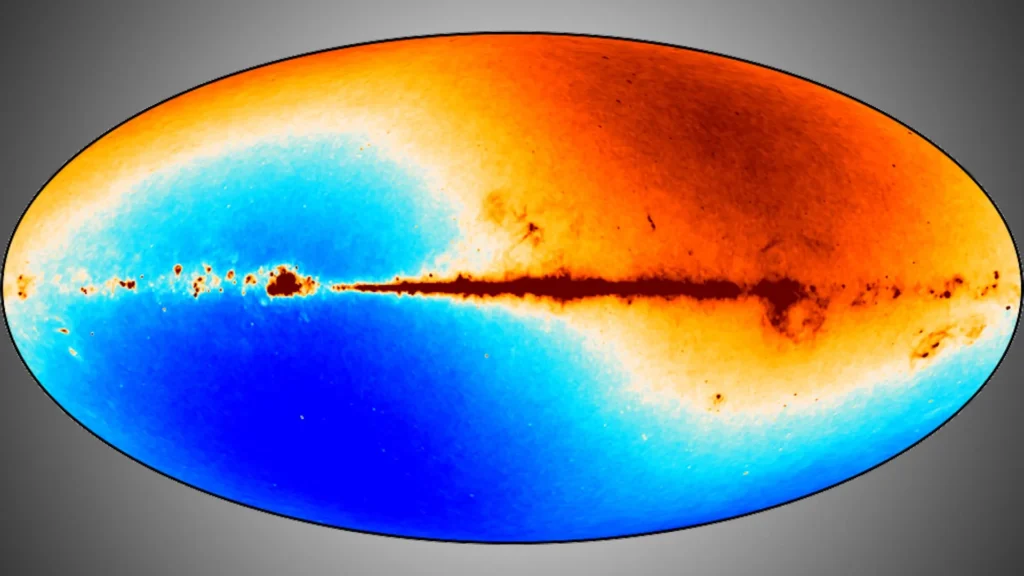
However, even within this near-perfect uniformity, cosmologists detected subtle variations. One of the most significant of these is the CMB dipole anisotropy. This phenomenon manifests as a slight temperature difference across the sky: one hemisphere appears fractionally hotter, and the opposite hemisphere fractionally cooler, by about one part in a thousand. This observed dipole is widely attributed to the Earth’s (and our solar system’s) motion relative to the CMB rest frame. As our solar system rushes through space at approximately 370 kilometers per second, the CMB photons ahead of us are blueshifted (appear hotter), and those behind us are redshifted (appear cooler), creating this observed dipole. Crucially, this local motion does not challenge the underlying assumption of a uniform universe, as it’s a consequence of our perspective rather than an intrinsic asymmetry of the cosmos itself.
Emerging Tensions: Cracks in the Cosmological Edifice
Despite the profound successes of the Lambda-CDM model, several "tensions" – significant disagreements between different datasets – have emerged in recent years, posing serious challenges to the idea of a perfectly uniform universe. These discrepancies suggest that our current model might be incomplete or fundamentally flawed.
One of the most widely debated of these tensions is the "Hubble tension." Named after Edwin Hubble, who in 1929 famously discovered that the universe is expanding, this tension refers to a persistent disagreement in measurements of the universe’s expansion rate, known as the Hubble constant (H₀). Measurements derived from observations of the early universe (e.g., from the CMB by missions like Planck) predict a slower expansion rate than those derived from observations of the nearby, more recent universe (e.g., using supernovae and Cepheid variables observed by the Hubble Space Telescope and Gaia satellite). The difference is statistically significant, often exceeding 5 standard deviations, and has proven stubbornly difficult to resolve within the standard model. While the Hubble tension points to a potential need for new physics or revised cosmological parameters, it primarily concerns the rate of expansion rather than the fundamental structure of the universe.
The Cosmic Dipole Anomaly: A More Fundamental Challenge
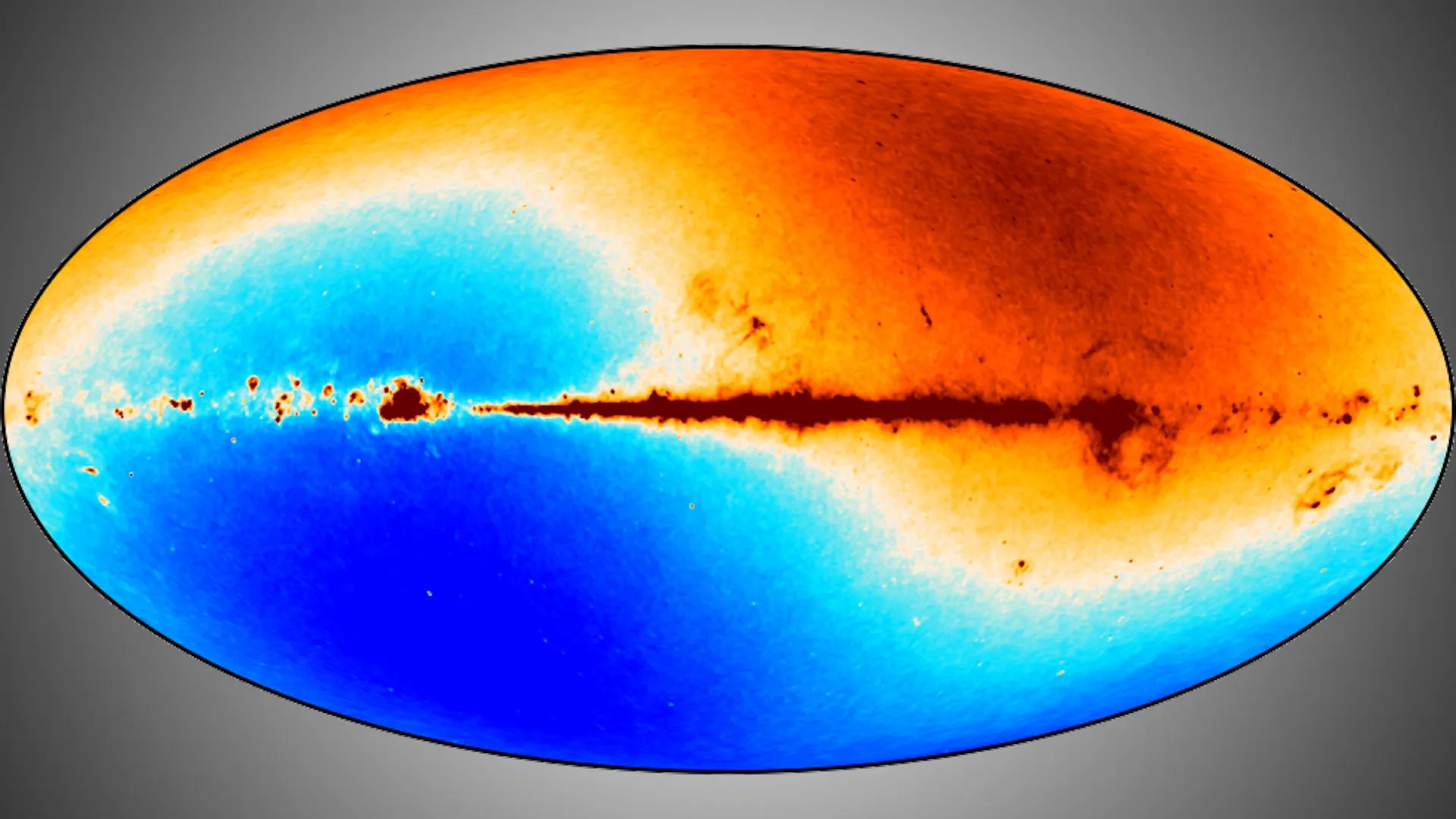
The recent study highlights another, arguably more fundamental, tension: the "cosmic dipole anomaly." While it has received less public attention than the Hubble tension, its implications could be more profound because it directly questions the assumption of cosmic isotropy. The anomaly arises from comparing the direction and magnitude of the CMB dipole (attributed to our local motion) with the distribution of matter in the distant universe. If the universe is indeed isotropic and homogeneous on large scales, then our motion relative to the CMB should be consistent with our motion relative to the distribution of distant astronomical sources, such as radio galaxies and quasars. In other words, if we are moving towards a "hotter" region of the CMB, we should also observe an apparent clustering of distant galaxies in that same direction due to the relativistic effects of our motion.
This concept was formalized in 1984 by astronomers George Ellis and John Baldwin, who proposed a direct test of the cosmological principle, now known as the "Ellis-Baldwin test." The test involves searching for a corresponding dipole anisotropy in the sky distribution of very distant astronomical sources. The sources must be sufficiently far away to ensure that any observed clustering is due to cosmological effects and our motion, rather than merely local gravitational structures. If the FLRW assumption of a symmetrical universe is correct, then the observed variation in distant astronomical sources should be directly determined by, and consistent with, the observed variation in the CMB. Consistency between these two "dipoles" – one from the CMB and one from the distribution of matter – would strongly support the standard Lambda-CDM model.
The Universe Fails the Ellis-Baldwin Test
The challenge, however, lies in the precise measurement required for the Ellis-Baldwin test. Such a precise and comprehensive catalogue of distant astronomical sources has only recently become available, thanks to advancements in observational astronomy. The recent study, leveraging this wealth of data, performed the Ellis-Baldwin test with unprecedented accuracy. The outcome is startling: the universe fails the test. The variation in the distribution of matter does not match that in the CMB.
This finding is not a singular, isolated result. The researchers note that the same inconsistency has been observed using different types of telescopes and satellites, and across various wavelengths in the electromagnetic spectrum. For instance, observations made with terrestrial radio telescopes yield results consistent with those from satellites observing at mid-infrared wavelengths. This independent corroboration across diverse observational methods significantly strengthens the validity of the findings and reduces the likelihood of instrumental or methodological errors. The cosmic dipole anomaly has thus established itself as a major challenge to the standard cosmological model, indicating a potential fundamental deviation from isotropy that cannot be explained by local motion alone.
Implications for Fundamental Physics and the Future of Cosmology
The implications of the cosmic dipole anomaly are profound. Unlike the Hubble tension, which might be resolved by tweaking existing cosmological parameters or introducing new, relatively minor components (like early dark energy), the cosmic dipole anomaly directly questions the FLRW description itself. Abandoning FLRW would necessitate a radical re-evaluation of general relativity on cosmic scales, potentially requiring new solutions to Einstein’s equations that account for anisotropy or even a paradigm shift beyond our current understanding of gravity. This is not merely a matter of refining the Lambda-CDM model; it suggests that the fundamental blueprint of the universe as we understand it might be incorrect.
The scientific community has, to a large extent, been reluctant to fully embrace the implications of the cosmic dipole anomaly. This hesitation is understandable; the FLRW metric has served as the foundational bedrock for modern cosmology, simplifying complex problems and yielding consistent results for decades. To "go back to square one," as the researchers suggest, implies dismantling a highly successful framework and starting anew, a daunting prospect for any scientific discipline.
However, the relentless march of technological advancement in astronomy is bringing forth an "avalanche of data" that cannot be ignored. New observatories and missions, such as the European Space Agency’s Euclid satellite, NASA’s SPHEREx mission, the Vera C. Rubin Observatory, and the Square Kilometre Array (SKA) project, are poised to provide unprecedented detail on the distribution of matter and the properties of the early universe. These instruments will gather data on billions of galaxies, offering a far more precise mapping of the cosmic web and potentially providing further evidence for or against the cosmic dipole anomaly.
The sheer volume and complexity of this forthcoming data may also necessitate novel analytical approaches. The researchers speculate that advanced techniques in artificial intelligence, particularly machine learning, could play a crucial role in constructing and testing new cosmological models. Machine learning algorithms are adept at identifying subtle patterns and correlations in massive datasets that might elude traditional human analysis, potentially offering bold new insights into how to build a revised or entirely new cosmological model.
Should the cosmic dipole anomaly continue to hold up under scrutiny and with new data, the impact on fundamental physics would be truly immense. It would challenge the very principles of general relativity as applied to cosmology, potentially opening doors to theories of gravity beyond Einstein’s framework or suggesting the existence of large-scale structures that violate the cosmological principle. Our understanding of dark energy and dark matter, which are integral components of the Lambda-CDM model, would also need to be re-examined within an anisotropic universe. Ultimately, confronting this anomaly could lead to a profound transformation in our perception of the universe’s ultimate shape, structure, and evolution, forever altering humanity’s place within the cosmos.