In a landmark study that bridges the gap between biological energy conversion and synthetic material science, researchers at the Dalian Institute of Chemical Physics (DICP) of the Chinese Academy of Sciences have identified a new fundamental mechanism for energy migration. Led by Professor Kaifeng Wu, the team has successfully demonstrated a process termed proton shuttle-assisted triplet energy transfer (PS-TET). This discovery, recently detailed in the journal Nature Materials, provides a sophisticated framework for understanding how the synchronized movement of protons and electrons can facilitate the transfer of spin-triplet excitation, a finding that holds profound implications for the future of solar energy harvesting, photocatalysis, and the development of next-generation optoelectronic devices.
The Convergence of Proton and Electron Dynamics
The synergy between electron and proton motion is a cornerstone of natural life. In biological systems, this relationship is most famously expressed through proton-coupled electron transfer (PCET). This process is the driving force behind bioenergetics, enabling essential functions such as cellular respiration, nitrogen fixation, and the primary stages of photosynthesis. For decades, scientists have sought to replicate the efficiency of PCET in engineered systems, leading to significant advancements in fuel cells and artificial photosynthetic arrays.
While PCET focuses on the movement of charges, recent years have seen a shift toward understanding how these movements influence energy states. This led to the identification of proton-coupled singlet energy transfer (PCEnT). However, the "triplet" counterpart—triplet energy transfer (TET)—remained poorly understood in the context of proton coupling. Unlike singlet states, which are short-lived and characterized by paired electron spins, triplet states involve unpaired spins and possess significantly longer lifetimes. This longevity makes triplet states both highly useful for chemical reactions and potentially problematic in electronic devices where they can lead to energy loss or material degradation.
The DICP team’s investigation into PS-TET addresses this critical knowledge gap, revealing how a "proton shuttle" can act as a catalyst for moving triplet energy between a semiconductor donor and a molecular acceptor.
Unveiling the Mechanism: The Proton Shuttle in Action
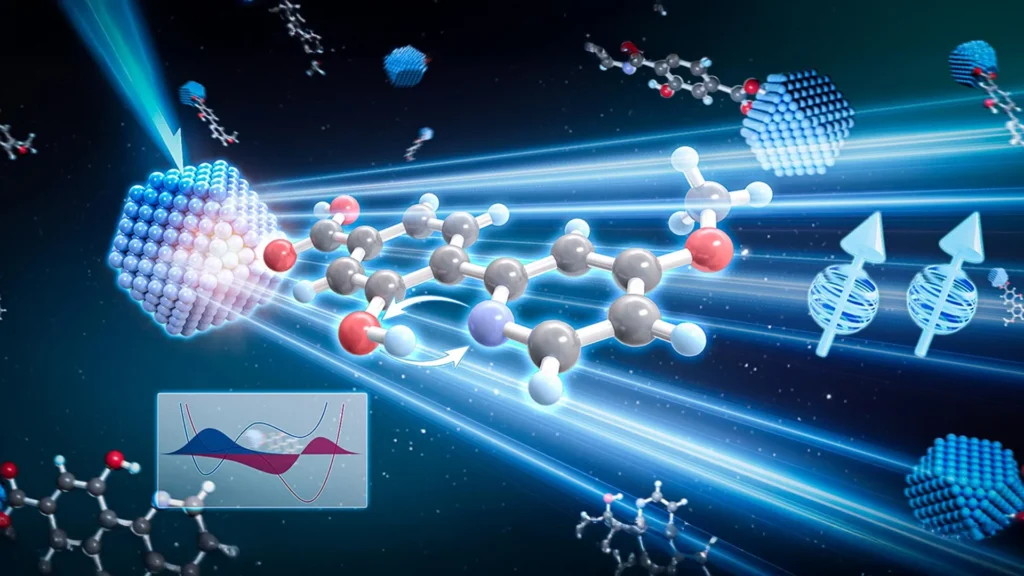
The experimental architecture utilized by Professor Wu’s team involved colloidal quantum dots (QDs) based on zinc selenide (ZnSe). These QDs served as the energy donors. Attached to the surface of these nanocrystals were "dyadic" acceptors—molecules composed of phenol and pyridine units. The phenol-pyridine structure was specifically chosen for its ability to host a mobile proton, creating a pathway for the "shuttle" effect.
The PS-TET process unfolds in a series of highly synchronized steps:
- Photoexcitation: The process begins when the ZnSe quantum dots absorb incoming photons, moving into an electronically excited state.
- The First Coupled Move: A "hole" (a positive charge carrier) moves from the ZnSe QD to the phenol component of the acceptor. Simultaneously, a proton shifts from the phenol unit to the adjacent pyridine unit.
- The Second Coupled Move: An electron then transfers from the ZnSe QD to the resulting phenoxyl radical. At the same time, the proton "shuttles" back from the pyridinium unit to its original location on the oxygen atom of the phenol.
- Resultant State: The net result of these microscopic shifts is the transfer of spin-triplet energy from the quantum dot to the phenol-pyridine dyad. Crucially, the proton ends the cycle exactly where it started, having facilitated the energy move without being consumed or permanently relocated.
This cyclical motion of the proton is what the researchers define as the "shuttle." By comparing this system to a methylated analog—where the mobile proton is replaced by a fixed methyl group—the team found that the presence of the proton shuttle dramatically increased both the speed and the overall efficiency of the energy transfer.
Quantum Tunneling and Temperature Independence
One of the most striking findings of the study was the kinetic behavior of the PS-TET process. In classical chemistry, the rate of a reaction typically increases with temperature as molecules gain the thermal energy required to overcome activation barriers. However, the DICP researchers observed that the rate of PS-TET remained nearly constant across a wide range of temperatures.
This temperature independence is a hallmark of quantum mechanical tunneling. In this regime, particles like protons do not "climb over" an energy barrier; instead, they "tunnel through" it, leveraging their wave-like properties. To verify this, the team performed extensive calculations involving proton vibrational wavefunction overlap integrals. These calculations confirmed that the system favors specific relaxation pathways that are steered by quantum effects, allowing for efficient energy migration even at room temperature.
The ability to harness quantum tunneling in a controlled, synthetic environment represents a major step forward in material design. It suggests that advanced materials can be engineered to operate with high precision and efficiency without requiring extreme thermal conditions.
A Chronology of Discovery and Research Context
The discovery of PS-TET did not happen in isolation but is the result of a decade-long evolution in the study of charge and energy transfer at the Dalian Institute of Chemical Physics.
- 2010-2015: Early research into colloidal quantum dots focused on their tunable optical properties and potential as replacements for traditional bulk semiconductors in solar cells.
- 2016-2018: Professor Kaifeng Wu and his colleagues began exploring the interface between inorganic nanocrystals and organic molecules, identifying how "hole transfer" could be used to initiate chemical reactions.
- 2019-2021: The team published several papers on proton-coupled electron transfer (PCET) in quantum dot systems, laying the groundwork for understanding how protons influence charge separation.
- 2022-2023: Building on the emerging concept of proton-coupled singlet energy transfer (PCEnT), the researchers turned their attention to the more complex triplet states.
- 2024: The discovery of PS-TET is finalized and published in Nature Materials, marking the first time a proton-shuttle mechanism has been documented for triplet energy transfer in a QD-molecule hybrid system.
Supporting Data: Tuning Energy Flow with Substituents
A key aspect of the study was the researchers’ ability to manipulate the PS-TET mechanism through molecular engineering. By introducing a trifluoromethyl (-CF3) group—a strongly electron-withdrawing substituent—onto the pyridine ring, the team was able to alter the electronic landscape of the acceptor.
Data from ultrafast transient absorption spectroscopy revealed that this single chemical change could reorder the sequence of the proton-coupled steps. In the original system, the hole transfer preceded the electron transfer. With the trifluoromethyl group, the energetics shifted, demonstrating that the PS-TET process is highly tunable. This "tunability" is essential for industrial applications, where different devices require different energy transfer rates and pathways.
Furthermore, the study provided quantitative evidence of the shuttle’s impact. The efficiency of triplet generation in the proton-shuttle system was measured to be several orders of magnitude higher than in systems where the proton was "locked" in place. This data underscores the potential for PS-TET to serve as a high-efficiency switch in molecular electronics.
Expert Perspectives and Industry Implications
The scientific community has reacted with significant interest to the DICP findings. While official statements from external peer reviewers are maintained within the journal’s confidential process, the broader implications discussed by Professor Wu and his colleagues suggest a transformative shift in several high-tech sectors.
"The discovery of the PS-TET mechanism has profound implications for many modern molecular technologies involving the spin-triplet excited states of molecules," noted Professor Wu.
Impact on Photoredox Catalysis
In the field of environmental and industrial catalysis, triplet states are often the active species that drive chemical transformations. By utilizing the PS-TET mechanism, scientists can design catalysts that generate triplet states more efficiently, leading to faster reaction times and lower energy requirements for producing chemicals or breaking down pollutants.
Advancements in Solar Energy
For the solar industry, the management of triplet states is a double-edged sword. In some next-generation solar cells, a process called "singlet fission" generates two triplet states from one absorbed photon, potentially doubling the current. PS-TET could be used to optimize this energy harvest. Conversely, in traditional organic photovoltaics, triplet states can be a source of energy loss through heat. Understanding how to "unplug" the proton shuttle could allow engineers to suppress these unwanted states, thereby increasing the open-circuit voltage and overall efficiency of the cells.
Evolution of Laser Technology and OLEDs
Organic Light-Emitting Diodes (OLEDs) and organic lasers also stand to benefit. In these devices, the accumulation of triplet states can lead to "quenching," where energy is lost rather than converted into light. The ability to precisely control the migration of these triplets via proton-shuttle mechanisms offers a new toolkit for preventing quenching and extending the operational lifespan of the devices.
Conclusion and Future Directions
The identification of proton shuttle-assisted triplet energy transfer (PS-TET) marks a significant milestone in the study of light-matter interactions. By demonstrating that a simple proton can act as a sophisticated "shuttle" for complex energy states, the researchers at the Dalian Institute of Chemical Physics have provided a new blueprint for material innovation.
The findings confirm that quantum mechanical effects, such as tunneling, are not confined to the absolute-zero temperatures of specialized laboratories but can be harnessed at room temperature in functional materials. As the research moves from the laboratory to practical application, the next steps will involve integrating PS-TET into large-scale device architectures.
Future research at DICP is expected to focus on expanding the library of proton-shuttle molecules and exploring whether similar mechanisms exist for other types of excitations, such as excitons in two-dimensional materials. As the world moves toward a more sustainable energy future, the ability to control energy at the level of individual protons and electrons will undoubtedly be a cornerstone of technological progress.