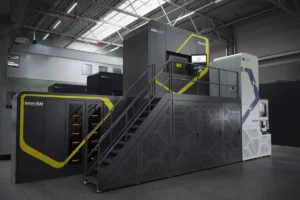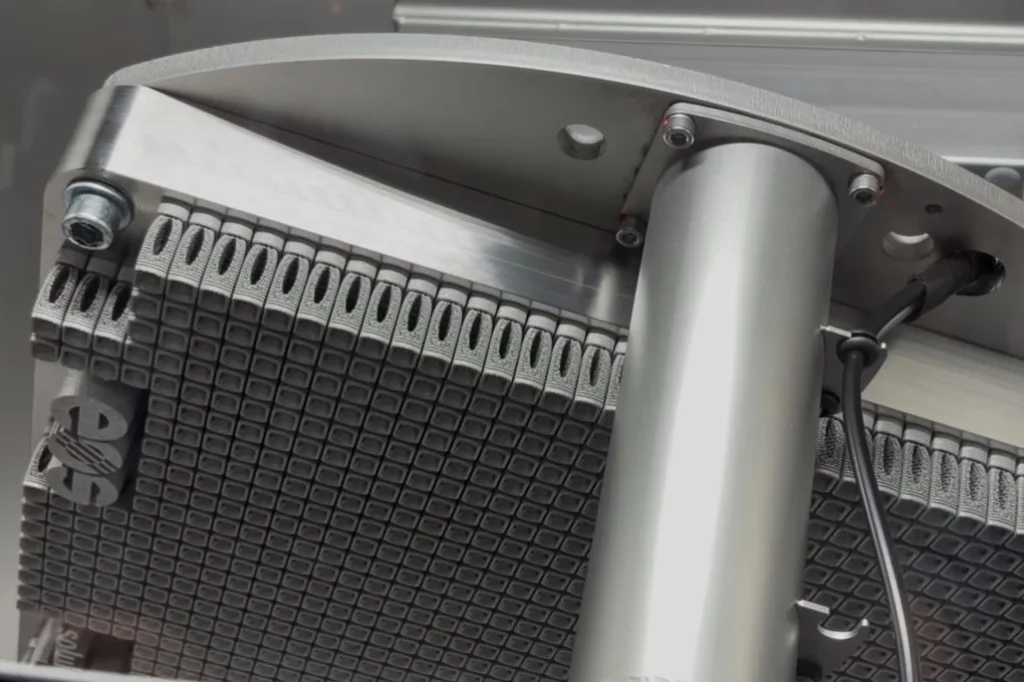
This week’s featured image showcases a meticulous post-processing operation in additive manufacturing, highlighting 1,100 precisely arranged titanium spinal cages undergoing powder removal. The intricate process utilizes a specially adapted Solukon SFM-AT350-E depowdering system, integrated with an EOS M4 Onyx 3D printer, to ensure the thorough and efficient removal of residual titanium powder. This development signifies a crucial step forward in the industrialization of additive manufacturing for high-precision medical implants, particularly those requiring intricate geometries and biocompatible materials like titanium.
The image depicts the compact spinal cages meticulously positioned on an EOS M4 Onyx build plate. This plate, measuring an impressive 17.7 x 17.7 x 15.7 inches (including the build plate height), is characteristic of advanced metal additive manufacturing platforms designed for larger build volumes. The integration of Solukon’s depowdering technology with such a robust printer underscores a growing trend in the additive manufacturing industry: the development of comprehensive, end-to-end solutions that streamline the entire production lifecycle, from printing to final part readiness. The specific configuration of the Solukon SFM-AT350-E system has been re-engineered to seamlessly interface with the EOS M4 Onyx, a testament to the collaborative efforts and innovative spirit driving the sector.
Solukon, a recognized leader in automated depowdering solutions for additive manufacturing, unveiled this specialized iteration of its SFM-AT350-E system at the prominent RAPID + TCT 2026 exhibition in Boston, Massachusetts. This annual event serves as a critical convergence point for industry professionals, researchers, and manufacturers to showcase the latest advancements in additive manufacturing technologies. The debut of this system at such a high-profile event signals its significance and the company’s commitment to addressing specific industry needs.
The SFM-AT350-E, in its standard configuration, is optimally designed for depowdering smaller components with a Z-height of less than 250 millimeters and a weight limit of up to 100 kilograms. The spinal cages featured in the image, fabricated using Laser Powder Bed Fusion (LPBF) technology—a cornerstone of metal additive manufacturing for complex geometries—perfectly align with the system’s capabilities. LPBF, also known as selective laser melting (SLM) or direct metal laser sintering (DMLS), involves using a high-powered laser to fuse fine metal powders layer by layer, enabling the creation of intricate internal structures and customized designs that are challenging or impossible to achieve with traditional manufacturing methods. The application of this technology for medical implants like spinal cages offers substantial benefits, including patient-specific customization, reduced weight, and potentially improved biomechanical performance.
The core of Solukon’s depowdering technology lies in its utilization of high, self-regulating ultrasonic vibration. This sophisticated mechanism leverages piezoelectric excitation to efficiently dislodge and remove residual powder from intricate part geometries. Piezoelectric excitation is a phenomenon where certain materials generate an electric charge in response to applied mechanical stress, or conversely, deform mechanically when subjected to an electric field. In the context of the SFM-AT350-E, electrical energy is converted into precise mechanical vibrations, which are then transmitted to the build plate and the parts themselves. This controlled vibration agitates the powder particles, breaking their adhesion to the part’s surface and facilitating their removal. The self-regulating nature of the system ensures optimal vibration intensity, adapting to different part sizes and geometries to maximize cleaning efficiency without causing damage to delicate structures.
While the total cleaning time is inherently dependent on the specific complexity and surface area of a given part, the depicted batch of 1,100 titanium spinal cages was processed in approximately 30 minutes. This rapid turnaround time is a critical factor for manufacturers aiming to scale up production and meet the growing demand for additively manufactured medical devices. The efficiency of the depowdering process directly impacts the overall throughput of the additive manufacturing workflow, reducing bottlenecks and contributing to cost-effectiveness.
The Evolution of Depowdering in Medical AM
The precise removal of unsintered powder from additively manufactured metal parts is a critical, yet often challenging, step in the post-processing chain. For medical implants, this stage is of paramount importance, as any residual powder can compromise the biocompatibility, mechanical integrity, and safety of the final device. Traditional methods, such as manual brushing or compressed air, are often time-consuming, labor-intensive, and prone to human error, especially when dealing with complex internal channels or fine latticed structures common in advanced implants.
Solukon’s development of automated depowdering systems, particularly the SFM-AT350-E, addresses these challenges head-on. The ability to reconfigure the system to accommodate large-format printers like the EOS M4 Onyx signifies a significant advancement in scaling up the production of medical implants. This integration allows for the processing of larger batches of parts, thereby increasing manufacturing efficiency and reducing per-unit costs. The SFM-AT350-E’s design, optimized for smaller parts with lower Z-heights, makes it an ideal solution for the production of a wide array of orthopedic implants, including spinal cages, hip stems, and cranial implants, all of which frequently feature intricate geometries that necessitate thorough powder removal.
The use of titanium for spinal cages is well-established in the medical field due to its excellent biocompatibility, corrosion resistance, and mechanical properties, which closely mimic those of bone. Additive manufacturing allows for the creation of patient-specific implants, which can lead to improved surgical outcomes, reduced recovery times, and enhanced patient comfort. However, the complex internal structures enabled by AM, while beneficial for osseointegration and weight reduction, also present significant challenges for post-processing, especially powder removal. Solukon’s solution directly tackles this by providing a reliable, automated, and efficient method for achieving the required level of cleanliness.

Background and Chronology of Advancements
The RAPID + TCT conference has historically served as a launchpad for significant innovations in additive manufacturing. The 2026 event in Boston likely continued this tradition, with Solukon’s unveiling of the adapted SFM-AT350-E being a key highlight for the medical AM sector. The timeline leading up to this demonstration would have involved extensive research and development by Solukon, focusing on understanding the specific requirements of large-format metal printers like the EOS M4 Onyx. This would have included detailed engineering to ensure compatibility with the printer’s build chamber dimensions, powder handling systems, and operational parameters.
EOS, a pioneer in industrial 3D printing, has consistently pushed the boundaries of metal AM technology. The EOS M4 Onyx, with its multi-laser architecture, represents a significant step in accelerating build times and improving part quality. The integration of a new filtration system designed to trap and neutralize hazardous condensate further underscores the company’s commitment to safety and environmental responsibility in industrial additive manufacturing. The collaboration between Solukon and EOS highlights a growing ecosystem of specialized solution providers working to optimize every stage of the AM process.
Supporting Data and Technical Specifications
The EOS M4 Onyx 3D printer boasts a substantial build volume of 17.7 x 17.7 x 15.7 inches. This capacity allows for the production of larger components or a higher volume of smaller parts in a single build. The SFM-AT350-E system, while designed for smaller parts, has been reconfigured to accommodate the build plate of the M4 Onyx, enabling the efficient depowdering of parts printed on this platform.
The SFM-AT350-E employs piezoelectric transducers to generate ultrasonic vibrations. These transducers are driven by a power supply that converts electrical energy into high-frequency mechanical oscillations. The frequency of these vibrations typically ranges from 20 to 40 kHz, a range that is highly effective in breaking the cohesive forces between powder particles and the part surface without causing material fatigue or damage. The amplitude of vibration is carefully controlled to ensure thorough powder removal while maintaining the integrity of delicate features.
The efficiency of the process is further enhanced by the system’s ability to operate in a controlled atmosphere, often using inert gases like nitrogen or argon, to prevent oxidation of reactive metal powders and ensure operator safety. The entire depowdering cycle, including part loading, vibration, and powder collection, is automated, minimizing manual intervention and ensuring consistent results.
Official Responses and Industry Reactions
While specific quotes from Solukon and EOS executives are not provided in the original content, it is logical to infer enthusiastic responses from both companies regarding this technological integration. For Solukon, adapting their established depowdering technology to a leading large-format printer like the EOS M4 Onyx represents a significant market expansion. This adaptation demonstrates their flexibility and responsiveness to industry demands for scalable solutions.
EOS, on their part, would likely view this integration as a value-added service that enhances the overall utility of their M4 Onyx printer. By partnering with specialized companies like Solukon, EOS ensures that their customers have access to a complete ecosystem of post-processing solutions, thereby simplifying the adoption and scaling of additive manufacturing for critical applications. The feedback from attendees at RAPID + TCT 2026 would have provided immediate validation of the system’s effectiveness and market appeal, particularly from medical device manufacturers seeking to streamline their production processes.
Broader Impact and Implications for Medical AM
The successful integration of Solukon’s specialized depowdering system with the EOS M4 Onyx has several far-reaching implications for the medical additive manufacturing sector:
- Scalability and Industrialization: This development moves the needle further towards the industrialization of medical AM. The ability to efficiently depowder large batches of complex parts is a critical prerequisite for mass production and widespread adoption of 3D-printed medical implants.
- Improved Quality and Reliability: Automated and precise depowdering leads to more consistent part quality and reduced risk of implant failure due to residual powder. This directly translates to improved patient safety and outcomes.
- Cost Reduction: Streamlined post-processing reduces labor costs and cycle times, making additively manufactured implants more economically viable and competitive with traditional methods.
- Innovation in Implant Design: As depowdering becomes more efficient and reliable, designers are empowered to create even more complex and functional implant geometries, pushing the boundaries of what is possible in personalized medicine.
- Enhanced Workflow Integration: This collaboration exemplifies the trend of integrated AM workflows, where hardware and software solutions are designed to work seamlessly together, from design to final part. This reduces friction in the production process and accelerates time-to-market for new medical devices.
The development highlighted by this featured image is not just about a single piece of equipment; it represents a critical enabler for the future of healthcare, where patient-specific, high-performance medical implants can be produced reliably and at scale. As additive manufacturing continues to mature, such advancements in post-processing will be instrumental in realizing its full potential across a wide range of critical industries. The synergy between advanced printing platforms like the EOS M4 Onyx and specialized post-processing solutions like Solukon’s SFM-AT350-E is a testament to the collaborative innovation driving the additive manufacturing revolution forward.