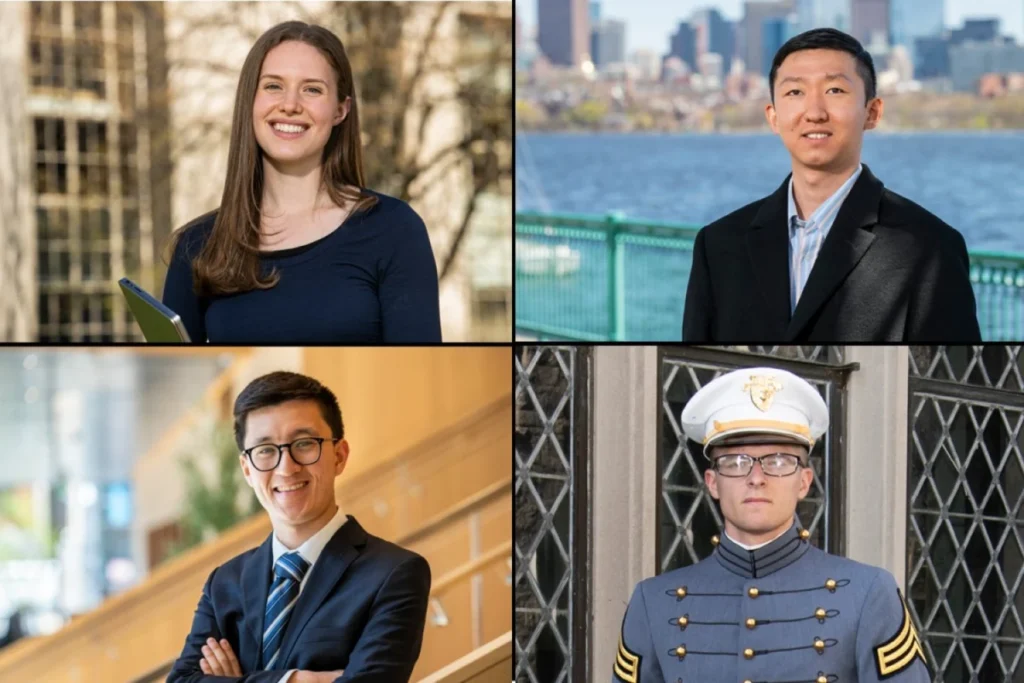
Cambridge, MA – Four highly promising scholars affiliated with the Massachusetts Institute of Technology (MIT), including three current students and one incoming graduate student, have been named recipients of the highly coveted Fannie and John Hertz Foundation Graduate Fellowship. This esteemed award, renowned for its unparalleled support of scientific and technological innovation, recognizes individuals poised to make transformative contributions to their fields. The 2024 MIT-affiliated Hertz Fellows are Annika Marschner, Alvin Q. Meng, Zachary S. Siegel, and Matthew Wanta, joining a distinguished cohort of 19 scholars selected nationwide.
The Hertz Fellowship stands as one of the most generous and flexible graduate fellowships in the United States, designed to empower exceptional doctoral candidates in applied physical, biological, and engineering sciences. Each recipient receives up to five years of comprehensive financial support, including a substantial stipend and full tuition equivalent. This unique funding model is specifically structured to provide fellows with an extraordinary degree of autonomy, allowing them to pursue high-risk, high-reward research projects that might not otherwise secure traditional funding. This freedom is crucial for fostering truly groundbreaking discoveries and disruptive innovations.
Philip Welkhoff, a Hertz Fellow himself and director of the malaria program at the Gates Foundation, co-led the rigorous selection process. Welkhoff articulated the foundation’s admiration for the new cohort, stating, "What particularly impresses me about this cohort is their fearlessness in taking on new challenges and advancing the frontiers of science. Each has exhibited tremendous creativity, grit, and vision, and I cannot wait to see what each accomplishes with the freedom to innovate provided by the Hertz Fellowship." His comments underscore the foundation’s commitment to identifying individuals not only with exceptional intellectual prowess but also with the audacious spirit required to push scientific boundaries.
The Hertz Foundation: A Legacy of Innovation and Autonomy
Established in 1963 by entrepreneur and philanthropist John D. Hertz, the foundation’s mission has consistently been to support the nation’s most promising young scientists and engineers. Hertz, a self-made millionaire known for founding The Hertz Corporation, envisioned a fellowship that would provide "unfettered access to knowledge and resources" for brilliant minds, believing that such autonomy was essential for true innovation. Over the decades, the Hertz Foundation has cultivated a reputation for identifying future leaders who go on to shape industries, advance national security, and solve some of the world’s most pressing challenges.
The fellowship’s impact extends far beyond financial aid. Fellows gain lifelong access to the robust Hertz Foundation network, which includes over 1,300 alumni named since its inception. This network facilitates invaluable mentorship opportunities, collaborative ventures, and exclusive events, fostering a vibrant community of scientific leaders. Connections forged within this elite group have historically led to the creation of groundbreaking startups, collaborative research initiatives, and the successful commercialization of advanced technologies across a spectrum of science, engineering, and technology fields. Notable contributions from Hertz Fellows span diverse areas, including advanced medical therapies, the development of global defense networks, and pivotal work on projects like the James Webb Space Telescope. The foundation’s emphasis on creating a supportive intellectual ecosystem is a cornerstone of its enduring success and influence.
MIT’s Enduring Contribution to Scientific Leadership
MIT, a global beacon for science and engineering education and research, consistently produces a significant number of Hertz Fellows. This year’s selection of four MIT-affiliated scholars reaffirms the institution’s role as a fertile ground for cultivating the next generation of scientific pioneers. The rigorous academic environment, coupled with unparalleled research opportunities and mentorship from world-renowned faculty, provides an ideal ecosystem for students to develop the "creativity, grit, and vision" that the Hertz Foundation seeks. The consistent recognition of MIT students by such a prestigious foundation highlights the university’s commitment to fostering a culture of innovation and high-impact research across its various departments.
Spotlight on the 2024 MIT-Affiliated Fellows
Each of the four MIT-affiliated recipients brings a unique background and a distinct vision for their future research, embodying the interdisciplinary spirit and bold ambition characteristic of Hertz Fellows.
Annika Marschner: Pioneering Bio-Inspired Robotics and Medical Technology
Annika Marschner, a distinguished member of MIT’s Class of 2026, earned her undergraduate degree in mechanical engineering and is set to embark on her PhD studies at MIT this fall. Her research trajectory has consistently focused on the cutting edge of biointerfacing and bio-inspired systems, aiming to bridge the gap between biological principles and engineered solutions.
During her undergraduate career, Marschner was instrumental in developing novel technologies in several leading laboratories. At MIT’s Raman Lab, she contributed to the creation of a custom benchtop stereoscope-compatible incubator and an extrusion-based desktop bioprinter, tools critical for advancing tissue engineering and cellular research. Her work extended internationally to ETH Zürich’s Tissue Engineering and Biofabrication Lab, where she designed a light-based filamented bioprinting system, showcasing her versatility in advanced manufacturing techniques for biological applications. Furthermore, her contributions to MIT’s Biomimetic Robotics Lab involved large-scale hardware designs for robotic systems, demonstrating her capacity for complex engineering challenges. Marschner’s undergraduate thesis specifically addressed the enhancement of speed and dexterity in dynamic motions for bio-inspired robotic limbs, a critical area for improving robotic performance in complex environments.
As a graduate student, Marschner plans to deepen her expertise in both hardware and control system design within biologically relevant contexts. Her primary interests lie in the transformative potential of assistive medical technology and surgical robotics. Her research could lead to more dexterous and intuitive robotic surgical tools, advanced prosthetics, or novel rehabilitation devices that seamlessly interact with the human body, ultimately improving patient outcomes and quality of life. The Hertz Fellowship will enable her to pursue these ambitious goals with the freedom necessary for such high-impact innovation.
Alvin Q. Meng: Unraveling Fundamental Chemical Interactions
Alvin Q. Meng is a current doctoral student in inorganic chemistry at MIT, where his research delves into the fundamental interactions that govern chemical structure and reactivity. Under the guidance of Professor Daniel L.M. Suess, Meng is currently immersed in the intricate study of iron-sulfur clusters. These clusters are ubiquitous in biology, playing crucial roles in enzyme catalysis, electron transfer, and sensing, making their fundamental understanding vital for advancements in medicine, energy, and materials science.
Born in Tianjin, China, Meng immigrated to the United States at the age of 10. He completed his undergraduate studies at the University of Virginia, earning degrees in both chemistry and mathematics. During his time there, he worked in the research group of Professor W. Dean Harman, where his work centered on the synthesis and characterization of dihapto-coordinated tungsten complexes of cyclopentadiene. A particular focus of his undergraduate research was on an unusual class of binuclear species characterized by a carbon–carbon bond linking two metal-bound five-membered rings. This research contributed to a deeper understanding of organometallic chemistry and the unique bonding capabilities of transition metals.
Meng’s continued pursuit of fundamental chemical insights is critical for developing new catalysts, understanding biological processes, and designing novel materials. His work on iron-sulfur clusters, for instance, could inform the development of more efficient industrial catalysts or provide insights into new therapeutic strategies for diseases linked to iron metabolism. The Hertz Fellowship will provide him with the resources to explore these complex chemical systems with the depth and rigor required to uncover new paradigms in inorganic chemistry.
Zachary S. Siegel: Bridging AI, Robotics, and Cognitive Science
Zachary S. Siegel is a graduate student in electrical engineering and computer science at MIT, pursuing a PhD within the esteemed Computer Science and Artificial Intelligence Laboratory (CSAIL). His research navigates the complex and increasingly vital intersection of robotics, cognitive science, and artificial intelligence, aiming to build machines that learn and reason with human-like proficiency.
Siegel graduated summa cum laude from Princeton University with a BSE in computer science and a minor in philosophy, an interdisciplinary background that profoundly influences his research approach. His academic excellence was recognized with numerous honors, including Tau Beta Pi, Sigma Xi, and the Outstanding Computer Science Independent Work Prize. His senior thesis, advised by Tom Griffiths and Jacob Andreas, explored how humans infer the goals of others in open-ended, real-world environments. Siegel’s work demonstrated that Bayesian inference accurately models people’s goal predictions, achieving this by comparing partial observations to a learned library of possible plans weighted by their prior likelihood. This foundational work provides critical insights into human intelligence and its potential replication in artificial systems.
At MIT, Siegel is advised by a formidable team of researchers: Leslie P. Kaelbling, Tomáš Lozano-Pérez, and Joshua B. Tenenbaum. His doctoral research is dedicated to creating AI systems that can learn from limited data and generalize to novel situations by integrating robot planning with Bayesian inference. He is particularly focused on combinatorial generalization – the remarkable human ability to compose known skills in new ways to solve previously unseen problems without needing additional demonstrations. This area of research is paramount for developing truly intelligent and adaptable robots capable of operating in complex, unpredictable environments, from manufacturing to disaster relief and personalized assistance. The Hertz Fellowship will empower Siegel to make significant strides in closing the gap between human and artificial intelligence, with profound implications for the future of robotics and AI.
Matthew Wanta: Innovating for National Security through Operations Research
Matthew Wanta is an incoming doctoral student who will join MIT’s operations research program this fall. A distinguished Class of 2026 graduate of the United States Military Academy at West Point, Wanta earned bachelor’s degrees in computer science and mathematical sciences, both with honors. His academic and research career has been marked by a strong focus on machine learning for autonomous systems, particularly in applications relevant to national security.
Wanta’s work centered on integrating probabilistic modeling and computer vision into cooperative drone search and swarm control frameworks. This expertise is critical for enhancing surveillance, reconnaissance, and response capabilities in challenging environments. In collaboration with the DEVCOM Armaments Center, Wanta developed advanced computer vision models designed for detecting energetic defects in artillery munitions. This innovation holds significant promise for enabling rapid, nonintrusive quality control in defense manufacturing, ensuring the safety and reliability of critical military assets.
Furthermore, his work with U.S. Special Operations Command and Army C5ISR organizations focused on autonomous aerial search and sensing. Here, he built sophisticated simulation architectures for probabilistic target localization and multi-agent coordination, which are vital for optimizing the effectiveness of autonomous systems in complex operational scenarios. Wanta’s leadership qualities were also evident throughout his time at West Point, where he served as company commander for Bravo Company, 2nd Regiment, president of Upsilon Pi Epsilon, and vice president of Phi Kappa Phi. He is also an Astronaut Scholar and a Sapper School graduate, having commissioned as an Army officer in the Cyber Corps. His unique blend of military leadership, technical expertise, and dedication to national security makes him an ideal candidate for applying operations research to critical defense challenges. The Hertz Fellowship will enable him to pursue research that could significantly enhance the capabilities of autonomous systems for national defense and security.
Broader Impact and Implications
The selection of these four MIT-affiliated scholars as Hertz Fellows carries significant implications not only for their individual careers but also for the broader scientific and technological landscape. Their research areas—from bio-inspired robotics and fundamental chemistry to advanced AI and national security applications of operations research—represent critical frontiers of human knowledge and technological development.
The financial and intellectual freedom afforded by the Hertz Fellowship allows these brilliant minds to pursue ambitious, long-term research goals without the constraints often imposed by more traditional funding mechanisms. This environment is precisely where paradigm-shifting discoveries are most likely to emerge. Furthermore, the lifelong network of Hertz Fellows provides an unparalleled platform for collaboration, mentorship, and the cross-pollination of ideas, accelerating the pace of innovation.
MIT’s continued success in nurturing such talent reinforces its position as a global leader in scientific research and education. The contributions of these fellows will undoubtedly enrich the MIT research ecosystem, inspire future generations of students, and ultimately translate into advancements that benefit society at large. As the world grapples with complex challenges ranging from climate change and disease to cybersecurity and autonomous systems, the investments made by foundations like Hertz in exceptional individuals like Marschner, Meng, Siegel, and Wanta are more crucial than ever. Their work promises to push the boundaries of what is possible, driving progress and shaping the future of science and technology for decades to come.






