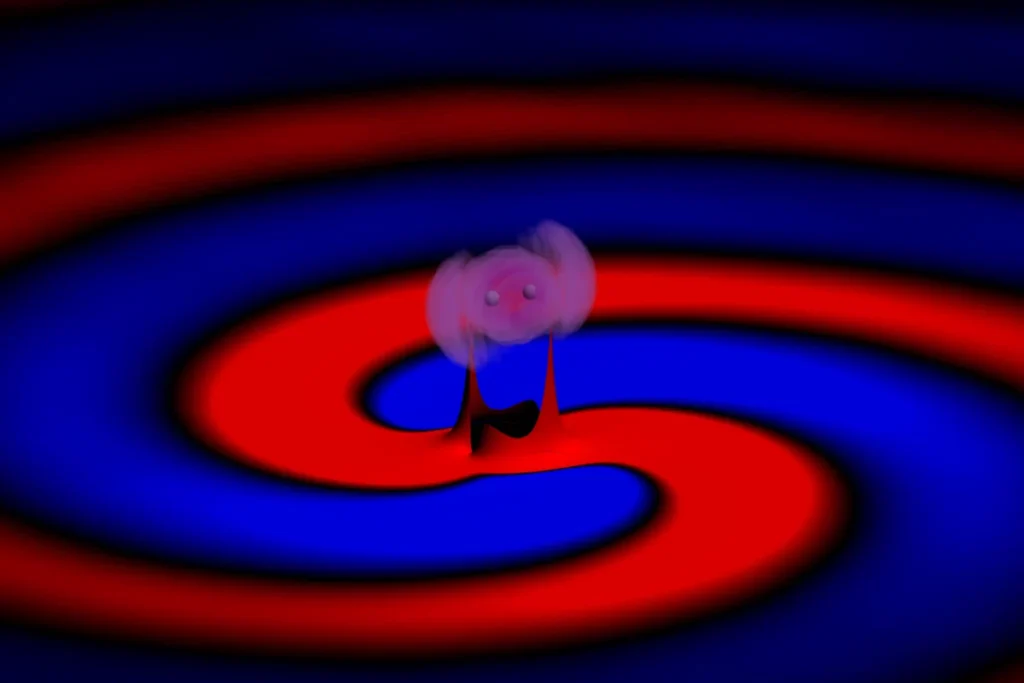
The mysterious nature of dark matter, an invisible substance that constitutes approximately 85 percent of the total matter in the universe, has long remained one of the most profound enigmas in modern physics. While it does not emit, absorb, or reflect light, its presence is inferred through its gravitational influence on visible matter. Now, a groundbreaking study led by researchers at the Massachusetts Institute of Technology (MIT) and several European institutions has introduced a sophisticated method to identify potential imprints of dark matter within the gravitational waves generated by colliding black holes. This research, published in the journal Physical Review Letters, suggests that the ripple-like distortions in spacetime captured by Earth-based observatories may hold the key to finally "seeing" the effects of this elusive substance.
By developing a predictive model that distinguishes between black hole mergers occurring in a vacuum and those occurring within a dense environment of dark matter, the team has opened a new frontier in the field of gravitational-wave astronomy. Their analysis of existing data has already yielded a provocative result: while most recorded signals align with vacuum-based models, one specific event, known as GW190728, exhibits characteristics that are consistent with the presence of a dark matter environment.
The Invisible Architect: Understanding Dark Matter and Gravity
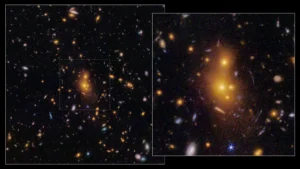
To understand the significance of this new methodology, one must first consider the unique challenges posed by dark matter. Unlike the baryonic matter that makes up stars, planets, and humans, dark matter is entirely transparent to the electromagnetic spectrum. It does not interact with light, magnetic fields, or electric charges. For decades, the primary evidence for its existence has come from large-scale cosmic observations, such as the rotation curves of galaxies and the phenomenon of gravitational lensing—where the gravity of a massive object bends light from a more distant source.
Physicists have proposed various candidates for dark matter, ranging from Weakly Interacting Massive Particles (WIMPs) to more exotic "light scalar" particles. These light scalar particles are theorized to be many orders of magnitude lighter than an electron. A key prediction of certain quantum mechanical models is that when these light particles encounter a rapidly rotating black hole, they do not merely fall in. Instead, through a process known as superradiance, the black hole’s rotational energy is transferred to the dark matter field, causing the particles to cluster into extremely dense, wave-like clouds around the black hole.
This "churning" effect creates a localized environment of high-density dark matter. When two such black holes spiral toward each other and eventually merge, they must plow through this dense medium. This interaction should, in theory, alter the frequency and shape of the resulting gravitational waves, leaving a distinct "imprint" that differs from the signals produced by a merger in empty space.
The Development of the Waveform Model
The research team, which included scientists from MIT, the Université Catholique de Louvain (UCLouvain) in Belgium, the University of Amsterdam, Queen Mary University of London, and Oxford University, set out to quantify exactly what these imprints would look like. Led by Josu Aurrekoetxea, a postdoctoral researcher at MIT, the team utilized advanced numerical simulations to model the dynamics of "black hole binaries"—pairs of black holes orbiting each other—within dark matter environments.
The simulations accounted for a vast array of variables, including:
- The individual masses and spin rates of the black holes.
- The density and distribution of the surrounding dark matter cloud.
- The distance the gravitational waves would travel across the expanding universe before reaching detectors on Earth.
The result was a comprehensive library of predicted gravitational waveforms. By comparing these theoretical "dark matter" waveforms against the "vacuum" waveforms typically used by observatories, the researchers created a screening tool capable of identifying subtle deviations in the signals recorded by the LIGO-Virgo-KAGRA (LVK) collaboration.
A Chronology of Discovery: Analyzing the LVK Data
The LVK network consists of several high-precision interferometers: the two LIGO detectors in the United States (Hanford and Livingston), the Virgo detector in Italy, and the KAGRA detector in Japan. Since the first historic detection of gravitational waves in 2015, these observatories have completed three major observing runs (O1, O2, and O3), cataloging dozens of binary mergers.
The research team applied their new model to the publicly available data from these first three runs. Their methodology involved several distinct phases:
- Signal Selection: The team identified the 28 clearest and most robust gravitational-wave signals from the hundreds of events recorded. Clarity was essential to ensure that any detected deviations were not merely the result of instrumental noise.
- Comparative Analysis: For each of the 28 events, the team performed a statistical comparison. They tested how well the observed signal fit the standard vacuum model versus how well it fit their new dark matter model.
- Validation: Most signals—27 out of the 28—showed a clear preference for the vacuum model, confirming the prevailing theories regarding the majority of black hole mergers detected thus far.
However, the analysis of event GW190728 provided a different result. Detected on July 28, 2019, during the third observing run, GW190728 was initially identified as the merger of two black holes with a combined mass roughly 20 times that of the sun. The team’s analysis revealed that this specific signal showed a statistical preference for the dark matter model over the vacuum model.
The Case of GW190728: Potential Evidence or Statistical Anomaly?
The preference for the dark matter model in the case of GW190728 represents a significant milestone, though the researchers are careful to maintain scientific rigor. Josu Aurrekoetxea noted that while the signal aligns with the team’s predictions for a dark matter imprint, the statistical significance is not yet high enough to declare a formal discovery of dark matter.
"The statistical significance of this is not high enough to claim a detection of dark matter, and further checks should be performed by independent groups," Aurrekoetxea stated. He emphasized that the primary value of the study lies in proving that such effects are detectable with current technology. Without these specific waveform models, any black hole merger occurring in a dark matter-rich environment would likely be misclassified as a standard vacuum merger, potentially masking the very evidence physicists are searching for.
The event GW190728 is particularly intriguing because of its mass and spin characteristics, which theoretically make it more susceptible to the effects of dark matter superradiance. If the "imprint" is confirmed, it would provide the first direct evidence of light scalar dark matter particles and offer a new way to measure the density of dark matter in specific regions of the universe.
Technical Implications and Supporting Data
The study’s findings highlight a shift in how gravitational-wave data is interpreted. Traditionally, the search for dark matter has focused on direct detection experiments (such as underground tanks of liquid xenon) or large-scale cosmological surveys. This new approach utilizes the "near-field" environment of black holes as a natural particle accelerator.
Key data points from the study include:
- Model Accuracy: The numerical simulations utilized "numerical relativity," the most precise method for solving Einstein’s equations of general relativity, to ensure the waveforms were accurate to a high degree of precision.
- Mass Sensitivity: The researchers found that the imprints are most pronounced in black hole binaries where the masses are relatively low (around 10 to 30 solar masses), as these systems spend more time orbiting each other before the final merger, allowing more time for the dark matter cloud to influence the signal.
- Environmental Density: The model suggests that for an imprint to be visible, the dark matter density must be significantly enhanced by the black hole’s rotation—a condition that the superradiance theory specifically addresses.
Reactions from the Scientific Community
The publication of these results has sparked significant interest within the astrophysics community. Co-author Soumen Roy of UCLouvain, who spearheaded the data analysis, described the current era as a "turning point" for the field. The ability to use gravitational waves as a probe for "new physics"—theories that go beyond the Standard Model of particle physics—is a primary goal for the next generation of observatories.
Rodrigo Vicente of the University of Amsterdam, who developed the analytical model used in the study, pointed out the unique scale of this research. "We would be able to probe dark matter at scales much smaller than ever before," Vicente said. While telescopes can see the effects of dark matter on the scale of entire galaxies (thousands of light-years), gravitational waves allow scientists to probe the environment immediately surrounding a black hole (only a few hundred kilometers).
Independent researchers have noted that while the GW190728 result is "suggestive," the scientific community will require more data from the ongoing and future LVK observing runs to confirm these findings. The fourth observing run (O4), which began in 2023 with upgraded sensitivity, is expected to provide a much larger catalog of events for the team to analyze.
Future Outlook: A New Era of Gravitational-Wave Astronomy
The implications of this research extend far beyond a single event in 2019. If dark matter imprints can be systematically identified, scientists will be able to create a "map" of dark matter density across the cosmos, based on the locations of merging black holes. This would provide invaluable data for cosmologists trying to understand how dark matter influenced the formation of the first stars and galaxies.
Furthermore, this method provides a way to test different theories of what dark matter actually is. If certain types of "imprints" are never found, it could rule out specific classes of dark matter particles, such as certain masses of axions or other light scalar bosons.
The work, supported by the U.S. National Science Foundation and MIT’s Center for Theoretical Physics, underscores the importance of interdisciplinary collaboration. By combining the expertise of general relativity experts, particle theorists, and data analysts, the team has turned the most violent events in the universe—the collision of black holes—into a precision instrument for exploring the invisible.
As the LVK detectors continue to scan the heavens, the potential for a definitive discovery grows. The next decade of gravitational-wave astronomy may not just be about finding more black holes, but about finally pulling back the veil on the dark matter that holds the universe together. For now, the "preference" shown in the signal of GW190728 stands as a tantalizing hint that the answers to some of the universe’s biggest questions may be rippling through the fabric of space and time, waiting to be decoded.