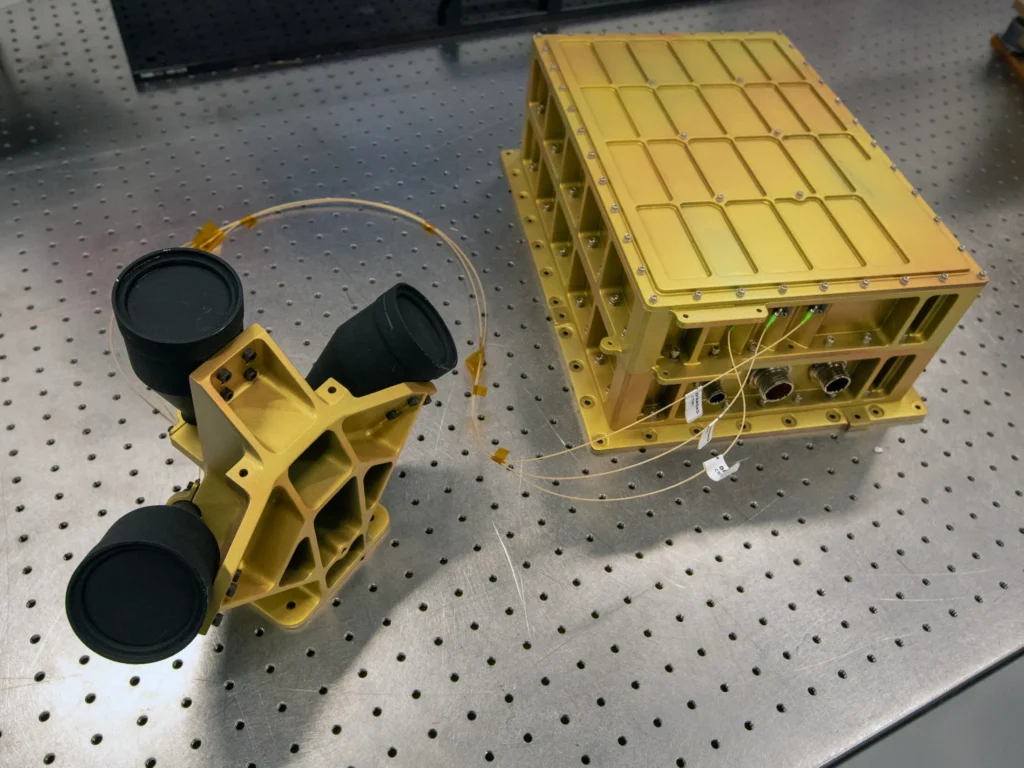
A groundbreaking NASA laser navigation system, designed to precisely guide spacecraft during their final descent to the lunar surface, has surpassed all preflight expectations, delivering "high measurement accuracy and flight validation" of velocity and altitude during its inaugural in-space demonstration in early 2024. This pivotal achievement, detailed in a NASA paper published last month in the prestigious AIAA Journal of Spacecraft and Rockets, marks a significant leap forward in lunar landing technology and holds immense promise for future deep space exploration.
The Navigation Doppler Lidar (NDL) device, a culmination of nearly two decades of dedicated research and development by Farzin Amzajerdian, a senior scientist at NASA’s Langley Research Center, performed "perfectly," according to Amzajerdian himself. "It was just beautiful watching such great quality measurements," he remarked, underscoring the exceptional data captured by the system.
A Critical Backup on an Unforeseen Journey
The NDL was initially intended to serve as a crucial backup navigation system for Intuitive Machines’ Odysseus lander, which made history in February 2024 as the first commercial lunar lander to successfully touch down on the Moon under NASA’s Commercial Lunar Payload Services (CLPS) initiative. The Odysseus mission, while ultimately experiencing a critical tip-over shortly after landing, represented a significant milestone for private lunar endeavors.
However, the mission’s trajectory took an unexpected turn during the final stages of descent. Intuitive Machines flight controllers identified that some of Odysseus’s primary navigation sensors were not functioning as intended. In a last-minute effort to salvage the landing, they attempted to integrate data from the NDL. Unfortunately, a software issue within the lander prevented it from fully utilizing the NDL’s critical real-time measurements.
Amzajerdian, in a subsequent interview, expressed his belief that the successful integration of NDL data might have averted the landing mishap. "I think it was the following Monday that they realized that the lander was on its side," Amzajerdian recounted, "And then when they looked carefully, they saw we didn’t use the NDL data." This poignant reflection highlights the potential impact of the NDL’s advanced capabilities.
Validation Amidst Challenges: A Testament to Technological Prowess
Despite the operational challenges encountered during the Odysseus landing, the NDL’s in-space demonstration is being hailed as a resounding success by Amzajerdian and his co-authors. The paper meticulously details the NDL’s performance, providing concrete evidence of its capabilities. The system was able to observe terrain features, such as craters, which were subsequently corroborated through comparisons with high-resolution digital elevation maps of the lunar surface.
The measured agreement between the lidar data and modeled measurements was exceptionally precise, falling within approximately 5 meters for altitude and 0.5 meters per second for velocity. These figures demonstrate the Navigation Doppler Lidar’s ability to produce highly accurate and reliable measurements, even in the harsh and unforgiving environment of space. This level of precision is paramount for future lunar missions, particularly those involving complex landings in challenging terrains.
Paving the Way for Artemis and Beyond
The successful demonstration of the NDL is not merely a technical achievement; it is a foundational step towards enabling NASA’s ambitious Artemis program, which aims to establish a sustainable human presence on the Moon. The NDL’s ability to provide accurate and reliable navigation data is critical for the safe and precise landings required for astronaut missions, scientific outposts, and the development of lunar infrastructure.
Furthermore, the NDL’s performance has been instrumental in fostering the development of a commercial lunar market. Tim Crain, Chief Technology Officer at Intuitive Machines, acknowledged this impact in an emailed statement provided by the company: "The 2024 demonstration inspired development of a commercial market. We now see vendors who have commercialized this technology or have been inspired by its success to develop similar sensors using different modalities of laser light measurements." This indicates a growing ecosystem of lunar landing technologies, driven in part by NASA’s pioneering efforts.
A Timeline of Lunar Navigation Advancements
The journey of the NDL technology can be traced back to its initial conceptualization by Amzajerdian approximately 20 years ago. The subsequent years were dedicated to rigorous research, development, and testing.
- Early 2000s: Initial research and development of Doppler lidar technology for terrestrial applications and potential spaceflight.
- 2016: NASA licenses the NDL technology to Psionic, a Virginia-based company, marking a significant step towards commercialization and the development of more compact and lighter versions.
- February 2024: The NDL’s first in-space demonstration occurs aboard the Intuitive Machines Odysseus lander during its inaugural CLPS mission. Despite a software issue preventing full utilization, the system captures valuable, high-accuracy data.
- Last Month: NASA publishes a paper in the AIAA Journal of Spacecraft and Rockets detailing the NDL’s successful performance and the implications of its first in-space demonstration.
- This Year (2024): The next flight of an NDL device is slated to occur on Astrobotic’s first Griffin lander.
- Late 2026: Astrobotic targets the launch of its Griffin lander, providing another opportunity for NDL validation.
- Next Year (2025): Intuitive Machines plans to fly its own laser navigation payload, named LUNA, on its IM-4 mission, demonstrating a continued commitment to laser-based lunar navigation.
Future Missions and Technological Evolution
The NDL’s success is not a solitary event but part of a broader, evolving landscape of lunar navigation technologies. The next iteration of the NDL is scheduled to embark on another lunar journey this year, carried aboard Astrobotic’s first Griffin lander. Astrobotic has indicated that the launch is targeted for "late 2026." This upcoming mission will provide another critical opportunity to validate the NDL’s performance in a different lunar landing scenario.
Furthermore, the impact of the NDL is already resonating within the commercial space sector. Intuitive Machines is actively developing its own laser navigation payload, codenamed LUNA, which is slated to be integrated into the company’s IM-4 mission scheduled for next year. This demonstrates a clear trajectory towards the adoption and further development of laser-based navigation solutions for lunar exploration.
While the current NDL is not designed for hazard detection, such as identifying boulders or craters, NASA is simultaneously developing separate lidar instruments specifically for these critical tasks. This parallel development ensures a comprehensive suite of navigation and hazard avoidance capabilities for future lunar missions.
The Advantage of the Lunar Environment for Lidar
The Moon’s extremely thin atmosphere presents a significant advantage for lidar technology. Unlike Earth, where clouds and atmospheric vapor can interfere with laser beams, the lunar environment allows for unobstructed operation. Lidar, an acronym for light detection and ranging, utilizes laser pulses and their reflections to precisely measure distances to objects. Doppler lidar, a more advanced form, can also determine whether the distance between the lidar and the object is increasing or decreasing, a crucial metric for landing.
Compared to radar systems, lidar offers superior performance on celestial bodies like Mars and the Moon. Amzajerdian highlighted this advantage, stating, "performance is better, and it can potentially reduce the mission cost because it’s much easier to integrate it into the vehicle." This cost-effectiveness and enhanced capability make lidar an increasingly attractive option for deep space navigation.
Broader Implications for Space Exploration
The successful demonstration of the Navigation Doppler Lidar represents more than just a technological triumph; it signifies a crucial step towards enabling more ambitious and complex lunar missions. The ability to land spacecraft with unprecedented precision is fundamental for:
- Scientific Exploration: Allowing for the deployment of sensitive scientific instruments in precise locations, maximizing data collection and discovery.
- Resource Utilization: Facilitating the landing of missions designed to extract resources like water ice, which is critical for future lunar bases and deep space travel.
- Human Habitation: Ensuring the safe and reliable landing of crewed missions, a prerequisite for establishing sustainable human settlements on the Moon.
- Commercial Lunar Economy: Lowering the barriers to entry for commercial entities developing lunar services, from cargo delivery to resource prospecting.
The NDL’s journey from a concept to a validated in-space system underscores NASA’s commitment to innovation and its strategic vision for lunar exploration. As humanity sets its sights on a sustained presence on the Moon and beyond, technologies like the Navigation Doppler Lidar will undoubtedly play a pivotal role in making those aspirations a reality. The data collected and the lessons learned from this initial demonstration will inform the design and deployment of future lunar landers, paving the way for a new era of lunar exploration and discovery. The future of lunar landings is becoming increasingly precise, thanks to the illuminating power of laser technology.