In a landmark study published in the prestigious journal Physical Review Letters, an international team of physicists has announced the successful theoretical and experimental identification of a novel class of quantum states known as "fractional Fermi seas." This breakthrough, spearheaded by the Nägerl group at the University of Innsbruck in collaboration with theoretical physicist Alvise Bastianello of the Centre National de la Recherche Scientifique (CNRS) and Université Paris-Dauphine, represents a significant leap forward in our understanding of many-body quantum systems. The research details the emergence of a new critical phase of matter that manifests when quantum particles are subjected to extreme, non-equilibrium conditions, effectively bypassing the constraints of long-standing physical theories.
The study centers on the behavior of ultracold atoms confined to a one-dimensional space, a setting where the laws of physics often diverge from the three-dimensional world we inhabit. By manipulating the interaction strengths between these particles through a process of continuous cycling, the researchers observed the formation of a state that defies the predictions of the Tomonaga-Luttinger liquid theory. For decades, this theory has served as the bedrock for understanding one-dimensional quantum fluids, but the discovery of the fractional Fermi sea suggests that the landscape of quantum matter is far more complex and versatile than previously imagined.
The Foundation of One-Dimensional Quantum Physics
To appreciate the significance of this discovery, one must first understand the behavior of particles in a quantum environment. In the macroscopic world, particles like billiard balls can move past one another or collide and bounce away. However, in the quantum realm—and particularly in one dimension—particles are restricted. Imagine a line of people in a narrow hallway; if one person moves, the entire line must respond. This collective behavior is the hallmark of one-dimensional quantum systems.
Typically, particles such as fermions (a category that includes electrons and certain types of atoms) obey the Pauli exclusion principle, which dictates that no two fermions can occupy the same quantum state simultaneously. At temperatures approaching absolute zero, these particles stack into energy levels from the lowest available state upward, much like water filling a container. This stacked configuration is known as the "Fermi sea." The surface of this "sea" represents the highest energy state occupied by the particles, known as the Fermi level.
For over half a century, the Tomonaga-Luttinger liquid (TLL) theory has been the primary framework used to describe these systems. TLL theory suggests that in one dimension, the individual identities of particles are lost, replaced by collective excitations that behave like waves. While TLL theory has been remarkably successful in predicting the properties of metals, superconductors, and carbon nanotubes, it primarily describes systems in or near a state of equilibrium. The new research from the Nägerl group ventures into the "non-equilibrium" frontier, where systems are actively driven and manipulated.
The Interaction Cycle: Forcing Matter into New States
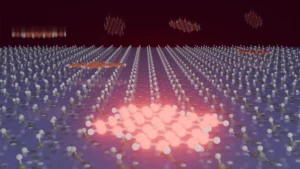
The experimental breakthrough was achieved using a sophisticated setup involving ultracold cesium atoms. These atoms are cooled to temperatures just a fraction of a degree above absolute zero, where their quantum nature becomes dominant. Using laser-based "optical lattices," the researchers trapped the atoms in one-dimensional tubes, effectively stripping away two dimensions of movement.
The core of the experiment involved what the researchers describe as an interaction cycle. By utilizing a phenomenon known as Feshbach resonance—a tool that allows physicists to tune the interaction between atoms using an external magnetic field—the team repeatedly and rapidly altered how the cesium atoms perceived one another. The atoms were shifted from a state of strong repulsion, where they push each other away, to a state of strong attraction, where they tend to clump together.
"Fermions, for instance, stack neatly into the available energy states to form the so-called ‘Fermi sea,’" explains Alvise Bastianello. "But what happens if one forces interacting atoms to continuously cycle through extreme conditions, smoothly shifting them from strongly repelling each other to strongly attracting each other?"
The result was not the chaotic heating or disintegration of the system that one might expect from such violent manipulation. Instead, the interaction cycle drove the atoms into a highly excited but remarkably stable and organized configuration. This state is what the researchers have termed the "fractional Fermi sea."
Characteristics of the Fractional Fermi Sea
The fractional Fermi sea is distinguished by a "reduced occupancy rule." In a standard Fermi sea, each energy state is either fully occupied or empty. In this new state, however, the particles appear to occupy states in a fractional manner, as if the fundamental rules of fermionic stacking have been rewritten.
Yi Zeng, the lead author of the study, notes that this process is fundamentally different from simply adding energy to a system. "Instead of simply heating the system, the interaction cycle reorganizes the atoms into a new many-body state," Zeng says. "This gives us a controlled way to explore quantum matter beyond the usual equilibrium paradigms."
Several unique physical signatures define this new phase:
- Friedel Oscillations: The researchers observed pronounced ripples in the density of the particles, known as Friedel oscillations. These oscillations are a signature of how quantum particles respond to boundaries or impurities, but in the fractional Fermi sea, they exhibit patterns that do not align with standard TLL predictions.
- Distinctive Decay Behavior: In typical quantum states, correlations between particles decay over distance following specific mathematical laws. The fractional Fermi sea shows a unique decay behavior across all levels of repulsive interaction, signaling a departure from known phases.
- Hidden Order: Despite being a highly excited state—meaning it possesses much more energy than the ground state—the fractional Fermi sea is not random. It possesses a "hidden order" that only becomes visible when analyzing the mathematical correlations between the particles.
Hanns-Christoph Nägerl, the group leader at the Department of Experimental Physics at the University of Innsbruck, emphasized the novelty of the state. "This state is highly excited, but it is not random," he says. "It has a hidden order that becomes visible in its correlations." He even suggested that the particles within this state might be viewed as a new type of quasiparticle, tentatively dubbed "super-Fermions."
Chronology and Collaborative Effort
The discovery is the culmination of years of research into ultracold atom dynamics. The Innsbruck group has long been a leader in the field of quantum simulation, using cold atoms to mimic complex physical systems that are otherwise impossible to calculate or observe directly.
The timeline of this specific discovery began with theoretical models developed by Alvise Bastianello, who sought to understand how one-dimensional systems react to periodic driving. The collaboration with the Nägerl group allowed these theoretical predictions to be tested against experimental reality. The work published in Physical Review Letters provides the essential theoretical framework, while a companion paper—currently under peer review—describes the physical experimental realization of the state.
This two-pronged approach—matching rigorous mathematical theory with high-precision experimental physics—is what allowed the team to confirm that they had indeed found a new critical phase rather than a transient experimental artifact.
Supporting Data and Technical Analysis
The researchers utilized a combination of Bethe ansatz calculations and numerical simulations to support their findings. The Bethe ansatz is a mathematical tool used to find exact solutions for certain one-dimensional quantum models. By applying this to the interaction-cycled system, the team was able to demonstrate that the fractional occupancy of the energy states was a stable, reproducible feature of the system.
Data from the study suggests that the fractional Fermi sea exists as a "critical phase." In physics, a critical phase is one where the system is on the verge of a phase transition, and its properties are characterized by universal scaling laws. The discovery that a non-equilibrium, driven system can settle into such a phase is a major revelation for the field of statistical mechanics. It suggests that "universality"—the idea that different physical systems can exhibit the same fundamental behavior—extends far into the realm of driven quantum matter.
Broader Implications and Future Research
The discovery of the fractional Fermi sea has profound implications for the future of quantum science. First and foremost, it proves that cold-atom simulators are capable of more than just replicating known physics; they can be used as "discovery engines" to find states of matter that have no equivalent in nature.
In the realm of materials science, understanding how to control and organize highly excited quantum states could eventually lead to the development of new materials with exotic electronic or magnetic properties. For example, the "super-Fermions" mentioned by Nägerl could theoretically possess transport properties that are more efficient than those of standard electrons in a wire.
Furthermore, the research provides a new playground for quantum computing and information. Highly organized, non-equilibrium states are often more robust against certain types of noise, which is the primary obstacle to building functional quantum computers. By exploring the "hidden order" of the fractional Fermi sea, scientists may find new ways to encode or protect quantum information.
"The discovery of fractional Fermi seas shows how far we can push quantum simulation," says Hanns-Christoph Nägerl. "Not only reproducing known models, but creating and probing states that go beyond established paradigms."
As the scientific community awaits the publication of the companion experimental paper, the current study stands as a testament to the power of non-equilibrium physics. It challenges the notion that systems must be at rest to be understood and opens a new chapter in the study of the quantum world, where movement and constant change are the keys to discovering the next frontier of matter.