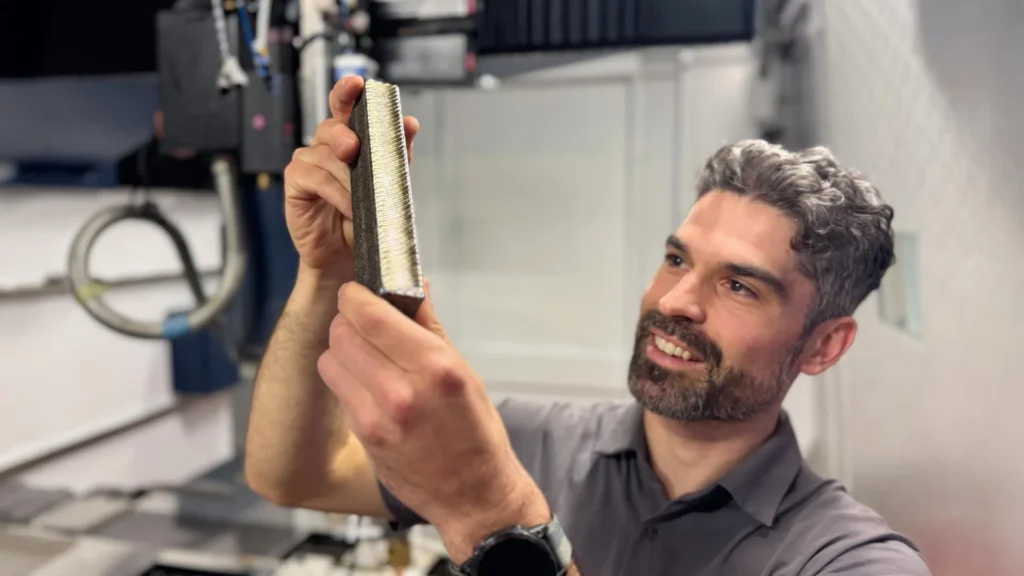
Engineers from RMIT University in Australia have achieved a significant breakthrough in additive manufacturing with the development of a novel 3D-printable titanium alloy that is approximately one-third cheaper than commonly used titanium alloys. This innovative material not only addresses cost barriers but also demonstrates enhanced mechanical properties, paving the way for broader adoption of 3D printing in critical sectors like aerospace and medical devices.
A Paradigm Shift in Titanium Alloys for Additive Manufacturing
The research, spearheaded by RMIT’s Centre for Additive Manufacturing (RCAM), centers on a strategic reformulation of titanium alloys, a departure from the long-standing reliance on established compositions like Ti-6Al-4V. This traditional alloy, while proven, presents limitations that hinder the full exploitation of 3D printing’s potential. The RMIT team’s approach involves replacing the increasingly expensive element vanadium with more readily available and cost-effective alternatives. This fundamental change has resulted in a material that is not only more economical to produce but also exhibits superior strength and performance characteristics.
The significance of this development lies in its potential to democratize access to high-performance 3D-printed titanium components. For decades, the aerospace and medical industries have recognized the advantages of titanium, including its exceptional strength-to-weight ratio, biocompatibility, and corrosion resistance. However, the cost of manufacturing with titanium, particularly through advanced methods like 3D printing, has been a considerable hurdle. The RMIT alloy aims to dismantle this barrier, offering a compelling value proposition without compromising on quality.
RMIT has proactively secured its intellectual property by filing a provisional patent on this innovative approach. The findings have also been meticulously documented and published in the prestigious scientific journal, Nature Communications, underscoring the rigor and scientific merit of the research. The university is actively exploring commercialization avenues, engaging with industry stakeholders to bring this transformative technology to market.
Addressing the Limitations of Legacy Alloys
Ryan Brooke, a PhD candidate at RCAM and the lead author of the study, articulated the driving force behind this research. He emphasized that while 3D printing technology has advanced rapidly, offering faster, less wasteful, and more customizable production methods, the industry has been constrained by the use of legacy alloys. "3D printing allows faster, less wasteful and more tailorable production yet we’re still relying on legacy alloys like Ti-6Al-4V that doesn’t allow full capitalization of this potential," Brooke explained. He drew an insightful analogy: "It’s like we’ve created an aeroplane and are still just driving it around the streets."
The implication of this analogy is profound. The inherent capabilities of 3D printing – its ability to create complex geometries, reduce material waste, and enable on-demand manufacturing – are not being fully leveraged when paired with older, less adaptable alloy compositions. The RMIT innovation seeks to unlock this latent potential. "New types of titanium and other alloys will allow us to really push the boundaries of what’s possible with 3D printing and the framework for designing new alloys outlined in our study is a significant step in that direction," Brooke added.
A Novel Framework for Alloy Design and Printing
Central to the RMIT team’s success is the development of a novel, time- and cost-saving methodology for selecting elements for alloying. This framework is specifically designed to capitalize on the unique capabilities of emerging 3D-printing technologies. The research provides a clearer, more predictable model for understanding and controlling the printed grain structure of metallic alloys in additive manufacturing. This is a critical aspect, as the microstructure of a material dictates its mechanical properties.
The practical outcome of this framework is already impressive. While specific details of the alloy’s composition are being withheld for commercial reasons, the team has confirmed that it is approximately 29% cheaper to produce than standard titanium alloys. This cost reduction is a direct consequence of substituting expensive elements and streamlining the alloy development process.
Furthermore, the new alloy exhibits a more uniform printing behavior, crucially avoiding the formation of undesirable column-shaped microstructures. These columnar structures are a known cause of uneven mechanical properties in some 3D-printed alloys, leading to potential points of weakness and unpredictable performance. By eliminating this issue, the RMIT alloy promises greater consistency and reliability in manufactured components.
Brooke highlighted the dual impact of their innovation: "By developing a more cost-effective formula that avoids this columnar microstructure, we have solved two key challenges preventing widespread adoption of 3D printing." He further elaborated on his market validation efforts, which included discussions with representatives from the aerospace, automotive, and MedTech industries as part of CSIRO’s ON Prime program. The feedback from these end-users was clear: incremental improvements are insufficient; a "full leap forward" is required to justify the transition to new materials and manufacturing processes. The RMIT alloy, he stated, delivers precisely that.
"What I heard loud and clear from end users was that to bring new alloys to market, the benefits have to not just be minor incremental steps but a full leap forward, and that’s what we have achieved here," Brooke reiterated. The alloy not only boasts a uniform grain structure and reduced production costs but also offers enhanced strength and ductility, a combination of properties that makes it exceptionally versatile.
The Path Forward: Collaboration and Commercialization
Professor Mark Easton, the corresponding author of the study and a key figure at RCAM, expressed enthusiasm for the future prospects of the new alloy. He emphasized that realizing the full potential of this breakthrough necessitates a collaborative effort across the entire supply chain. "We are very excited about the prospects of this new alloy, but it requires a team from across the supply chain to make it successful. So, we are looking for partners to provide guidance for the next stages of development," Professor Easton stated.
The successful production and testing of the alloy samples were conducted at RMIT’s state-of-the-art Advanced Manufacturing Precinct, a testament to the university’s commitment to cutting-edge research and development in additive manufacturing. This facility provides the infrastructure and expertise necessary to translate laboratory discoveries into tangible, market-ready solutions.
Background Context: The Rise of Additive Manufacturing and Titanium’s Role
Additive manufacturing, commonly known as 3D printing, has revolutionized how complex parts are designed and produced. Unlike traditional subtractive manufacturing methods that remove material from a larger block, 3D printing builds objects layer by layer from digital designs. This process offers unparalleled design freedom, enabling the creation of intricate geometries that were previously impossible or prohibitively expensive to manufacture.
Titanium and its alloys have long been a material of choice for demanding applications due to their exceptional properties. In aerospace, titanium is used extensively in aircraft engines, airframes, and landing gear, where its high strength and low density contribute to fuel efficiency and performance. The medical field values titanium for its biocompatibility, making it ideal for implants such as hip and knee replacements, dental implants, and surgical instruments.
However, the widespread adoption of titanium in 3D printing has been hampered by several factors. The cost of titanium powder, a key feedstock for 3D printing, is significant. Furthermore, traditional titanium alloys often require high processing temperatures and can be prone to defects during the printing process, such as porosity and cracking, which compromise the structural integrity of the final part. The development of new alloys that are more amenable to 3D printing processes, while maintaining or enhancing performance, has been a critical research objective.
Chronology of Development and Publication
While the precise timeline of the RMIT research is not detailed in the provided text, the publication in Nature Communications indicates a rigorous peer-review process, suggesting that the research has been underway for a considerable period. The filing of a provisional patent further signifies a commitment to commercialization, often pursued once a core innovation has been demonstrated and validated. The mention of Ryan Brooke completing market validation as part of CSIRO’s ON Prime program suggests that this stage of the research has recently concluded, marking a transition towards potential industrial partnerships.
Supporting Data and Performance Metrics
The RMIT team has reported several key performance indicators for their new alloy:
- Cost Reduction: Approximately 33% cheaper to produce than standard 3D-printed titanium alloys.
- Improved Strength and Performance: Demonstrated superior mechanical properties compared to Ti-6Al-4V.
- Uniform Grain Structure: Avoids the formation of problematic columnar microstructures, leading to more consistent mechanical properties.
- Enhanced Ductility: The alloy is reported to be more ductile, meaning it can deform under tensile stress without fracturing, a valuable property for many applications.
While the specific numerical values for strength and ductility are not provided in the original text, the qualitative descriptions and the comparison to industry standards like Ti-6Al-4V are compelling. The 29% cost saving is a significant figure that directly addresses a major industry concern.
Broader Impact and Implications
The development of a cheaper, stronger, and more reliably printable titanium alloy has far-reaching implications across multiple sectors:
- Aerospace Industry: Reduced component costs could lead to lighter, more fuel-efficient aircraft. The ability to print complex, optimized parts on-demand could also streamline manufacturing and maintenance processes. This could be particularly impactful for next-generation aircraft designs and satellite components.
- Medical Device Industry: Lower manufacturing costs for titanium implants could make advanced medical treatments more accessible. The enhanced properties could also lead to longer-lasting and more reliable implants, improving patient outcomes. The precision offered by 3D printing also allows for patient-specific implants, tailored to individual anatomy.
- Automotive Sector: While not explicitly highlighted as a primary target, the cost-effectiveness and performance benefits could find applications in high-performance vehicles, particularly in areas where weight reduction and strength are critical.
- Research and Development: The framework developed by RMIT for alloy design could accelerate the discovery and development of new metallic materials for additive manufacturing, pushing the boundaries of what is possible with 3D printing across various material types.
The success of this RMIT innovation underscores the ongoing evolution of additive manufacturing. As researchers continue to develop novel materials and processes, 3D printing is poised to move beyond its current niche applications and become a mainstream manufacturing technology capable of producing high-value, complex components at scale. The RMIT team’s work represents a crucial step in realizing this future, making advanced materials more accessible and enabling a new generation of engineered products. The university’s proactive approach to patenting and seeking commercial partners signals a clear intent to translate this scientific achievement into tangible industrial benefits.