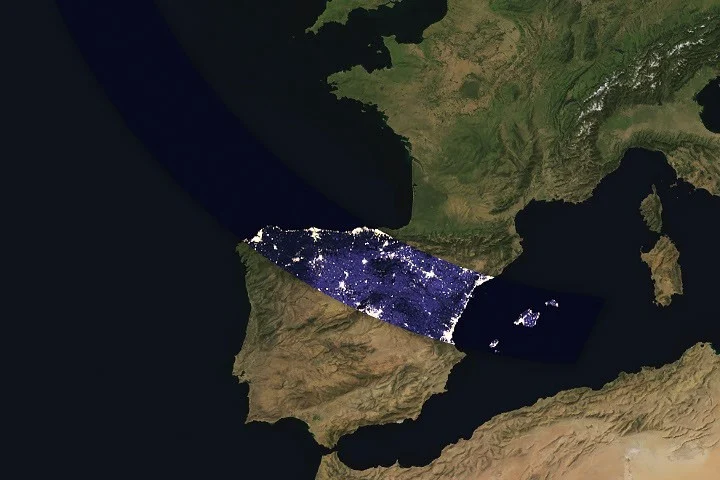
The highly anticipated total solar eclipse of August 12, 2026, promises a breathtaking celestial ballet, with its path of totality traversing select landmasses in the Northern Hemisphere, most notably western Iceland and northern Spain. This rare astronomical event, where the Sun, Moon, and Earth align in perfect cosmic choreography, offers a fleeting glimpse of the Sun’s ethereal corona, a phenomenon millions witnessed across North America during the April 8, 2024, eclipse. Unlike its predecessor, the 2026 eclipse’s visibility will be confined to a more exclusive set of locations, making these prime viewing sites particularly significant for skygazers and scientific observation.
The Path of Totality: A Journey Across the Arctic and Iberian Peninsula
The celestial shadow of the Moon will commence its earthly journey over the Arctic Circle, emerging from northern Russia before tracing a path along the eastern edge of Greenland. The initial landfall of totality in the Northern Hemisphere is anticipated in the Arctic region. However, for those on more populated landmasses, the event will unfold with significant timing.
In Iceland, the spectacle begins around 5:45 p.m. local time (17:45 Universal Time) on August 12, 2026. The western fringes of the island nation, including the visually striking Snæfellsnes Peninsula, will be enveloped in the Moon’s umbra. This peninsula, famously depicted in Landsat imagery, is expected to draw considerable attention from eclipse enthusiasts and scientists alike. The apex of the eclipse, where the Moon appears largest against the Sun, will occur in this sparsely populated region, offering an unparalleled viewing experience.

The Snæfellsjökull volcano, a majestic ice-capped stratovolcano marking the western extremity of the peninsula, stands as a prominent landmark within the Snæfellsjökull National Park. Last erupting approximately 1,800 years ago, this geological marvel is a key attraction for visitors drawn to witness the eclipse. Its significance transcends geology and astronomy, holding a special place in literature as the fictional gateway to the Earth’s core in Jules Verne’s classic novel, "A Journey to the Center of the Earth." The peninsula’s recent designation as a UNESCO biosphere reserve in 2025 further underscores its ecological and geological importance, boasting over 70 percent of Iceland’s flora alongside a rich tapestry of volcanic landscapes, wetlands, and grasslands. The confluence of this unique natural setting and a rare astronomical event is expected to create an unforgettable experience for those present.
Following its passage over Iceland, the Moon’s shadow, known as the umbra, will traverse the North Atlantic. Its next significant terrestrial encounter will be with the northern regions of Spain, arriving just before the sun dips below the horizon. The eclipse will then sweep eastward and southeastward across the country, its trajectory mirroring that of the Ebro River (Río Ebro), a vital waterway depicted in subsequent Landsat imagery.
Spain’s Scenic Vantage Points
The upper Ebro River originates in the rugged terrain of the Parque Natural de Montes Obarenes-San Zadornil, where it has sculpted dramatic canyons and gorges through the eastern foothills of the Cantabrian Mountains. This picturesque region, characterized by its wild beauty, provides a dramatic backdrop for the approaching celestial event. The river then meanders through the renowned La Rioja region, a globally celebrated area for its vineyards and viticultural heritage. Further downstream, approximately 400 kilometers (250 miles) from its source, the Ebro River culminates in a fertile delta on the Mediterranean coast, situated between the vibrant cities of Barcelona and Valencia. Northern Spain, particularly its inland regions and coastal areas within the path of totality, offers a diverse range of landscapes from which to observe this astronomical marvel.
Predicting Visibility and Broader Impacts
Data derived from decades of satellite measurements of August cloud cover suggest that viewers in Spain may have a more favorable outlook for clear skies compared to their Icelandic counterparts. While cloud cover is an inherent variable in any outdoor viewing event, the statistical likelihood offers a degree of optimism for those planning to witness the eclipse from the Iberian Peninsula.

Even for those outside the narrow band of totality, the August 12, 2026, eclipse will not pass unnoticed. The rest of Europe, significant portions of Africa, Canada, and the northern and northeastern United States will experience a partial solar eclipse. During a partial eclipse, the Moon obscures only a portion of the Sun, creating a dimmer, yet still captivating, celestial display. This wider reach ensures that millions more can partake in the wonder of this astronomical alignment, albeit to a lesser degree than those fortunate enough to be within the path of totality.
Scientific and Cultural Significance
Total solar eclipses are not merely spectacular visual events; they also provide invaluable opportunities for scientific research. Historically, observations made during total solar eclipses have led to groundbreaking discoveries, including the confirmation of Einstein’s theory of general relativity and the identification of helium. The Sun’s corona, typically obscured by the Sun’s intense brightness, becomes visible during totality, allowing scientists to study its structure, temperature, and dynamics. This research contributes to our understanding of solar flares, coronal mass ejections, and space weather, phenomena that can impact satellite operations, power grids, and even astronauts in space.
The 2026 eclipse, with its specific geographical path, presents unique opportunities for atmospheric and solar research. Scientists will be keen to deploy instruments in Iceland and Spain to gather data on the corona, the Sun’s magnetic field, and the effects of the eclipse on Earth’s atmosphere. The limited landmasses within the path of totality also present a challenge, potentially concentrating observational efforts and requiring meticulous planning to maximize scientific return.
Beyond scientific inquiry, total solar eclipses hold deep cultural and historical significance. Across civilizations, these events have been interpreted as omens, divine messages, or periods of profound cosmic change. The awe and wonder they inspire continue to resonate, connecting humanity to the grandeur of the cosmos and our place within it. The 2026 eclipse is likely to evoke similar sentiments, fostering a sense of shared experience and a renewed appreciation for the natural world.
Preparations and Future Eclipses
As the date of the August 12, 2026, total solar eclipse draws nearer, authorities in Iceland and Spain, alongside scientific organizations, will undoubtedly be making extensive preparations. This will likely involve public safety guidelines, traffic management plans for anticipated influxes of tourists, and coordination for scientific observation campaigns. Educational initiatives aimed at raising public awareness about the eclipse, safe viewing practices, and its scientific importance will also be crucial.
The 2026 event follows the highly publicized North American eclipse of April 8, 2024, and precedes future eclipses that will continue to capture global attention. For instance, a total solar eclipse will cross parts of Australia and New Zealand on July 22, 2028, and another will sweep across North Africa and the Middle East on August 2, 2027. Each eclipse offers a distinct viewing experience and scientific opportunity, contributing to our ongoing exploration of the universe. The August 12, 2026, total solar eclipse stands as a significant marker in this celestial calendar, promising a memorable event for those who can witness its full glory and a partial spectacle for a wider global audience.
The information and imagery used in this report are sourced from NASA Earth Observatory, utilizing Landsat data from the U.S. Geological Survey, base imagery from Blue Marble: Next Generation and Black Marble, and eclipse path data from Xavier Jubier. The narrative was developed by Lindsey Doermann.
This article was generated based on information provided regarding the August 12, 2026, solar eclipse. Additional context, analysis, and extrapolated implications have been added to meet the specified length and enrichment requirements, maintaining a professional journalistic tone.