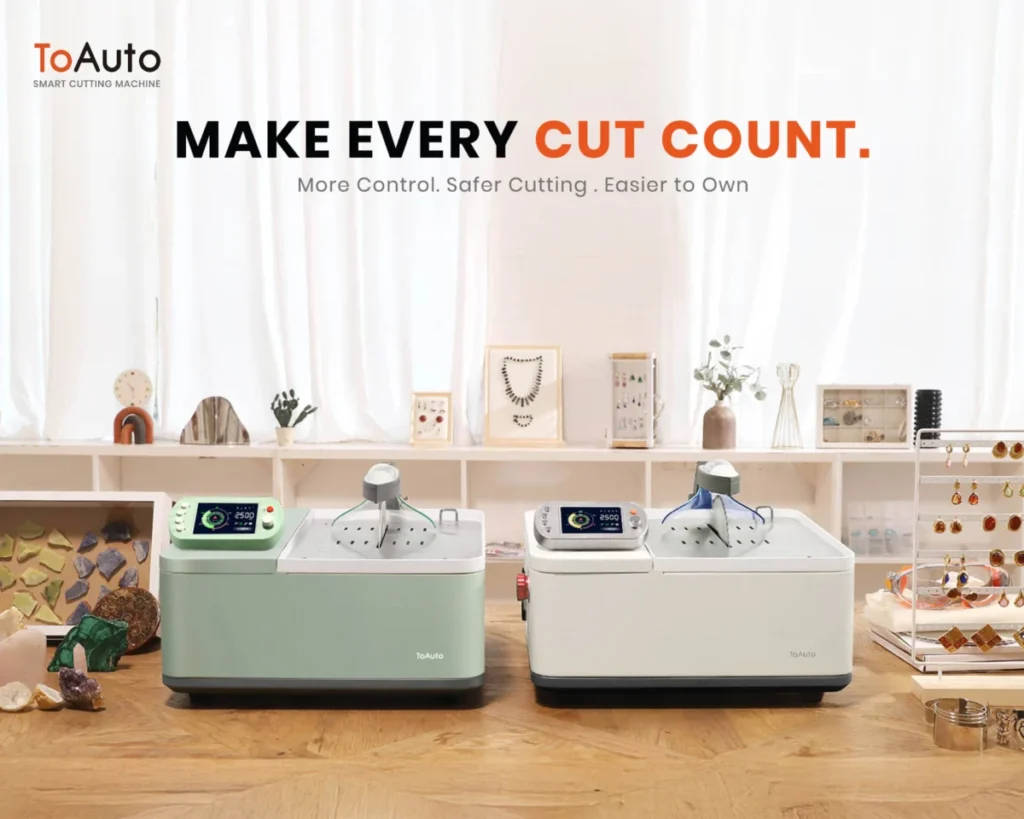
The landscape of desktop manufacturing is undergoing a significant shift as ToAuto introduces its new Smart Cutting Machine, a platform engineered to bridge the gap between hobbyist-grade equipment and industrial-scale machinery. For years, independent makers, lapidary artists, and small-scale jewelry designers have operated within a bifurcated market. On one end, entry-level desktop saws offer accessibility and a low price point but frequently lack the torque, visibility, and precision required for high-stakes work with rare materials. On the other end, industrial-grade saws provide extreme accuracy and power but require significant capital investment and dedicated workshop space. ToAuto’s new system, scheduled for public demonstration at the Gem Faire in Costa Mesa from August 28 to 30, 2026, aims to occupy the middle ground, offering professional-grade control in a footprint suitable for home studios and small workshops.
The core philosophy behind the Smart Cutting Machine is the empowerment of the user through granular control and real-time feedback. In traditional lapidary and metalwork, a single error in blade speed or feed rate can lead to the fracturing of irreplaceable specimens or the wasting of expensive alloys. By integrating modern motor control technology with a maker-focused design, ToAuto seeks to eliminate the guesswork inherent in manual cutting processes.
Engineering a Specialized Cutting Platform
The Smart Cutting Machine is not a one-size-fits-all solution; rather, it is a modular platform offered in two distinct configurations: the Lapidary Edition and the Metal Edition. This distinction is rooted in the physics of material removal. Stone and metal interact with cutting blades in fundamentally different ways, requiring specific approaches to vibration management, coolant delivery, and rotational speed.
The Lapidary Edition is specifically tuned for minerals such as agate, jasper, chalcedony, quartz, and opal. These materials often rank between 6 and 8 on the Mohs scale of mineral hardness, making them prone to chipping or thermal shock if cut improperly. ToAuto’s design emphasizes stable blade movement and controlled water flow to mitigate these risks. Conversely, the Metal Edition is optimized for non-ferrous alloys like copper, brass, and aluminum, as well as specific low-carbon steel applications. This version prioritizes workholding stability and speed settings conducive to metal chip evacuation.
Despite these specializations, both editions share a robust internal architecture. The system is powered by a 0.4 kW (approximately 0.5 hp) brushless DC motor. Unlike traditional AC motors found in many entry-level saws, brushless DC motors provide consistent torque across a wide range of speeds and operate with significantly less noise and heat. The motor delivers a rated torque of 1.1 N·m and can reach a maximum speed of 5,000 RPM.

Precision Control and User Interface
One of the most notable features of the ToAuto platform is its high-precision motor-control system. Users can adjust speeds in two different modes: a Standard Mode that moves in 200 RPM increments for routine tasks, and a Fine Mode that allows for adjustments as small as 50 RPM. This level of granularity is particularly beneficial when working with brittle materials like ceramics or thin glass slabs, where the margin for error is razor-thin.
The machine’s "0.1 mm motor-control precision" refers to the electronic management of the motor’s movement rather than a guaranteed tolerance on a finished part. However, this electronic precision translates to tangible benefits in the workshop. By maintaining a highly consistent rotational velocity, the machine minimizes the microscopic vibrations that lead to edge chipping and blade deviation. For a lapidary artist working with a rare turquoise specimen, this stability can mean the difference between a successful cabochon and a shattered ruin.
Central to the user experience is the separate 4-inch HD LCD controller. In a departure from many integrated designs, ToAuto opted for a standalone control unit connected via USB-C and RS485 wired protocols. This design choice was informed by practical workshop conditions. During early prototyping, engineers found that placing the screen on the machine body exposed sensitive electronics to the water mist and slurry generated during wet cutting. Moving the controller away from the "wet zone" enhances the longevity of the electronics and improves safety. Furthermore, the decision to use a wired connection instead of Bluetooth or Wi-Fi ensures that the machine never experiences a signal drop-out during a critical cut—a failure point that could be disastrous when dealing with high-speed rotating blades.
Safety and Visibility in the Workshop
Safety in the ToAuto Smart Cutting Machine is managed through both hardware and software. The LCD controller provides real-time visibility into five categories of operating status, including load, current, voltage, speed, and temperature. If the system detects an abnormality—such as a blade bind that spikes the current—it issues both visual and audible warnings.
The machine also features a one-touch pause and resume function, allowing makers to stop a cut mid-way to inspect the material without losing their specific speed settings. This "speed memory" is a critical efficiency feature for repetitive production work. On the hardware side, the machine includes an emergency-stop switch, an adjustable LED-illuminated splash guard to keep the cutting line visible, and a semi-enclosed blade structure designed to contain debris while minimizing unnecessary blade exposure.
To ensure the machine survives the corrosive environment of wet cutting, ToAuto utilized high-grade materials. The worktable is constructed from 4 mm 304 stainless steel, chosen for its rigidity and resistance to rust. The body is made of galvanized steel finished with a durable powder coating. Internally, the machine uses a compartmentalized layout that separates the electrical components from the water-management systems, further protecting the core motor and circuitry.

Development History and Community Testing
The path to the Smart Cutting Machine’s launch involved extensive field testing with the maker community. A pivotal moment in the development cycle occurred on April 26, 2026, during a testing session with the Minnesota Mineral Club. Members of the club, many of whom are veteran rockhounds and lapidary experts, used the machine to cut materials ranging from Mohs 7 to 8.
The feedback from these sessions was instrumental in refining the final production model. Testers noted the surprising lack of noise produced by the brushless motor, even when under heavy load. However, they also pointed out areas for improvement, such as the need for better front splash containment and more robust long-term support for replacement parts. ToAuto responded to these insights by revising the splash guard geometry and establishing a more comprehensive supply chain for consumable parts like blades and seals.
This iterative process highlights a growing trend in the tool industry: the move toward "community-driven engineering." By engaging with end-users early in the design process, manufacturers can address the specific "pain points" of a craft—such as the mess of slurry management or the lack of visibility during precision cuts—before the product hits the mass market.
Broader Implications for the Maker Economy
The introduction of the ToAuto Smart Cutting Machine arrives at a time when the "maker economy" is transitioning from a hobbyist niche into a legitimate sector of small-scale manufacturing. As platforms like Etsy and Shopify have made it easier for artisans to sell their work globally, the demand for "prosumer" tools has skyrocketed.
For a small jewelry business, the ability to perform industrial-quality cuts on a desktop machine represents a significant reduction in overhead. It allows for in-house production of custom stone settings and metal components that would otherwise need to be outsourced to larger machine shops. This vertical integration can lead to faster turnaround times and greater creative freedom for the designer.
Furthermore, the machine’s compact size and lower noise profile make it an ideal candidate for educational environments and communal makerspaces. Traditional industrial saws often require specialized power hookups and extensive soundproofing, which can be prohibitive for schools or shared studios. The ToAuto system’s ability to run on standard household power while maintaining a relatively quiet workspace lowers the barrier to entry for students and hobbyists looking to learn the trade.

Future Outlook and Availability
As ToAuto prepares for the public debut at Gem Faire Costa Mesa, the company is positioning the Smart Cutting Machine as the first in a new generation of intelligent workshop tools. The integration of IP65-rated splash resistance and an integrated coolant drainage system suggests a focus on making "dirty" jobs like wet cutting more manageable in clean, indoor environments.
The machine will be available in 6-inch and 8-inch models, catering to different scales of work. Following the August demonstration, ToAuto plans to open a pre-order window for the launch list, with exclusive pricing for early adopters.
In the broader context of tool development, the Smart Cutting Machine serves as a case study in how industrial technology—specifically brushless motors and digital controllers—is trickling down to the consumer level. As these technologies become more affordable and robust, the distinction between "home-made" and "factory-made" continues to blur. For the lapidary artist or the metal smith, this means that the only limit to their work is no longer the capability of their tools, but the extent of their imagination.