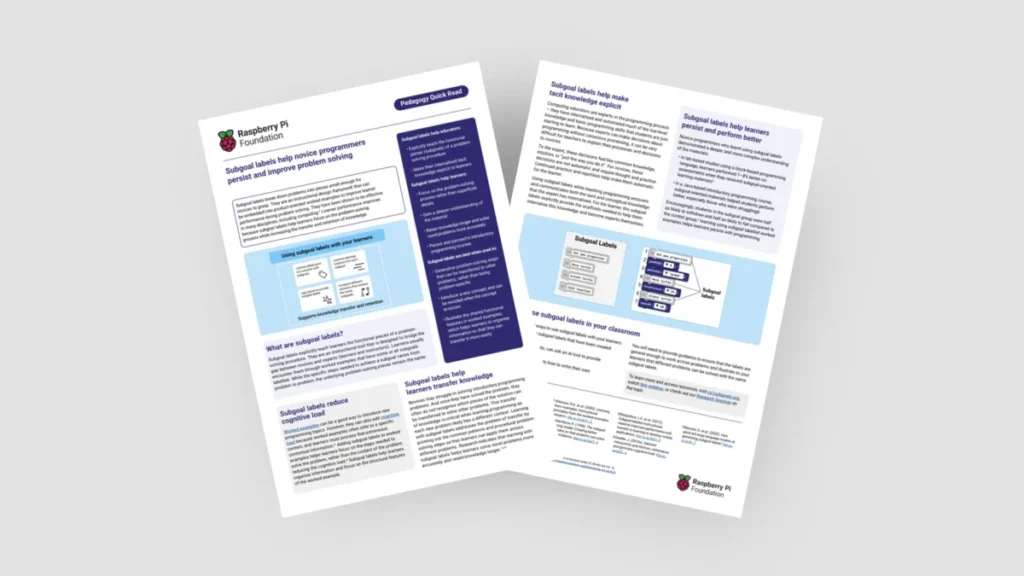
The Raspberry Pi Foundation has recently unveiled a comprehensive pedagogical framework centered on the use of subgoal labels, a strategic instructional tool designed to bridge the significant gap between expert intuition and novice struggle in computer science education. This initiative arrives at a critical juncture as global education systems increasingly integrate programming into core curricula, often facing the challenge of high student frustration and attrition rates. By formalizing the "automatic" decisions experienced programmers make, subgoal labels provide a structured scaffolding that allows learners to deconstruct complex problems into manageable, conceptual components.
The Cognitive Gap in Programming Instruction
At the heart of the foundation’s latest research is the "expert blind spot," a psychological phenomenon where individuals with high levels of mastery in a subject lose the ability to perceive the difficulty of basic tasks. For a seasoned software engineer, the process of initializing a variable, setting up a loop, or defining a function is nearly subconscious. However, for a student encountering these concepts for the first time, each step represents a high-stakes decision point that consumes significant cognitive resources.
Cognitive Load Theory, a cornerstone of educational psychology developed by John Sweller in the 1980s, suggests that the human brain has a limited capacity for processing new information in working memory. When a beginner is presented with a blank code editor and a complex prompt, the "intrinsic load" of the problem often exceeds their cognitive capacity. Subgoal labels serve as a cognitive offloading mechanism. By providing a high-level roadmap of the "sub-steps" required to reach a solution, educators can reduce the extraneous load, allowing students to focus their mental energy on the specific logic and syntax required for each segment.
Defining Subgoal Labels in the Computing Classroom
Subgoal labels are concise, descriptive tags assigned to functional parts of a programming task. Unlike line-by-line comments, which often explain what a specific piece of code does, subgoal labels explain the purpose or the intent behind a block of code. They act as a conceptual bridge between the problem statement and the final syntax.
In the newly released "Quick Read" resource by the Raspberry Pi Foundation, the organization illustrates this through a standard "Turtle graphics" exercise. A typical prompt might ask a student to "Draw a blue square in the top right corner of the screen." To an expert, this involves four distinct logical phases:
- Setup: Importing libraries and initializing the turtle sprite.
- Positioning: Moving the pen to the specific coordinates without drawing.
- Styling: Setting the pen color and thickness.
- Construction: Executing the loop to draw the geometry of the square.
By explicitly labeling these phases in a worked example, the educator provides a mental model that the student can later replicate in different contexts. The subgoal labels function as "scaffolding"—a temporary support structure that is gradually removed as the learner gains proficiency.
The Evolution of CS Pedagogy: A Brief Chronology
The move toward subgoal labeling represents a shift from "discovery-based learning" to "explicit instruction" in computer science.
- 1960s-1980s: Early computing education often relied on a "sink or swim" approach, where students were given manuals and left to experiment. This worked for highly motivated hobbyists but failed to scale to general education.
- 1990s: The introduction of Block-based programming (like Scratch) reduced the "syntax burden," allowing students to focus on logic.
- 2010s: As CS became a mandatory subject in many regions, researchers began applying general educational theories, such as Vygotsky’s "Zone of Proximal Development," specifically to coding.
- 2020-Present: Organizations like the Raspberry Pi Foundation and the Ada Computer Science project have begun advocating for "Worked Examples" and "Subgoal Labels" as evidence-based methods to improve retention and diversity in STEM.
Supporting Data and Research Efficacy
Empirical evidence supporting the use of subgoal labels is robust. Research conducted in various STEM disciplines, including mathematics and chemistry, has consistently shown that students who learn with subgoal labels perform better on "transfer tasks"—problems that are structurally similar but contextually different from the examples they were taught.
In a landmark study by Richard Catrambone (1998), students taught with subgoal labels were significantly more successful at solving novel problems than those taught with standard step-by-step instructions. The labels helped students organize their knowledge into "schemas," or mental frameworks. In the context of programming, a student who understands the "Initialization" subgoal can apply that logic whether they are working in Python, JavaScript, or C++, whereas a student who only memorizes the syntax of one specific example often struggles to adapt.
Furthermore, data from the Raspberry Pi Foundation’s own teacher surveys suggests that scaffolding techniques like subgoal labels significantly increase the confidence of non-specialist teachers. As many primary and secondary school computer science teachers come from non-technical backgrounds, having a structured "labeling" system allows them to explain the why behind the code more effectively.
Practical Implementation Strategies for Educators
The Foundation’s report outlines three primary methods for integrating these labels into the classroom without requiring a total curriculum overhaul:
- Enhancing Worked Examples: When presenting a completed code snippet on a projector or handout, teachers should overlay the code with subgoal labels. This highlights the structure of the solution rather than just the syntax.
- Scaffolded Problem Solving: Provide students with the subgoal labels as a starting point, but leave the code areas blank. This forces students to think about the "how" of each specific goal without feeling overwhelmed by the "where do I start?" dilemma.
- Label Recognition Tasks: Give students a block of code and ask them to identify where one subgoal ends and another begins. This "reverse engineering" encourages code comprehension, which is a precursor to code writing.
Reactions from the Educational Community
The introduction of these resources has been met with positive feedback from educational practitioners. "The challenge has always been that students get ‘stuck’ at the very beginning," says one London-based computing lead. "Subgoal labels give them a way to talk about the problem before they even touch the keyboard. It turns a coding task into a logic task, which is much more approachable."
Educational researchers also point out that this method is particularly beneficial for students from underrepresented backgrounds in tech. By demystifying the "hidden logic" of programming, subgoal labels lower the barrier to entry, potentially helping to close the gender and socioeconomic gaps currently prevalent in the technology sector.
Analysis of Broader Implications
The shift toward subgoal labels reflects a broader maturation of computer science as an academic discipline. For decades, programming was treated as a craft or a vocational skill learned through apprenticeship and trial-and-error. Today, it is being recognized as a cognitive science that requires specific instructional designs.
As Artificial Intelligence (AI) and Large Language Models (LLMs) like ChatGPT become more prevalent in classrooms, the role of subgoal labels may evolve even further. If an AI can generate the syntax, the human programmer’s job becomes one of "architecting" the subgoals. Teaching students to think in subgoals is, essentially, teaching them "prompt engineering." It trains them to break down a high-level intent into the logical components that an AI—or a human collaborator—can execute.
Moreover, the focus on subgoal labels addresses the "longevity" of skills. Syntax changes—Python 2 becomes Python 3, and new frameworks emerge every year—but the underlying subgoals of software development (initialization, data processing, error handling, output) remain constant. By focusing on these labels, educators are teaching "computational thinking" in its purest form.
Conclusion and Future Outlook
The Raspberry Pi Foundation’s release of the "Subgoal Labels Pedagogy Quick Read" is more than just a teacher’s aid; it is a call for a more empathetic and scientifically grounded approach to technical education. By acknowledging the cognitive strain placed on beginners and providing the tools to mitigate it, the foundation is paving the way for a more inclusive and effective digital literacy program globally.
As the foundation continues to collect data on the implementation of these labels, the next phase of research will likely look at "fading"—the process of gradually removing labels as students gain expertise. The ultimate goal of any scaffolding is to eventually be unnecessary, leaving behind a student who has internalised the labels and can intuitively navigate the complexities of computer science. For now, however, these signposts are a vital addition to the modern classroom, ensuring that the next generation of creators is not stopped by the daunting sight of a blinking cursor on a blank screen.