The fundamental laws of physics often appear to be in direct conflict with the observable reality of the cosmos. For decades, cosmologists and theoretical physicists have grappled with a profound paradox: if the Second Law of Thermodynamics dictates that the Universe must trend toward a state of maximum disorder, or entropy, how has the cosmos managed to produce the intricate, highly ordered structures of galaxies, stars, planets, and biological life? A groundbreaking theoretical study led by Professor Ginestra Bianconi, a mathematician at Queen Mary University of London, offers a sophisticated new resolution to this dilemma. Published in the journal Physical Review D, the research suggests that the emergence of cosmic complexity is not a violation of thermodynamic principles but rather a natural consequence of a framework known as Gravity from Entropy (GfE).
By redefining gravity not merely as a fundamental force or the curvature of spacetime, but as an emergent phenomenon rooted in quantum information, Professor Bianconi’s work provides a mathematical bridge between the microscopic quantum world and the macroscopic evolution of the Universe. The study posits that while the total entropy of the Universe continues to climb—satisfying the Second Law—the local entropy per unit of volume actually decreases as the Universe expands. This "thinning out" of entropy allows for the localized concentration of matter and energy, creating the necessary conditions for the birth of stars and the eventual rise of life.
The Entropy Paradox and the Second Law
To understand the significance of Bianconi’s work, one must first appreciate the weight of the Second Law of Thermodynamics. Albert Einstein famously lauded this law as the most secure of all physical principles, suggesting it would never be overthrown. In its simplest form, the law states that in an isolated system, the total entropy—a measure of the number of ways a system can be arranged, often associated with disorder—will always increase over time.
The early Universe, beginning with the Big Bang approximately 13.8 billion years ago, is generally understood to have started in a state of remarkably low entropy. As the Universe aged, entropy increased, leading toward an eventual "heat death" where energy is uniformly distributed and no further work can be performed. However, the visual evidence of the Universe suggests the opposite of disorder. From the primordial plasma emerged organized hydrogen clouds, which collapsed into stars, which clustered into galaxies. On the surfaces of planets like Earth, matter organized into self-replicating biological systems of immense complexity.
Explaining this growth of complexity within a system that is fundamentally decaying into disorder has remained one of the most stubborn "missing links" in modern cosmology. Standard models of General Relativity describe the "how" of gravitational collapse but do not always reconcile the "why" with the overarching thermodynamic arrow of time.
The Theory of Gravity from Entropy
The core of Professor Bianconi’s research lies in Gravity from Entropy (GfE). This theoretical framework is part of a broader movement in modern physics to treat gravity as an "emergent" property rather than a primary one. Much like the temperature of a gas is not a property of a single molecule but emerges from the collective motion of trillions of molecules, emergent gravity suggests that spacetime and gravity arise from deeper, underlying quantum degrees of freedom.
In the GfE model, gravity is described as an informational tension. The theory utilizes a mathematical construct known as the GfE Lagrangian, which is defined by the Quantum Geometric Relative Entropy (QGRE). This represents the difference between two distinct mathematical "metrics" (the rules used to measure distance and time): the actual physical spacetime metric and a secondary metric influenced by matter fields and the curvature of space.
According to this view, gravity is the physical manifestation of the Universe attempting to resolve the informational difference between these two metrics. It transforms the study of the cosmos from a question of mere force into a question of statistical mechanics and information theory.
A Chronology of Thermodynamic Gravity
The link between gravity and heat is not entirely new, but Bianconi’s work represents a significant leap forward in the timeline of this field. The intellectual lineage of GfE can be traced back through several key milestones:
- The 1970s (The Bekenstein-Hawking Revolution): Jacob Bekenstein and Stephen Hawking discovered that black holes are not truly "black" but possess entropy and emit radiation. This proved that gravity and thermodynamics were inextricably linked at the event horizon.
- 1995 (Jacobson’s Equation of State): Physicist Ted Jacobson demonstrated that Einstein’s field equations for General Relativity could be derived from purely thermodynamic considerations, suggesting that gravity might be the "thermodynamics of spacetime."
- 2010 (Verlinde’s Entropic Gravity): Erik Verlinde proposed that gravity is an entropic force caused by changes in the information associated with the positions of material bodies.
- 2024 (Bianconi’s QGRE Model): Professor Bianconi’s latest study applies these concepts to the evolution of the entire Universe, specifically addressing the growth of complexity through the lens of expanding volume.
Expansion as a Mechanism for Order
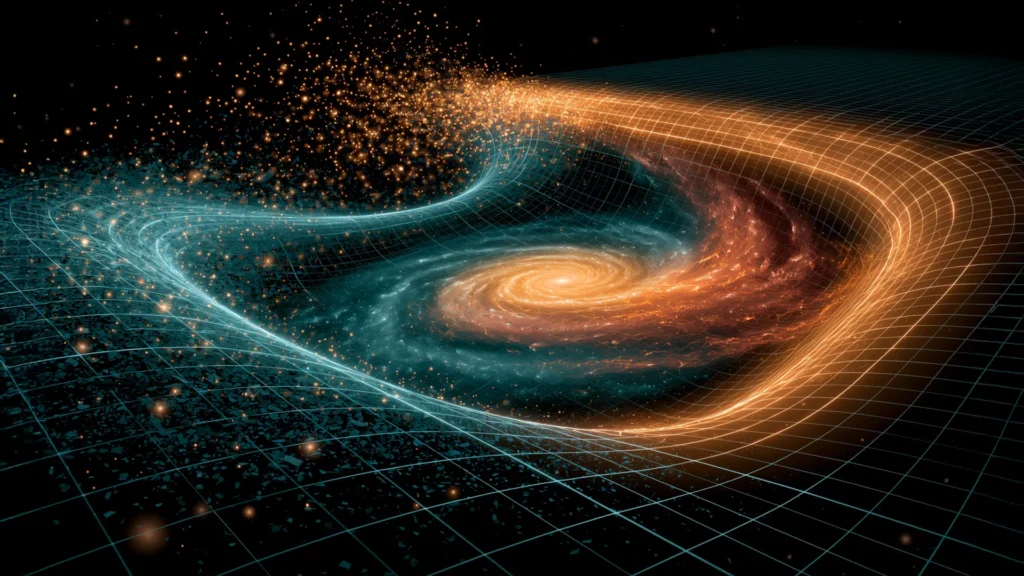
The most striking finding of the new study is how it handles the expansion of the Universe. Using Friedmann-Robertson-Walker (FRW) spacetimes—the standard mathematical models for an expanding, uniform Universe—Bianconi analyzed how entropy behaves on a local versus global scale.
The data suggests a dual-tracked process. As the Universe expands, its total volume increases exponentially. Because total entropy is a function of this volume, the total entropy of the Universe rises, satisfying the Second Law. However, the Quantum Geometric Relative Entropy (QGRE)—which measures the entropy per unit of volume—gradually declines.
"This work reveals how the Gravity from Entropy theory can tackle the challenging question to reconcile the second principle of thermodynamics with the emergence of complexity in our Universe," Professor Bianconi stated.
In essence, as the Universe gets bigger, there is more "room" for entropy to be spread out. This reduction in local entropy density creates "pockets" of low entropy where matter can organize itself into complex structures without defying the global trend toward disorder. It is akin to a room becoming more cluttered in total, but because the room is growing into a mansion, the individual corners of the house can remain meticulously organized.
Dark Energy and Predictions for Future Observation
One of the most significant implications of Bianconi’s research involves Dark Energy, the mysterious force driving the accelerated expansion of the Universe. In standard General Relativity, Dark Energy is often treated as a "Cosmological Constant"—a fixed value ($Lambda$) that does not change.
However, the GfE framework suggests a different path. At low energies and weak spacetime curvature, GfE equations mirror those of Einstein’s General Relativity. But as conditions become more extreme—such as in the very early Universe or across vast cosmological distances—the GfE model predicts a "dynamic" dark energy contribution.
This means that the force we call Dark Energy may evolve over time as the informational state of the Universe changes. This provides a potential solution to the "Hubble Tension," a current crisis in astronomy where different methods of measuring the Universe’s expansion rate yield conflicting results. If Dark Energy is dynamic rather than constant, as the GfE model suggests, it could explain these discrepancies. Researchers may soon be able to test these predictions using data from the James Webb Space Telescope (JWST) and the Euclid mission, both of which are currently mapping the expansion history of the cosmos with unprecedented precision.
Scientific Analysis: Implications for the Origin of Life
While the study is rooted in high-level mathematics and cosmology, its implications extend to the very foundations of biology. The transition from inanimate matter to living organisms is the ultimate example of increasing local complexity. By providing a thermodynamic "permission slip" for complexity to emerge, Bianconi’s work suggests that life may not be a fluke or an anomaly, but a predictable outcome of the Universe’s thermodynamic evolution.
If the "local entropy per unit volume" is destined to decrease in an expanding Universe, then the formation of complex chemical bonds and biological structures becomes statistically more likely over time. This shifts the narrative of life from being a struggle against the laws of physics to being a process supported by the very nature of spacetime expansion.
Broader Impact and Future Research
The proposal remains in its theoretical stages, but it has already sparked significant interest within the theoretical physics community. By connecting the dots between General Relativity, quantum mechanics, and the Second Law of Thermodynamics, the study offers a potential "Theory of Everything" candidate that prioritizes information as the fundamental building block of reality.
The next steps for Professor Bianconi and her colleagues involve refining the GfE Lagrangian to see if it can account for other mysterious phenomena, such as Dark Matter or the behavior of matter inside the singularity of a black hole. Furthermore, the inherent thermal character of the GfE equations—where temperature and pressure arise naturally from the geometry of space—suggests that we may eventually view the Universe not as a machine governed by forces, but as a living thermodynamic system governed by the flow of information.
As observational technology catches up with these high-level theories, the scientific community may be on the verge of a paradigm shift. If gravity is indeed an entropic byproduct, our understanding of the past, present, and future of the Universe will be fundamentally rewritten, finally reconciling the cold, chaotic requirements of thermodynamics with the vibrant, structured reality of the world we inhabit.