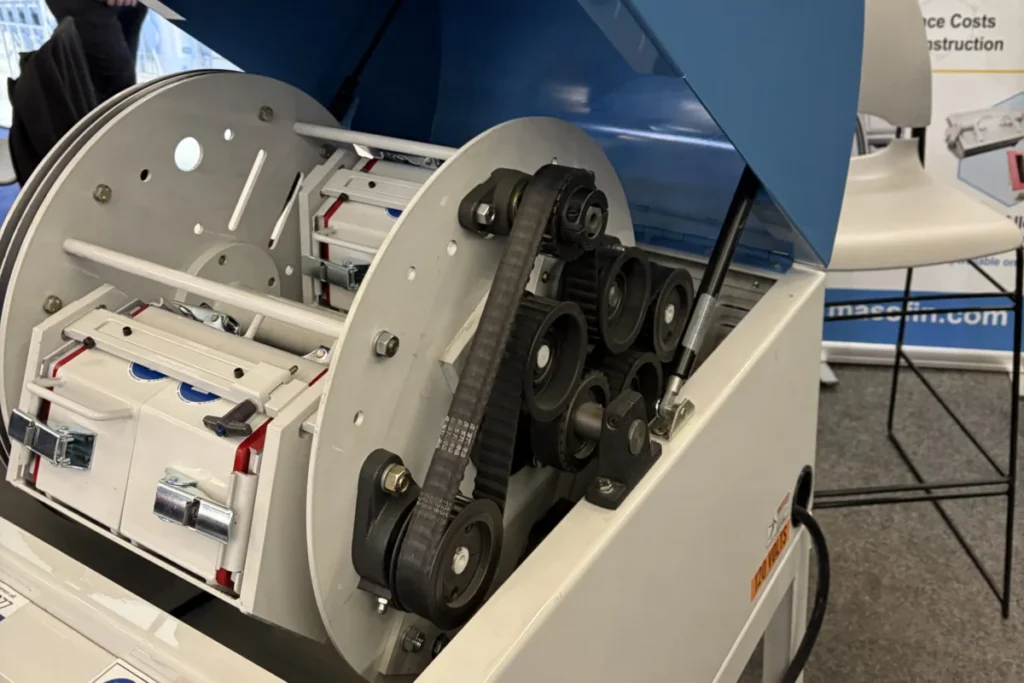
As the additive manufacturing (AM) sector continues its rapid expansion, the demand for efficient and specialized post-processing solutions has become paramount. Addressing this growing need, Mass Finishing Inc. (MFI), a recognized leader in industrial parts polishing and deburring machinery, has unveiled its latest innovation: the HZ-6 centrifugal barrel tumbler finishing machine. This compact, mobile unit is specifically engineered to tackle the unique surface finishing challenges presented by additively manufactured components, offering a high-throughput, high-quality solution for both micro-precision and larger parts.
The HZ-6 boasts a modest footprint of just 3 by 2 feet, yet it houses a robust two-barrel system with dual cradle positions. This design allows for the simultaneous finishing of multiple small, intricate 3D-printed parts, significantly boosting productivity. Its integrated wheel system enhances maneuverability, allowing it to be easily relocated to wherever it is needed on a shop floor or stored away when not in use, a crucial consideration for facilities with limited space. MFI highlights that the HZ-6 is designed to deliver rapid, high-polished finishes, a critical step in making additively manufactured parts suitable for demanding applications across various industries.
Addressing the Surface Roughness Challenge in AM
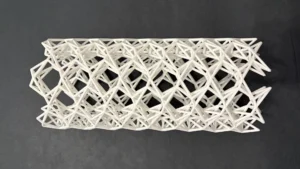
A persistent hurdle in the widespread adoption of 3D-printed metal parts, particularly those produced using processes like laser powder bed fusion (LPBF), is inherent surface roughness. The layer-by-layer deposition of melted powder, while enabling complex geometries, often results in a textured surface that can compromise functional performance. In sectors such as aerospace, energy, and healthcare, a smooth and uniform surface finish is not merely aesthetic; it is essential for optimal performance and patient safety. For instance, in medical applications, 3D-printed implants and stents require a meticulously smooth surface to promote effective bone in-growth and prevent adverse biological reactions. The HZ-6 aims to bridge this gap, providing a robust post-processing solution that elevates the quality and applicability of AM parts.

The Power of Centrifugal Barrel Finishing
Centrifugal barrel finishing, also known as centrifugal barrel tumbling, represents a high-energy, accelerated alternative to more traditional post-processing methods like vibratory finishing. MFI explains that the HZ-6 operates on the "Ferris Wheel" principle, where the rotation of the turret is directly synchronized with the rotation of the barrels. This synchronized motion generates significant centrifugal force, creating a powerful sliding action within the barrels.
The HZ-6 system is equipped with versatile barrel configurations. It features one standard, full-size latched-end barrel measuring 8.375 inches in length, alongside two half-size latched-end barrels, each 3.625 inches long. This flexibility allows for efficient finishing of a wide range of part sizes and quantities. The half-size barrels are particularly suited for processing small, micro-precision components, while the full-size barrel can accommodate parts up to 8 inches long and with an outside diameter of up to 4.5 inches.
"The demand for compact, highly efficient finishing equipment has been a driving force behind our product development," stated a spokesperson for Mass Finishing Inc. (inferred statement based on product focus). "The HZ-6 is a direct response to the needs of additive manufacturing users who require precise and rapid surface finishing without a substantial investment in large machinery or a significant footprint."
A Comparative Advantage in Speed and Efficiency
The operational principle of centrifugal barrel finishing leverages centrifugal force to rapidly remove excess material, deburr components, and polish surfaces. This process achieves isotropic finishes, meaning that parts are polished uniformly and evenly in all directions. This high-energy approach translates into substantial time savings. While conventional vibratory finishing might require 10 to 20 hours to achieve a desired smooth surface on a metal AM component, MFI claims the HZ-6 can accomplish similar results in as little as one hour, processing multiple parts concurrently.

The HZ-6 is designed to accommodate a broad spectrum of media, including heavy ceramic, porcelain, and plastic media in various shapes and sizes. This versatility allows for tailored finishing processes for both hard and soft metal materials commonly used in additive manufacturing, such as titanium, copper, nitinol, and carbon steel. The system is also engineered to be significantly quieter than many vibratory tumbling systems, contributing to a more pleasant and productive shop environment.
A Spectrum of AM Surface Finishing Techniques
The journey from a raw 3D-printed part to a finished product often involves a series of post-processing steps to address inherent surface imperfections. These imperfections can include layer lines, residual powder, support structure marks, and internal roughness. The choice of finishing method is contingent upon several factors, including the material used, the part’s geometry (especially complex internal features), the desired surface roughness, and the intended end-use application. MFI’s HZ-6 fits into this landscape as a specialized solution for high-throughput polishing.
Beyond centrifugal barrel finishing, several other established methods are employed in the AM post-processing workflow:
- Media Blasting (Bead, Sand, or Soda): Often a preliminary step for both metal and polymer AM parts, media blasting uses pressurized media to remove loose powder, smooth minor surface defects, and create a uniform matte finish. It is recognized for its speed and cost-effectiveness.
- Tumbling and Vibratory Finishing: In this process, parts are placed in a bowl or barrel with abrasive media and subjected to hours or even days of agitation. It is well-suited for batch processing of small to medium-sized parts and for edge breaking.
- Chemical and Electrochemical Polishing: These methods involve submerging parts in specific chemical solutions that selectively dissolve surface peaks while leaving valleys relatively intact. They are particularly effective for intricate geometries, including lattice structures, conformal cooling channels, and medical implants, addressing both external and internal surfaces.
- Abrasive Flow Machining (AFM): AFM utilizes a viscous, abrasive-laden putty that is pumped back and forth through internal passages under pressure. This technique is widely adopted for smoothing complex internal features found in components like AM fuel nozzles, manifolds, and hydraulic blocks.
- CNC Machining: This traditional subtractive manufacturing process remains critical for achieving high precision on mating surfaces, bearing journals, sealing faces, and tight-tolerance features. The integration of AM and CNC machining within hybrid manufacturing platforms is becoming increasingly prevalent.
- Manual Grinding, Sanding, and Polishing: Despite advancements in automated processes, manual finishing remains indispensable for certain applications, particularly for large structural parts, prototypes, and the removal of support witness marks. In low-volume metal AM workflows, manual finishing can often represent a significant portion of the cost.
- Laser Polishing: This advanced technique employs a defocused laser to remelt a thin surface layer. Surface tension then smooths out microscopic irregularities. Laser polishing offers the advantage of being consumable-free, requiring no media cleanup from internal features, and allows for precise control. It is an attractive option for small, high-value components in the dental and aerospace industries.
- Coatings and Plating: Post-mechanical preparation, AM parts can benefit from various coatings and platings, such as anodizing, physical vapor deposition (PVD), electroless nickel, and powder coating. These treatments can mask minor surface defects, enhance wear or corrosion resistance, and provide a uniform aesthetic finish.
- Vapor Smoothing: In this automated process, 3D-printed parts are placed in an airtight vessel with a solvent and heated. The resulting vapor smooths and polishes the part’s surface over several hours. This method is particularly effective for achieving a high-quality finish on complex geometries and is gaining popularity due to its efficiency and consistency.
The Broader Implications for AM Adoption
The introduction of MFI’s HZ-6 centrifugal barrel tumbler marks a significant step forward in making additively manufactured parts more accessible and functionally superior. By addressing the critical post-processing stage of surface finishing with an efficient, compact, and high-throughput solution, MFI is contributing to the broader maturation of the AM industry. As AM technologies continue to evolve and find applications in increasingly critical sectors, the development of specialized equipment like the HZ-6 will be instrumental in unlocking the full potential of this transformative manufacturing approach. The ability to rapidly achieve high-quality surface finishes on a variety of AM materials, from delicate micro-components to larger industrial parts, empowers manufacturers to meet stringent performance requirements and accelerate the integration of 3D-printed parts into mainstream production.