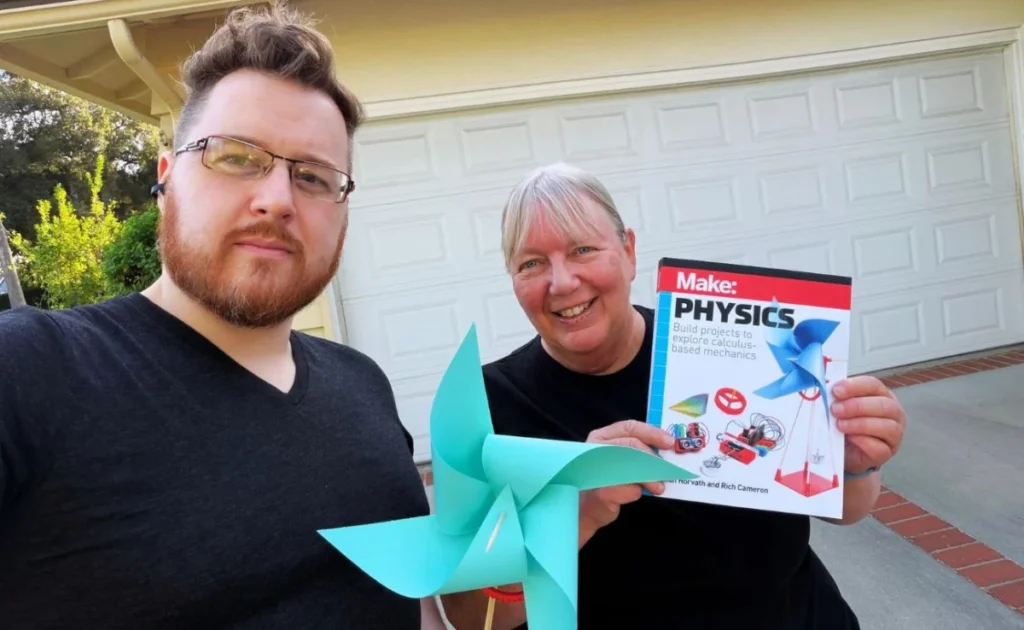
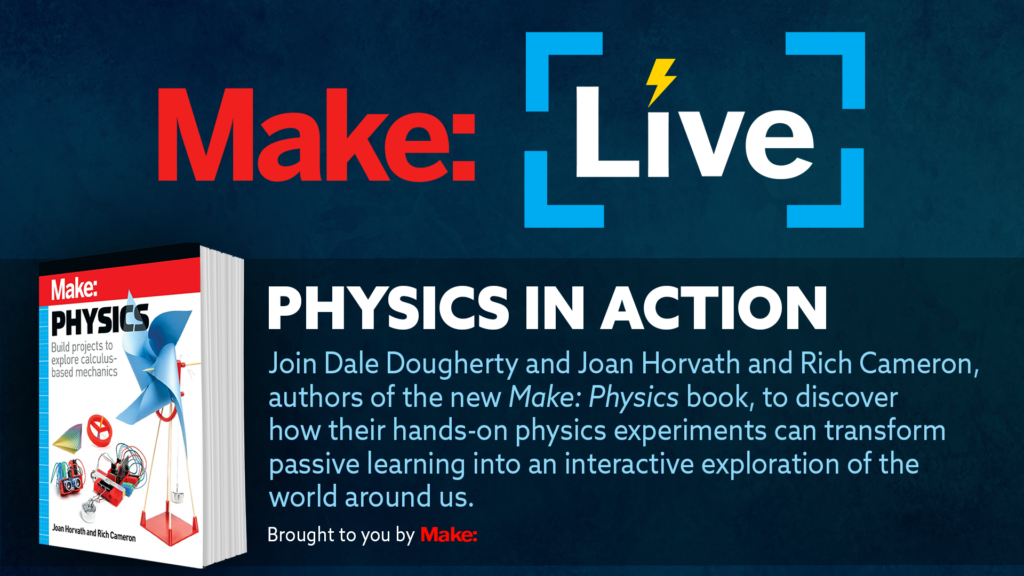
The Maker movement, a global subculture focused on the intersection of traditional craftsmanship and modern technology, is set to host a significant educational forum on Friday, July 24, 2026. At 1:00 PM Pacific Time, Dale Dougherty, the founder of Make: Magazine and a pioneer of the Maker movement, will host a live session featuring authors Joan Horvath and Rich Cameron. The primary focus of the event is the release and pedagogical implications of their latest work, Make: Physics, a comprehensive guide designed to revolutionize the way mechanics and kinematics are taught through hands-on, maker-based experimentation.
The session aims to address a long-standing challenge in science education: the gap between abstract mathematical concepts and tangible physical reality. By targeting advanced high school students, first-year college engineering undergraduates, and adult learners, Horvath and Cameron intend to demonstrate that the principles of physics are best understood not through lecture-hall observation, but through the construction and manipulation of physical models.
A New Framework for Physics Education
Make: Physics represents a culmination of over a decade of collaborative work between Joan Horvath and Rich Cameron. The duo has established a reputation within the scientific and educational communities for their ability to translate complex engineering workflows into accessible, maker-level projects. Their previous work has often centered on the utility of 3D printing and microcontrollers in professional and academic settings.
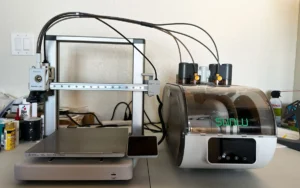
In this new volume, the authors pivot toward the fundamental laws of the universe. The book covers essential topics such as kinematics, energy, momentum, and rotational dynamics. However, unlike traditional textbooks that rely heavily on two-dimensional diagrams and rote memorization of formulas, Make: Physics utilizes 3D-printed components and BBC micro:bit processors to create interactive experiments.
The BBC micro:bit, a pocket-sized computer originally developed by the BBC for computer science education in the UK, serves as the central data-collection hub in many of the book’s projects. By utilizing the device’s onboard sensors—such as accelerometers and magnetometers—students can collect real-time data from their experiments, allowing them to see the immediate correlation between physical movement and mathematical representation.
Bridging Calculus and Mechanics
One of the most significant hurdles for students entering STEM (Science, Technology, Engineering, and Mathematics) fields is the integration of calculus with physical mechanics. Often, these subjects are taught in silos, leaving students struggling to understand how a derivative or an integral translates to the acceleration of a physical object.
During the Make: Live session, Horvath and Cameron will detail how their book explicitly connects these dots. By building their own experimental apparatuses, students are forced to engage with the variables of calculus in a three-dimensional space. The authors argue that when a student 3D prints a gear system or programs a sensor to measure the velocity of a projectile, the underlying calculus becomes a necessary tool for success rather than a hurdle to be cleared.
This methodology aligns with the "constructivist" theory of education, which posits that learners build new knowledge upon the foundation of previous experiences. By "making" the physics happen, the student is no longer a passive recipient of information but an active investigator.
Perspectives from the Classroom and the Laboratory
The upcoming live event will feature a panel of experts to provide a multifaceted view of the book’s potential impact. Joining the authors is Dr. Simon Huss, the STEAM (Science, Technology, Engineering, Arts, and Mathematics) Director at Windward School. Dr. Huss brings an educator’s practical perspective, offering insights into the real-world application of maker-based projects in a secondary school environment.
Educational data suggests that hands-on learning significantly improves retention rates. According to a meta-analysis of 225 studies published by the National Academy of Sciences, students in classes with active learning performed 6% better on examinations than those in traditional lectures, and students in classes with traditional lecturing were 1.5 times more likely to fail than were students in classes with active learning. Dr. Huss is expected to discuss how the projects outlined in Make: Physics can be integrated into existing curricula to mitigate "science fatigue" among students.
Furthermore, the session will include Dr. Mina Sun, a scientist and prominent advocate for blind and non-visual learners. Dr. Sun’s involvement highlights a critical, yet often overlooked, aspect of STEM education: accessibility. Traditional physics education relies heavily on visual data—graphs, charts, and chalkboard demonstrations. For learners with visual impairments, these methods create significant barriers to entry.
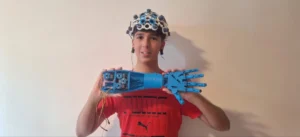
The maker-centric approach, however, emphasizes tactile models and physical interaction. 3D printing allows for the creation of high-fidelity, tactile representations of scientific concepts. Dr. Sun will discuss how the hands-on nature of the projects in Make: Physics can democratize science, making it accessible to a broader range of learners by providing non-visual pathways to understanding complex phenomena.
The Evolution of the Maker Movement
The release of Make: Physics and the subsequent Make: Live event mark a maturation of the Maker movement. Initially seen by some as a hobbyist niche focused on DIY electronics and 3D-printed trinkets, the movement has increasingly influenced formal education and industrial prototyping.

In the mid-2010s, "Makerspaces" began appearing in libraries and universities across the globe. By 2026, the integration of these spaces into the core curriculum of STEM programs has become a standard for many leading institutions. The work of Horvath and Cameron reflects this shift from "making for the sake of making" to "making for the sake of understanding."
The timeline of development for this approach is noteworthy:
- 2012–2015: Early adoption of consumer 3D printing in schools primarily for artistic and basic engineering projects.
- 2016–2020: The rise of low-cost microcontrollers like the Arduino and BBC micro:bit allows for sophisticated data collection in the classroom.
- 2021–2025: Increased focus on "Open Science" and DIY instrumentation, reducing the cost of high-level laboratory equipment.
- 2026: The publication of comprehensive guides like Make: Physics, which formalize the maker-based pedagogy into a structured academic framework.
Analysis of Broader Implications
The implications of this shift toward maker-based physics are twofold. First, it addresses the "skills gap" in the modern workforce. Employers in engineering and technology sectors increasingly seek candidates who possess not only theoretical knowledge but also practical problem-solving skills and familiarity with digital fabrication tools. By introducing these tools in the context of fundamental physics, educators are preparing students for the realities of modern industrial environments.
Second, the approach has the potential to reignite interest in the sciences among adult learners and those who felt alienated by traditional schooling. The "learn-by-doing" model lowers the psychological barrier to entry for complex subjects. As lifelong learning becomes a necessity in a rapidly changing economy, resources that allow for self-directed, project-based exploration are becoming increasingly valuable.
The Make: Live session on July 24 is expected to draw a diverse audience, ranging from secondary school teachers looking for new lab ideas to hobbyists interested in the physics of their creations. The event will be streamed globally, reflecting the decentralized and inclusive nature of the Maker community.
Conclusion
As science education continues to evolve in the late 2020s, the role of physical experimentation remains paramount. Joan Horvath and Rich Cameron’s Make: Physics serves as both a textbook and a manifesto for a more engaged, accessible, and practical form of scientific inquiry. By leveraging the tools of the Maker movement—3D printing, microcontrollers, and open-source collaboration—the authors are providing a roadmap for the next generation of scientists and engineers to not only learn about the world but to build their understanding of it from the ground up.
The discussion led by Dale Dougherty, featuring the insights of Dr. Simon Huss and Dr. Mina Sun, will likely serve as a benchmark for how educational materials are evaluated in the future: not just by the accuracy of their content, but by the effectiveness of their engagement and the breadth of their accessibility. Participants and viewers are encouraged to bring their curiosity and questions to what promises to be a pivotal moment in the ongoing dialogue between the Maker movement and formal science education.