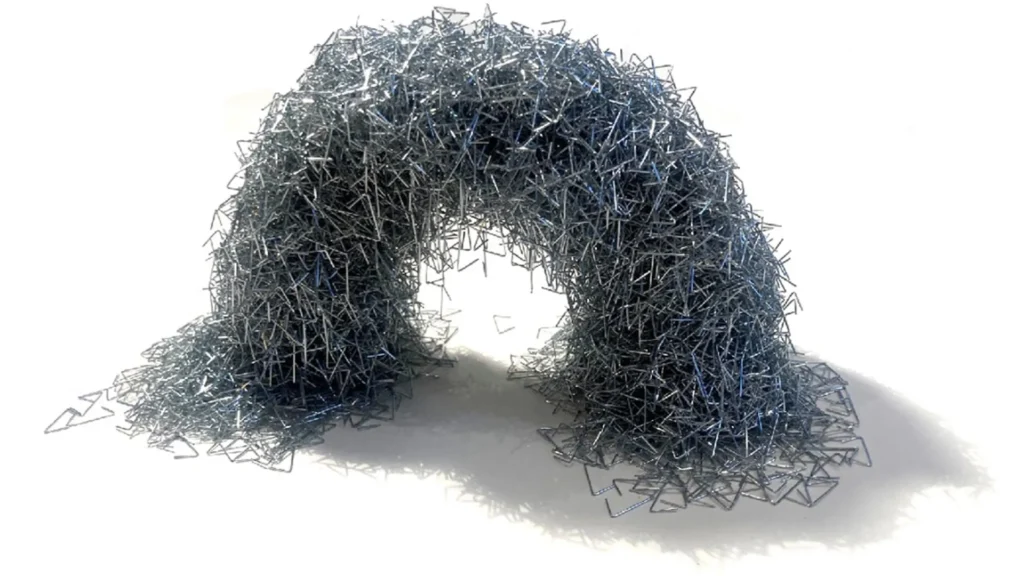
The mechanical behavior of a tightly compressed bundle of office staples offers a profound lesson in material science, demonstrating how individual, disconnected units can collectively mimic the properties of a single, robust solid. While these staples are not chemically bonded or fused, their geometric entanglement allows them to resist significant pulling forces, yet they remain capable of instant disassembly under the influence of specific external stimuli. Researchers at the Paul M. Rady Department of Mechanical Engineering at the University of Colorado Boulder have identified this phenomenon as a cornerstone for a new class of "tunable" and "reversible" materials. By moving beyond traditional chemical adhesives and permanent fasteners, the team is exploring how the strategic design of particle geometry can lead to structures that are simultaneously strong, adaptable, and fully recyclable.
Led by Professor Francois Barthelat, head of the Laboratory for Advanced Materials & Bioinspiration, the research team has spent years investigating the intersection of geometry and structural integrity. Their latest findings, published in the Journal of Applied Physics, provide a roadmap for creating engineered materials that utilize mechanical interlocking rather than chemical bonding. This shift in paradigm suggests a future where everything from temporary infrastructure to advanced robotics could be assembled and disassembled with unprecedented ease, significantly reducing waste and increasing the lifespan of raw materials.
The Science of Entanglement and Particle Geometry
At the heart of this research is the concept of entanglement, a physical state where discrete components become so intertwined that they can no longer move independently without deforming or overcoming significant friction. While entanglement is a familiar concept in daily life—manifesting in tangled hair, knotted fishing lines, or the complex weave of a bird’s nest—its application in material engineering has historically been underutilized. Most industrial materials rely on "convex" particles, such as the grains found in sand or gravel. Because these shapes lack protrusions or recessed areas, they cannot physically hook into one another.
"Sand is smooth and convex-shaped, meaning it cannot interlock from grain to grain," explained Youhan Sohn, a PhD student and co-author of the study. The research team’s breakthrough came from questioning what would happen if the fundamental "grain" of a material was redesigned. By moving from convex shapes to "non-convex" or "concave" geometries, the researchers discovered they could fundamentally alter the macroscopic behavior of the collective material. When particles possess "arms" or "legs," they create a three-dimensional web of mechanical constraints. This network allows the material to carry loads across a wide area, effectively distributing stress in a manner similar to a solid piece of steel or plastic, despite being composed of thousands of individual, loose pieces.
To identify the optimal geometry for this entanglement, the CU Boulder team employed Monte Carlo simulations. This computational approach allowed the researchers to simulate millions of interactions between various particle shapes, testing how different configurations reacted to tension, compression, and shear forces. The objective was to find a shape that maximized "topological interlocking"—a state where the particles are trapped by their neighbors’ geometry.
The Superiority of the Staple Design
Through their simulations and subsequent physical "pickup tests," the researchers identified the "two-legged" staple shape as a standout performer. This geometry proved exceptionally efficient at creating a dense network of interlocks. When a bundle of these staple-like particles is subjected to a tensile load (a pulling force), the "legs" of the staples hook into the "crowns" of others, creating a chain-reaction of resistance.
One of the most significant findings of the study is the material’s ability to resolve a classic engineering dilemma: the trade-off between strength and toughness. In traditional material science, "strength" refers to a material’s ability to resist deformation under load, while "toughness" refers to its ability to absorb energy and resist fracturing. Typically, materials that are very strong (like glass) are brittle, and materials that are very tough (like rubber) are not particularly strong.
"Our entangled granular material using the staple-like particle demonstrates both high strength and toughness at the same time," noted Saeed Pezeshki, a PhD student involved in the project. The interlocking nature of the staples allows the material to remain rigid under initial stress (strength) while the slight sliding and re-adjusting of the particles under higher loads allow the material to absorb energy without a catastrophic failure (toughness).
Reversibility and the Role of Vibration
Perhaps the most transformative aspect of the staple-inspired material is its inherent reversibility. Unlike traditional construction materials like concrete or epoxy, which require destructive force to remove or recycle, entangled materials can be "switched" between solid-like and liquid-like states. The catalyst for this transformation is vibration.
The researchers discovered that by applying specific vibration patterns, they could control the degree of entanglement within the particle mass. Gentle, low-frequency vibrations encourage the particles to settle into more stable, interlocked positions, effectively "curing" the material into a solid state. Conversely, stronger or more chaotic vibrations provide enough kinetic energy to unhook the particles, causing the solid bundle to dissolve back into a loose collection of individual staples.
Professor Barthelat described the sensation of handling the material as "remote and exotic," noting that it defies standard categorization. It occupies a liminal space between a liquid and a solid, offering a degree of "tunability" that is rare in the natural world. This ability to command a material to become strong on demand and then return to a pourable state has profound implications for the circular economy and industrial efficiency.
Chronology of Research and Experimental Validation
The journey toward these findings began several years ago at the Laboratory for Advanced Materials & Bioinspiration, where the team initially focused on the mechanical properties of biological structures like nacre (mother-of-pearl) and bone. These natural materials use "brick-and-mortar" architectures to achieve high performance.
- Initial Phase (Conceptualization): The team transitioned from studying biological composites to exploring "granular" matter, questioning if the strength of a solid could be achieved without the "mortar" (adhesives).
- Simulation Phase (Computational Modeling): Using Monte Carlo methods, the team tested various "U-shaped" and "H-shaped" particles to see which configurations yielded the highest density of mechanical contacts.
- Physical Prototyping: The researchers manufactured thousands of macro-scale staples using 3D printing and precision cutting to validate the simulation data.
- Testing Phase: The "pickup test" involved submerging a probe into a container of the particles and measuring the force required to lift a mass of entangled staples. The staple-shaped particles consistently outperformed traditional shapes, lifting masses many times their own weight.
- Publication: The formalized results were peer-reviewed and published in the Journal of Applied Physics, marking the transition of this technology from a laboratory curiosity to a viable engineering concept.
Implications for Sustainable Construction and Infrastructure
The potential applications for this technology are vast, particularly in the realm of sustainable construction. Currently, the construction industry is one of the world’s largest producers of waste. Buildings are often demolished using wrecking balls and explosives, resulting in heaps of commingled debris that are difficult to sort and recycle.
By utilizing entangled granular materials, future engineers could design "demountable" infrastructure. Imagine a bridge or a temporary support column made of interlocking metallic staples. Once the structure’s service life is over, a specialized vibration unit could be attached to the base. Within minutes, the bridge would "melt" back into a pile of reusable staples, ready to be transported to a new site and reassembled. This approach would virtually eliminate the carbon footprint associated with the production of new cement and the disposal of old concrete.
Furthermore, these materials offer a solution for building in remote or extreme environments, such as disaster zones or even lunar bases. Because the raw material is "pourable," it can be transported easily and then vibrated into a structural form once it reaches its destination.
Swarm Robotics and the "Terminator" Vision
Beyond civil engineering, the research has caught the attention of the robotics community. The concept of "swarm robotics" involves large numbers of small, simple robots working together to achieve a complex goal. If these individual robots were shaped like the CU Boulder staples, they could physically entangle with one another to form larger tools, bridges, or protective barriers.
"I was talking with other students who believe this technology can be used in swarm robotics—where small robots can entangle, do a task, and then disentangle when they are done," Pezeshki said. This vision aligns with the "liquid metal" concepts popularized in science fiction, such as the T-1000 character from the film Terminator 2. While we are still far from a shape-shifting humanoid robot, the fundamental physics demonstrated by Barthelat’s team proves that a collection of discrete units can change its phase and shape to adapt to its environment.
Future Directions: From Staples to Burrs
The CU Boulder team is not stopping at the staple design. Their current research is moving toward even more complex geometries inspired by "burrs"—the prickly seeds of plants like the burdock, which evolved to cling to animal fur using hundreds of tiny hooks.
By adding more "legs" and smaller, hook-like features to their particles, the researchers believe they can increase the probability of entanglement and create materials with even higher tensile strength. These "multi-legged" particles would act like a 3D version of Velcro, providing a mechanical bond that is incredibly difficult to break through force alone but remains entirely reversible through the correct vibrational "key."
As the team works to scale up production and explore different materials—ranging from high-strength polymers to recycled metals—the "staple effect" stands as a testament to the power of geometric design. In a world increasingly focused on sustainability and adaptability, the ability to build and unbuild our world with the shake of a hand could represent the next great leap in human ingenuity. The work at CU Boulder suggests that the secret to the next generation of super-materials may not lie in a new chemical formula, but in the humble, interlocking shape of an office staple.