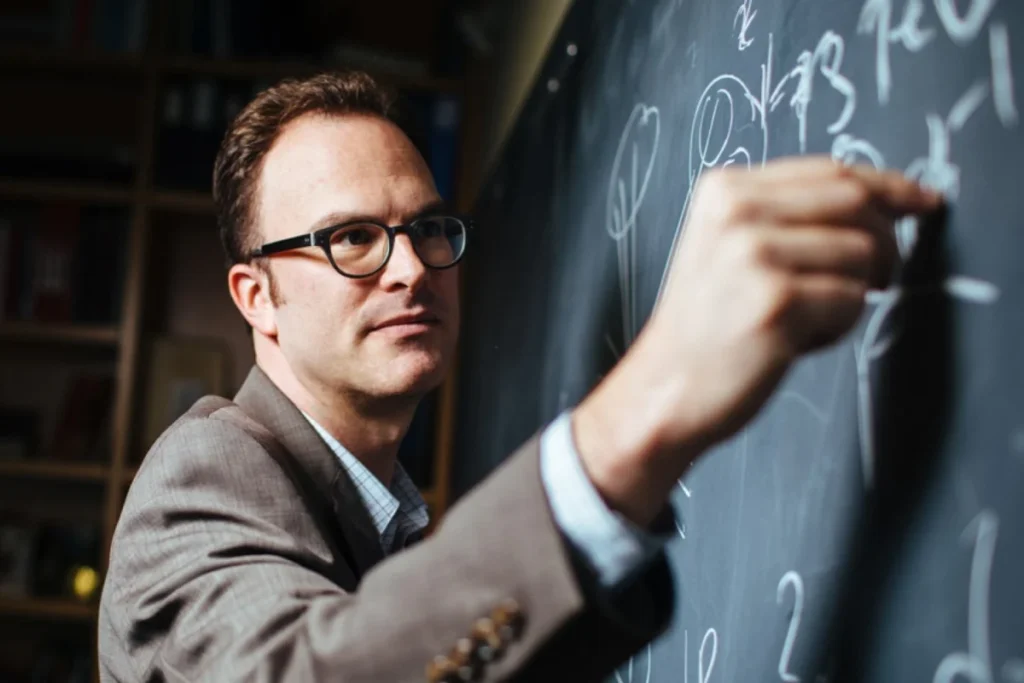
The Massachusetts Institute of Technology has officially named Professor Jesse Thaler as the new director of the MIT Laboratory for Nuclear Science (LNS), marking a significant shift in leadership as the institution prepares to integrate advanced artificial intelligence into the bedrock of fundamental physics research. Effective August 1, Thaler succeeds Professor Bolek Wyslouch, whose decade-long tenure saw the laboratory navigate a period of immense growth and technological transition. Thaler, a renowned theoretical particle physicist, steps into the role with a mandate to bridge the gap between traditional quantum field theory and the rapidly evolving field of machine learning.
The Laboratory for Nuclear Science, established in 1946, has long been a cornerstone of MIT’s research infrastructure, serving as a hub for exploring the fundamental constituents of matter and the forces that govern the universe. Under Thaler’s leadership, the laboratory is expected to double down on its commitment to AI-driven discovery, a move signaled by his previous success as the inaugural director of the National Science Foundation (NSF) AI Institute for Artificial Intelligence and Fundamental Interactions (IAIFI).
A Strategic Transition in Leadership
The appointment of Jesse Thaler comes at a pivotal moment for the MIT School of Science. Nergis Mavalvala, the Dean of the MIT School of Science and the Curtis and Kathleen Marble Professor of Astrophysics, emphasized that Thaler’s background makes him uniquely suited for the current scientific landscape. Mavalvala noted that Thaler has performed pioneering work on particle jets at the Large Hadron Collider (LHC) and has established himself as a global leader in synthesizing AI with particle physics. She remarked that the collaborative nature of Thaler’s research programs would be essential as the Laboratory for Nuclear Science enters an era where AI is no longer just a tool, but a primary driver of scientific breakthroughs.
Outgoing director Bolek Wyslouch leaves behind a legacy of stability and expansion. During his ten years at the helm, LNS maintained its position as a premier site for nuclear and high-energy physics, managing complex experimental collaborations both on-campus and at international facilities like CERN. Thaler’s transition into the role is seen as a natural evolution, moving from the experimental and administrative foundations laid by Wyslouch toward a future defined by computational power and algorithmic innovation.
The Evolution of the Laboratory for Nuclear Science
To understand the weight of this appointment, one must look at the history and scope of the LNS. Founded in the immediate aftermath of World War II, the laboratory was created to provide a formal structure for MIT’s burgeoning research into nuclear science. Over nearly eight decades, its mission has expanded significantly. Today, LNS is not merely focused on the nucleus of the atom; its research umbrella encompasses cosmology, the study of gravity, quantum field theory, and the emerging domain of quantum information science.
LNS serves as the administrative and intellectual home for a vast array of experimental and theoretical groups. It provides the technical infrastructure necessary for MIT physicists to participate in global experiments, such as those conducted at the Relativistic Heavy Ion Collider (RHIC) at Brookhaven National Laboratory and the Large Hadron Collider in Switzerland. By appointing Thaler, MIT is signaling that the next chapter of this history will be written in the language of data science and automated inference.
AI and the Data Deluge in Particle Physics
A primary driver for Thaler’s appointment is the "data deluge" currently facing the physics community. Modern particle accelerators and cosmological surveys generate amounts of data that are nearly impossible for human researchers to process using traditional methods. At the Large Hadron Collider, for instance, sensors record millions of particle collisions every second. Sifting through this noise to find evidence of new physics—such as dark matter candidates or deviations from the Standard Model—requires sophisticated algorithms.
Thaler has been at the forefront of developing these algorithms. His work on "particle jets"—the sprays of particles produced in high-energy collisions—has revolutionized how physicists interpret collider data. By applying machine learning, Thaler and his colleagues can identify patterns in these jets that were previously obscured.
"In my own field of particle physics, researchers are developing cutting-edge AI algorithms to handle the data deluge from collider experiments and to perform heroic theoretical calculations," Thaler stated upon his appointment. He noted that while these algorithms are designed for physics, their utility often extends into other fields, suggesting that the work done at LNS under his direction will have broad societal implications.
The IAIFI Legacy and Educational Innovation
Before taking the reins at LNS, Thaler made a significant impact as the director of IAIFI. Launched in 2020, IAIFI was designed to foster a two-way street between physics and AI: using AI to improve physics research, and using physics principles to improve the transparency and reliability of AI. The institute was recently renewed for another five-year term, a testament to its success.
One of Thaler’s most enduring contributions at IAIFI has been his focus on the human element of scientific discovery. He championed the creation of dedicated postdoctoral fellowships that allow early-career researchers to move freely between disciplines. Furthermore, in collaboration with the MIT Institute for Data, Systems, and Society (IDSS), he helped establish a novel doctoral program that integrates physics, statistics, and data science.
Thaler intends to bring this interdisciplinary framework to the LNS. He believes that giving young scientists the space to build connections across different domains and career stages is transformative. This philosophy is expected to permeate the LNS culture, encouraging theoretical physicists to collaborate more closely with experimentalists and computer scientists.
Strategic Partnerships and Philanthropic Support
The leadership change at LNS coincides with significant financial and strategic milestones. Thaler will also oversee the Center for Theoretical Physics (CTP), which is part of the LNS. Recently, the CTP was renamed the MIT Center for Theoretical Physics – a Leinweber Institute (CTP-LI) following a landmark donation from the Leinweber Foundation.
This donation is part of a larger effort to establish a network of theoretical physics research institutes. According to the Science Philanthropy Alliance, this represents the largest philanthropic commitment ever made to the field of theoretical physics. This influx of capital provides Thaler with the resources necessary to recruit top-tier talent and fund high-risk, high-reward theoretical research that might not qualify for traditional federal grants.
Additionally, LNS is set to play a major role in the Department of Energy’s (DOE) Genesis Mission. This initiative is specifically focused on AI-enabled scientific discovery, aligning perfectly with Thaler’s expertise. The mission aims to leverage high-performance computing and machine learning to solve some of the most complex problems in nuclear physics, from the behavior of quarks and gluons to the evolution of the early universe.
Biographical Background of Jesse Thaler
Jesse Thaler’s rise to the directorship of LNS is the culmination of a distinguished academic career. He earned his Bachelor of Science in math and physics from Brown University in 2002, followed by a PhD in physics from Harvard University in 2006. His early career included a prestigious fellowship at the Miller Institute for Basic Research in Science at the University of California at Berkeley, where he refined his focus on beyond-the-Standard-Model physics.
Since joining the MIT faculty in 2010, Thaler has become a central figure in the physics department. He currently holds the title of William and Emma Rogers Professor of Physics. His move to the LNS directorship will see Professor Mike Williams take over his previous role as the director of IAIFI, ensuring a continuity of vision across MIT’s physics and AI initiatives.
Analysis: The Broader Implications for Fundamental Science
The appointment of Jesse Thaler is more than a routine administrative change; it is a reflection of a broader trend in the global scientific community. We are currently witnessing a "computational turn" in fundamental science. For decades, the primary bottlenecks in physics were experimental (building bigger colliders) or theoretical (solving complex equations by hand). Today, the bottleneck is often the extraction of signal from noise.
By placing an AI specialist at the head of the Laboratory for Nuclear Science, MIT is positioning itself to lead this transition. This move suggests several likely outcomes for the future of the laboratory:
- Algorithmic Transparency: As AI becomes more integrated into physics, there is a risk of "black box" results. Thaler’s focus on "physics-informed" AI suggests that LNS will prioritize models that are not only accurate but also physically interpretable.
- Cross-Pollination of Fields: The techniques developed at LNS for particle physics are likely to find applications in climate modeling, materials science, and medical imaging, further cementing MIT’s role as an engine of multi-disciplinary innovation.
- Global Leadership in Nuclear Theory: With the support of the Leinweber Foundation and the DOE, LNS is poised to become the world’s leading center for the theoretical study of nuclear matter, particularly in the context of the upcoming Electron-Ion Collider (EIC).
As science enters what Dean Mavalvala calls a "new era of AI-driven discovery," the MIT Laboratory for Nuclear Science, under Jesse Thaler, appears ready to define the parameters of that era. By combining the rigor of traditional nuclear science with the transformative potential of artificial intelligence, the laboratory is set to continue its 78-year tradition of pushing the boundaries of what is known about the physical world.