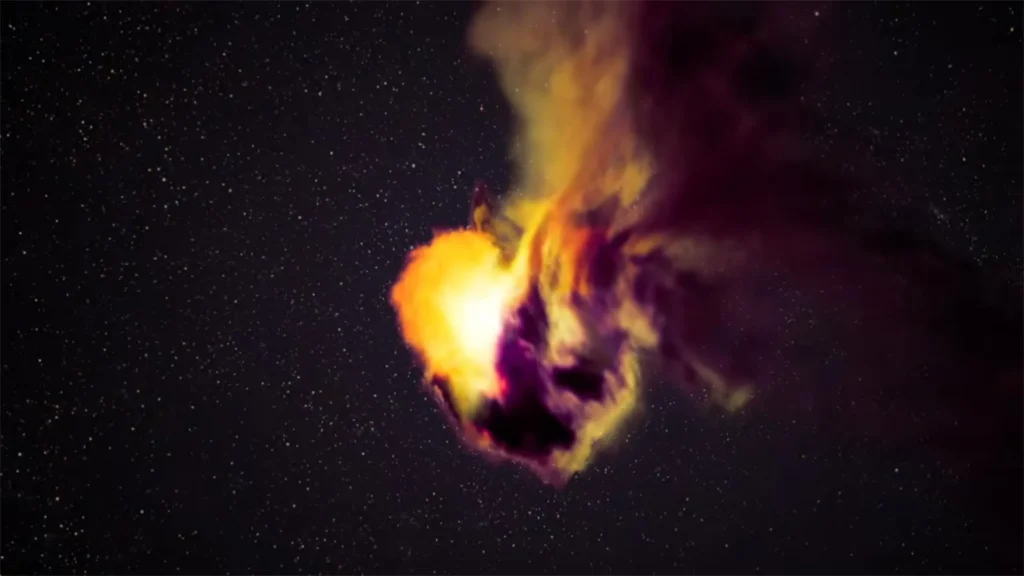
The death of a massive star is one of the most violent and transformative events in the cosmos, serving as the primary engine for the chemical enrichment of the universe. In a landmark study published in the journal Nature, an international team of researchers led by Steve Schulze of Northwestern University has provided an unprecedented look into the final moments of a massive star by observing a rare cosmic phenomenon known as an “extremely stripped supernova.” Designated as SN 2021yfj, this explosion has offered scientists a rare opportunity to peer through the outer layers of a dying star and witness the expulsion of its deepest chemical reservoirs, specifically the silicon layer that forms just months before a star’s final collapse.
The discovery of SN 2021yfj represents a significant leap in our understanding of stellar evolution and the mechanisms that govern the distribution of elements across the galaxy. While standard supernovae typically obscure their inner workings behind vast shells of hydrogen and helium, this "extremely stripped" event provides a direct window into the nuclear furnace that powers massive stars. The findings not only corroborate long-standing theoretical models of stellar nucleosynthesis but also raise provocative new questions regarding how stars shed their mass in the lead-up to their demise.
The Architecture of Stellar Fusion
To understand the significance of SN 2021yfj, one must first consider the standard lifecycle of a massive star. Stars are effectively giant nuclear reactors, powered by the fusion of lighter elements into heavier ones. This process occurs in distinct stages, often visualized as an “onion-skin” model. In the earliest and longest phase of a star’s life, hydrogen atoms are fused into helium within the core. Once the hydrogen is exhausted, the core contracts, temperatures rise, and the star begins fusing helium into carbon and oxygen.
For stars significantly more massive than our Sun, this process continues through increasingly heavy elements. Following the helium cycle, the star moves on to fuse carbon, then neon, then oxygen, and finally silicon. Each successive stage of fusion is significantly more energetic but also vastly shorter in duration. While the hydrogen-burning phase can last for millions of years, the final silicon-burning phase, which produces an iron core, is completed in a matter of days or even hours.
As these cycles progress, the star develops a layered structure. The outermost layer consists of unburned hydrogen, followed by layers of helium, carbon, neon, oxygen, and silicon, with the iron core at the very center. Under normal circumstances, when a star explodes, the observer primarily sees the outermost layers—hydrogen or helium. SN 2021yfj is unique because these outer layers were entirely absent, allowing astronomers to detect the signature of the silicon layer, which is usually buried deep within the stellar interior.
The Mechanics of Core Collapse
The transition from a living star to a supernova occurs when the core begins producing iron. Unlike the fusion of lighter elements, which releases energy that provides the outward pressure necessary to counteract gravity, the fusion of iron is an endothermic process—it consumes energy rather than releasing it. Without the outward pressure of nuclear fusion, the star’s core can no longer support the immense weight of its outer layers.
In a fraction of a second, the iron core collapses under its own gravity, reaching densities so high that protons and electrons are crushed together to form neutrons. This collapse continues until the core reaches nuclear density, at which point it becomes incredibly rigid. The infalling outer layers of the star hit this rigid core and "bounce," creating a powerful shockwave that travels outward. This shockwave, further energized by a massive burst of neutrinos, tears the star apart in a core-collapse supernova.
In the case of SN 2021yfj, the explosion occurred after the star had already been "stripped" of its outer envelopes. The shockwave did not have to travel through millions of miles of hydrogen; instead, it immediately encountered a thick shell of gas that had been recently ejected from the star’s inner layers. By analyzing the light spectrum of this explosion, Schulze and his colleagues were able to identify that this shell was rich in silicon, providing direct evidence of the star’s internal composition just before the collapse.
Chronology of the Discovery
The detection of SN 2021yfj followed a rigorous observational timeline that utilized some of the world’s most advanced astronomical facilities. The event was first flagged as a transient source of interest by automated sky surveys, which monitor the heavens for sudden changes in brightness.
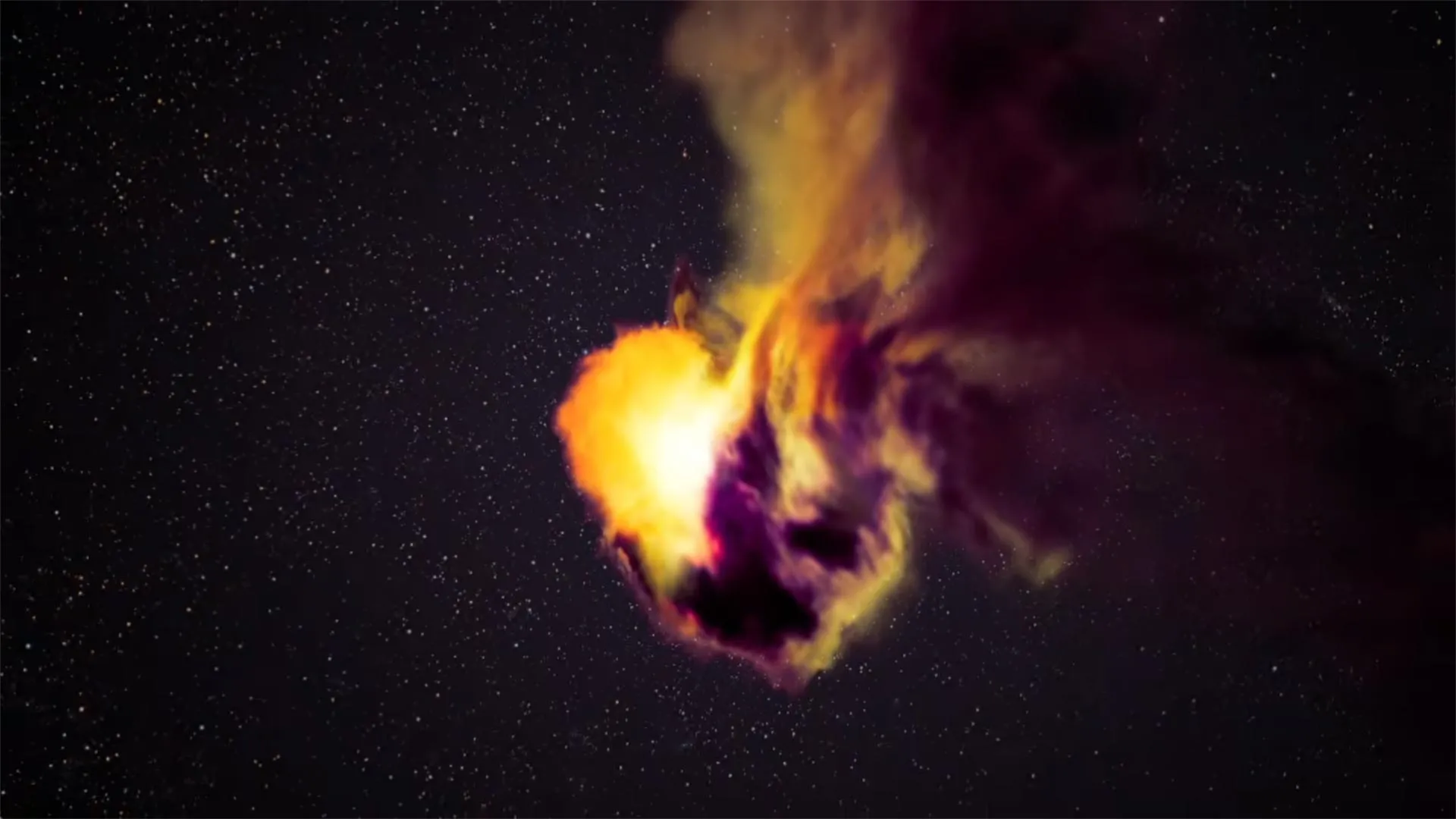
- Initial Detection: The supernova was first identified in 2021. Its light curve—the measurement of its brightness over time—immediately stood out to researchers because it did not fit the profile of a standard Type II (hydrogen-rich) or even a standard Type Ib/Ic (hydrogen-poor) supernova.
- Spectroscopic Analysis: Following the initial detection, the team performed spectroscopy, a technique that breaks down light into its constituent colors to reveal the chemical fingerprints of the material involved. The absence of hydrogen and helium lines, combined with the presence of heavy elements, confirmed the "extremely stripped" nature of the progenitor star.
- Identification of the Silicon Shell: As the supernova evolved, the interaction between the explosion’s shockwave and the surrounding circumstellar material (CSM) became apparent. The team identified that the star had ejected a massive amount of material—specifically from its silicon layer—only months before the final explosion.
- Data Correlation: By comparing the observations with computational models of stellar evolution, the researchers were able to reconstruct the final months of the star’s life, confirming that the ejected material was indeed the product of the final stages of nuclear burning.
The Mystery of the Stripping Process
One of the most significant challenges presented by SN 2021yfj is explaining how a star could lose so much of its mass so quickly. Standard stellar winds—the constant stream of particles ejected from a star’s surface—are generally not powerful enough to strip a star down to its silicon layer, especially on the short timescales required for such an event.
The silicon layer only exists for a few months before the star goes supernova. For this layer to be visible outside the star at the time of the explosion, the star must have shed all its outer layers (hydrogen, helium, carbon, oxygen, and neon) and then begun shedding its silicon layer in a very short window.
The most plausible explanation, according to the research team, involves a binary star system. In this scenario, the progenitor of SN 2021yfj was not a solitary star but was orbiting a companion star. As the progenitor expanded during its late evolutionary stages, its outer layers could have been pulled away by the gravity of the companion star—a process known as Roche lobe overflow. In more extreme cases, the two stars might have shared a "common envelope," where the progenitor’s outer layers engulfed both stars, leading to rapid mass loss as the companion spiraled inward. This gravitational interaction provides a mechanism for stripping the star far more efficiently than stellar winds alone.
Supporting Data and Observations
The data collected from SN 2021yfj provides a rare empirical benchmark for theoretical astrophysics. Key data points from the study include:
- Velocity of Ejecta: The speed at which the silicon-rich shell was moving suggested a high-energy ejection event shortly before the core collapse.
- Chemical Abundance: The spectra revealed a high concentration of intermediate-mass elements like magnesium and sulfur, in addition to silicon, which are the hallmarks of the final burning cycles in stars between 10 and 25 times the mass of the Sun.
- Luminosity Profile: The brightness of the supernova over time indicated that the explosion was "powered" by the interaction with dense surrounding gas, a phenomenon known as a Type Icn supernova, though SN 2021yfj represents an even more extreme version of this class.
Scientific Reactions and Implications
The astronomical community has reacted to the findings with significant interest. Dr. Steve Schulze noted that the observation of the silicon layer is a "holy grail" for stellar researchers, as it allows for the direct testing of the models used to describe how the universe’s heavy elements are produced.
While not directly quoted in the Nature paper in a narrative sense, the consensus among co-authors and the broader scientific community is that SN 2021yfj serves as a "Rosetta Stone" for understanding the deaths of massive stars in binary systems. Historically, it was assumed that most stars die in isolation, but recent decades of research suggest that the majority of massive stars are part of binary or multiple-star systems. SN 2021yfj provides the most compelling evidence to date of how these interactions can fundamentally alter the life cycle and eventual explosion of a star.
Broader Impact: The Origin of Elements
The implications of this research extend far beyond the study of a single supernova. Supernovae are the primary source of the elements that make up our world. While the Big Bang produced primarily hydrogen and helium, almost every other element in the periodic table was forged inside a star or during a stellar explosion.
- Oxygen and Neon: These elements, essential for the formation of planetary atmospheres and water, are primarily produced in the cores of massive stars and dispersed via core-collapse supernovae.
- Silicon and Magnesium: These are the primary components of rocky planets like Earth. The observation of a silicon-rich shell in SN 2021yfj provides a direct look at the "delivery system" for the building blocks of future solar systems.
- The Evolution of the Universe: By understanding how supernovae eject their material, scientists can better model the chemical evolution of galaxies over billions of years. Early in the universe’s history, stars were composed almost entirely of hydrogen. As successive generations of stars lived and died, they "polluted" the interstellar medium with heavier elements, allowing for the formation of complex chemistry, planets, and eventually, life.
Conclusion and Future Research
The study of SN 2021yfj confirms that our current theories regarding the internal "onion-skin" structure of massive stars are largely accurate. However, it also highlights the complexity of stellar mass loss and the critical role of binary interactions.
As next-generation observatories like the Vera C. Rubin Observatory come online, astronomers expect to find more examples of extremely stripped supernovae. These future observations will allow scientists to determine if SN 2021yfj was a unique outlier or if such extreme stripping is a common, though previously hidden, part of how the universe recycles stellar matter. For now, SN 2021yfj remains a singular beacon, providing a fleeting but profound glimpse into the final, desperate moments of a dying star and the birth of the elements that define our existence.