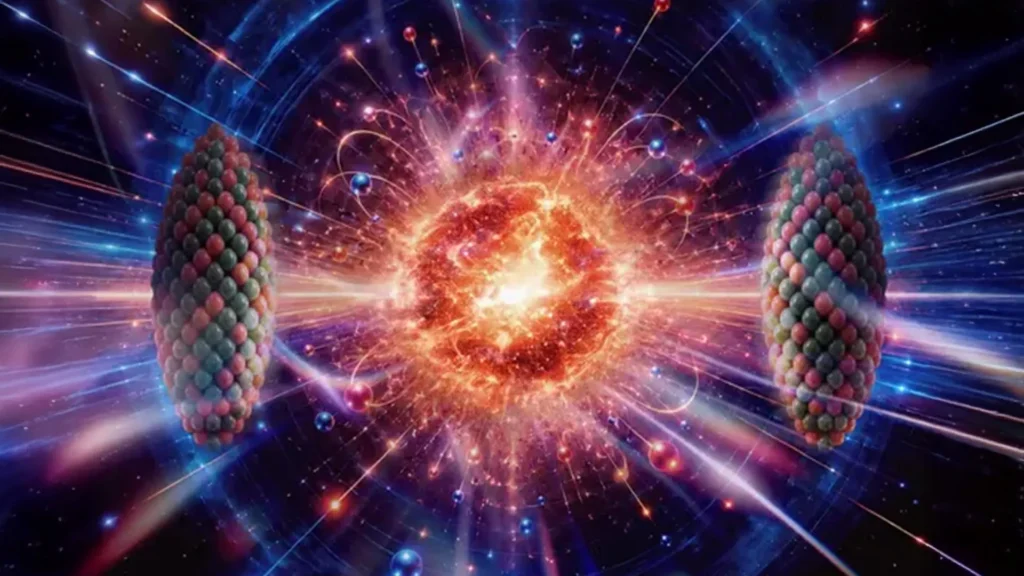
In the high-stakes world of particle physics, the quest to understand the fundamental building blocks of the universe often leads to the most extreme environments imaginable. When atomic nuclei, such as those of gold or lead, are accelerated to nearly the speed of light and collided within the subterranean tunnels of massive particle accelerators, they don’t just shatter; they melt. For a fleeting instant, this collision produces a substance known as quark-gluon plasma (QGP)—a "primordial soup" that existed merely microseconds after the Big Bang. While scientists have spent decades studying the temperature and "swirl" (vorticity) of this exotic matter, a groundbreaking study led by physicists at Fudan University has shifted the focus to a long-overlooked fundamental: acceleration.
The research team, spearheaded by Professor Yu-Gang Ma and Professor Xu-Guang Huang, has provided the first comprehensive map of acceleration within the quark-gluon plasma. Their findings suggest that acceleration is not merely a byproduct of the explosion but a core thermodynamic parameter that could reshape our understanding of the Quantum Chromodynamics (QCD) phase diagram—the "map" of how matter transitions between different states under extreme conditions.
The Genesis of the Perfect Fluid
To understand the significance of this research, one must first look back at the discovery of the quark-gluon plasma itself. In the early 2000s, experiments at the Relativistic Heavy Ion Collider (RHIC) at Brookhaven National Laboratory revealed that QGP does not behave like a gas, as originally predicted, but rather like a "nearly perfect fluid" with incredibly low viscosity. This discovery upended the field of nuclear physics, suggesting that quarks and gluons—the constituents of protons and neutrons—interact much more strongly than previously thought.
Since then, the scientific community has focused heavily on the plasma’s magnetic properties and its vorticity. In 2017, researchers confirmed that QGP is the most vortical fluid ever observed, spinning at rates that dwarf the most violent tornadoes or Jupiter’s Great Red Spot. However, as Professor Huang notes, "acceleration is just as fundamental as vorticity." Just as electric and magnetic fields are intrinsically linked in the study of electromagnetism, the acceleration and rotation of a fluid are the two pillars of its hydrodynamic evolution. Despite this, the specific dynamics of how this fireball accelerates outward had remained largely unmapped until now.
Methodology: Simulating the Subatomic Fireball
The Fudan University team utilized a sophisticated computational approach to track the evolution of the plasma. Because the life of a quark-gluon plasma droplet is measured in zeptoseconds (10^-21 seconds), it cannot be observed directly in real-time with traditional sensors. Instead, physicists rely on complex transport models that simulate the trajectories of thousands of particles produced in a collision.
The researchers integrated two of the most respected frameworks in the field: the A Multi-Phase Transport (AMPT) model and the Ultra-relativistic Quantum Molecular Dynamics (UrQMD) model. To bridge the gap between individual particle data and fluid dynamics, they employed a "Gaussian smearing" method. This technique effectively "smooths out" the data from thousands of discrete particles, transforming them into a continuous field of energy density, momentum, and velocity.
By applying these models across a vast range of collision energies—from 3.5 GeV (gigaelectronvolts) used in lower-energy experiments to 2.76 TeV (teraelectronvolts) at the Large Hadron Collider (LHC)—the team was able to observe how acceleration scales with the power of the impact.
The Discovery of Acceleration Hotspots
The results of the simulations revealed a striking phenomenon: the most intense acceleration does not occur at the center of the collision, but at the very edge of the expanding fireball. The team found that "proper acceleration" (the acceleration experienced by a particle in its own rest frame) can reach magnitudes of several hundred MeV (megaelectronvolts).
This concentration of force at the boundary is driven by the relativistic Euler equation, a cornerstone of fluid mechanics. At the edge of the QGP droplet, there is a violent drop in pressure as the plasma meets the vacuum of the accelerator pipe. Simultaneously, the enthalpy density (a measure of the system’s internal energy and pressure) remains low at the periphery. These two factors work in tandem to create a massive pressure gradient, slingshotting the outer layers of the plasma outward at staggering rates.
The study also highlighted a distinct difference in behavior based on collision energy. At lower energies (the "nuclear stopping" regime), the incoming nuclei have enough mass and "friction" to slow each other down upon impact, creating a significant deceleration phase of approximately 500 MeV. Conversely, at ultrarelativistic energies, the nuclei are so energetic that they essentially pass through one another, leaving behind a trail of energy that erupts into intense, brief pulses of acceleration.
The Unruh Effect: Turning Motion into Heat
Perhaps the most provocative aspect of the Fudan study is the connection between acceleration and the Unruh effect. In quantum field theory, the Unruh effect predicts that an observer undergoing extreme acceleration will perceive "empty" space as being filled with a warm bath of thermal radiation. In essence, for a particle accelerating at the rates seen in QGP, the vacuum itself begins to feel hot.
The researchers calculated that the acceleration levels of several hundred MeV are energetically comparable to the temperatures required for the QCD transition—the point where quarks and gluons are no longer "confined" inside protons and neutrons but move freely.
"This possibility suggests acceleration could add a new ‘acceleration axis’ to the phase structure of QCD matter," Professor Huang explained. Traditionally, the phase diagram of matter is defined by temperature and density (baryon chemical potential). If acceleration acts as a pseudo-temperature, it could influence the chiral symmetry restoration and the confinement-deconfinement transition, effectively adding a third dimension to our map of the fundamental states of matter.
Implications for Particle Spin and Global Polarization
Beyond the theoretical structure of matter, the study offers a potential solution to one of the most persistent mysteries in experimental physics: the "spin alignment" of particles. In high-energy collisions, particles called hyperons (such as the Lambda baryon) emerge with a specific spin orientation. While vorticity explains much of this alignment, experimental data from RHIC and the LHC have shown discrepancies that current models struggle to account for.
The Fudan team argues that the intense acceleration gradients at the plasma’s edge could generate previously unexplored transport effects. These effects may interact with the particles’ spin, providing the missing piece of the puzzle. By accounting for acceleration, researchers may finally be able to match their theoretical predictions with the actual spin patterns observed in collider detectors.
Chronology of Progress in QGP Research
The Fudan University study marks a significant milestone in a timeline of discovery that spans over four decades:
- 1980s: Theoretical predictions suggest that under extreme heat, nuclei will melt into a plasma.
- 2000: CERN announces evidence of a new state of matter.
- 2005: RHIC experiments confirm QGP behaves as a "perfect liquid" rather than a gas.
- 2017: QGP is confirmed as the most vortical fluid in existence.
- 2020-2023: Research shifts toward "sub-nucleonic" fluctuations and small-system collisions (proton-lead).
- 2024: The Ma and Huang team provides the first systematic mapping of acceleration as a thermodynamic control parameter.
Future Outlook: Searching for the "Smoking Gun"
The scientific community has reacted to the study with cautious optimism. While the theoretical framework is robust, the next challenge lies in experimental verification. The Fudan researchers are already planning the next phase of their work, which involves incorporating more realistic (3+1)D hydrodynamic evolution into their calculations.
The ultimate goal is to identify a "smoking gun" signature—a specific pattern in the distribution or polarization of particles that can only be explained by the influence of acceleration. If successful, this would transform acceleration from a theoretical curiosity into a practical tool for probing the strongest forces in nature.
As Professor Huang concluded, the study of quark-gluon plasma is about more than just understanding high-energy collisions; it is about understanding the origin of the universe itself. By mapping the hidden dimension of acceleration, physicists are peering deeper into the first moments of time, turning non-inertial quantum effects into measurable signatures that define the very fabric of reality. The "acceleration axis" may soon become a standard feature of the maps used to navigate the subatomic world, providing a clearer picture of how the universe transitioned from a chaotic, accelerating soup of quarks into the structured world of atoms and galaxies we inhabit today.