In a significant advancement for the field of condensed matter physics, a team of researchers at the University at Buffalo (UB) has unveiled a theoretical framework for a new quantum sensing method designed to identify and characterize altermagnets. This third class of magnetic materials, which remained hidden from scientific classification for decades, holds the potential to fundamentally transform the landscape of modern electronics. By utilizing microscopic defects within diamonds, the proposed sensing technique offers a non-invasive and highly precise way to verify the existence and behavior of these elusive materials, bridging the gap between theoretical prediction and industrial application.
The research, published in the prestigious journal Physical Review Letters, marks a pivotal moment in the study of magnetism. For nearly a century, the scientific community operated under the understanding that magnetism was primarily divided into two categories: ferromagnetism and antiferromagnetism. The emergence of altermagnetism—a state that combines the most desirable properties of both—has sparked a global race to identify suitable materials and integrate them into the next generation of computing hardware.
The Evolution of Magnetism: From Ancient Lodestones to Altermagnets
To understand the magnitude of the University at Buffalo’s proposal, it is necessary to examine the historical context of magnetic classification. Ferromagnetism is the most familiar form, exemplified by the common refrigerator magnet. At the atomic level, the electron spins in a ferromagnet are aligned in the same direction, creating a strong external magnetic field. This alignment allows ferromagnets to be easily manipulated by external fields, making them the backbone of magnetic data storage, such as hard drives. However, ferromagnets face limitations in speed and scalability; the magnetic fields they produce can interfere with neighboring components in miniaturized circuits.
Antiferromagnetism, discovered in the mid-20th century, represents the opposite arrangement. In these materials, neighboring electron spins point in opposite directions, effectively canceling each other out and resulting in zero net external magnetism. While this lack of a magnetic field makes them difficult to detect and manipulate, antiferromagnets possess a significant advantage: they can switch their magnetic states at terahertz (THz) frequencies—thousands of times faster than the gigahertz (GHz) speeds typical of ferromagnets.
The concept of altermagnetism was first proposed less than a decade ago, gaining significant traction around 2019. Researchers at the Johannes Gutenberg University of Mainz, led by Libor Šmejkal and Jairo Sinova, noticed anomalies in materials like ruthenium dioxide ($RuO_2$). These materials appeared to have no net magnetization, suggesting they were antiferromagnets, yet they exhibited electronic properties—such as the anomalous Hall effect—usually reserved for ferromagnets. This realization led to the classification of altermagnets: materials where the atoms are arranged in a way that the magnetic moments cancel out, but the underlying crystal symmetry allows the electronic energy bands to become "spin-split." This means that even without an external magnetic field, electrons with different spins move through the material differently.
A Quantum Lens: The Diamond Defect Sensing Method
Despite the excitement surrounding altermagnets, identifying them in a laboratory setting remains a formidable challenge. Conventional tools often lack the sensitivity to distinguish the subtle directional patterns of altermagnets from those of standard antiferromagnets. This is where the University at Buffalo’s intervention becomes critical.
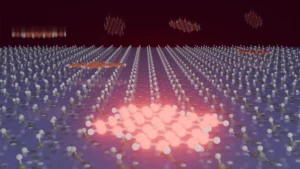
The team, led by Jamir Marino, PhD, an assistant professor of physics at UB, proposed using a quantum sensor known as a Nitrogen-Vacancy (NV) center. An NV center is a point defect in a diamond’s crystal lattice where a nitrogen atom replaces a carbon atom, and an adjacent site in the lattice is left vacant. This defect behaves like a single atom trapped in a solid, and its quantum state is extremely sensitive to nearby magnetic fluctuations.
The proposed experiment involves placing a diamond containing an NV center in close proximity to a candidate altermagnetic material. Researchers would then use laser pulses to "prepare" the magnetic spin of the NV center in a specific orientation. Over time, the magnetic environment of the altermagnet causes the NV center’s spin to lose its orientation—a process known as relaxation.
"The key is the directionality," explains Marino. "Because of the unique symmetry of altermagnets, the way they cause the NV center to relax will change depending on the orientation of the defect’s spin. In a standard antiferromagnet, the relaxation might be uniform, but in an altermagnet, we expect to see telltale signatures that vary as we rotate the sensing spin. This provides a ‘fingerprint’ that is unique to the altermagnetic state."
Chronology of Discovery and Development
The journey toward this sensing proposal has been a collaborative effort spanning several years and multiple international institutions:
- 2019: Researchers at Johannes Gutenberg University Mainz identify ruthenium dioxide as a potential candidate for a new type of magnetic behavior that does not fit the ferromagnet/antiferromagnet binary.
- 2021-2022: Theoretical work formalizes the concept of "altermagnetism," predicting that over 200 materials—including common insulators and metals—could belong to this category.
- 2023: Experimental signatures of altermagnetism begin to emerge in various labs using photoemission spectroscopy, but the results remain difficult to replicate or interpret due to the invasive nature of the tests.
- 2024: The University at Buffalo team, in collaboration with the original Mainz theorists, publishes the NV center sensing proposal in Physical Review Letters, providing a non-invasive roadmap for future experiments.
Technical Data and Implications for Spintronics
The shift toward altermagnets is driven by the urgent need to move beyond traditional semiconductor technology. As electronic components shrink, they generate more heat due to electrical resistance. Spintronics—electronics that utilize the "spin" of an electron rather than its charge—offers a solution. Because spin can be manipulated with less energy than charge transport, it promises devices that are both faster and more energy-efficient.
Data suggests that altermagnets could outperform current materials in several key metrics:
- Switching Speed: Altermagnets are predicted to operate in the terahertz range. Current silicon-based transistors and ferromagnetic memory (MRAM) operate largely in the low gigahertz range. A jump to THz could increase processing speeds by a factor of 1,000.
- Scalability: Because altermagnets have no net external magnetic field, they do not suffer from "stray field" interference. This allows individual magnetic bits to be packed much closer together on a chip without corrupting each other’s data.
- Material Abundance: Preliminary database screenings suggest that altermagnetic properties might exist in more than 200 materials. In comparison, there are only about 100 known high-quality ferromagnetic materials used in technology today.
The UB proposal is particularly significant because it addresses the "observation problem." In many condensed matter experiments, the act of measuring a sample can alter its state. The NV center approach is "passive" in the sense that the diamond sensor sits near the material without requiring a direct electrical connection or high-energy bombardment, preserving the material’s natural quantum dynamics.
Reactions from the Scientific Community
The proposal has been met with enthusiasm from the researchers who first theorized the existence of altermagnets. Jairo Sinova, a co-author of the study and a leading figure in the Mainz group, noted that the sensing technique could become an essential tool for the global physics community. "It offers advantages over conventional experimental techniques by detecting subtle directional magnetic patterns across different regions of a material without significantly disturbing it," Sinova stated.
The collaborative nature of the research—involving experts from the University at Buffalo, the Johannes Gutenberg University of Mainz, the Max Planck Institute, and the University of Strasbourg—underscores the interdisciplinary effort required to advance quantum materials science.
Jamir Marino emphasizes that while the proposal is currently theoretical, it is grounded in sophisticated models of quantum dynamics. "We have provided the blueprint," Marino says. "The next step is for experimentalists to take these diamond sensors and apply them to the candidate materials we’ve identified. If the results match our predictions, we will have confirmed a new state of matter that has been right under our noses for a century."
The Broader Impact: Energy Efficiency and AI
The long-term implications of identifying and utilizing altermagnets extend far beyond the laboratory. As the world becomes increasingly reliant on data centers and artificial intelligence, the energy consumption of computing has become a global concern. Modern data centers consume nearly 1% of the world’s total electricity, much of which is dissipated as heat.
Altermagnetic spintronics could lead to "non-volatile" memory that does not require a constant flow of electricity to maintain data, combined with the processing speed of the fastest current semiconductors. This would not only reduce the power requirements of massive server farms but also extend the battery life of consumer electronics, from smartphones to electric vehicle control systems.
Furthermore, the precision of NV center sensing has applications in other areas of quantum technology. The ability to detect minute magnetic signatures at the atomic scale is a cornerstone of quantum computing and high-precision medical imaging. The success of the UB team’s method in the realm of magnetism could pave the way for similar sensing techniques in other branches of material science.
Conclusion
The proposal by the University at Buffalo researchers represents a vital bridge between theoretical physics and practical engineering. By providing a clear, non-invasive method to identify altermagnets, the team has cleared a major hurdle in the path toward a new era of electronics. As experimentalists begin to implement this "quantum fingerprinting" technique, the scientific community moves one step closer to a future where computers are not only faster and more powerful but also fundamentally more efficient. The discovery of altermagnets may well be remembered as a turning point in the history of magnetism, and the UB sensing technique as the key that unlocked its potential.