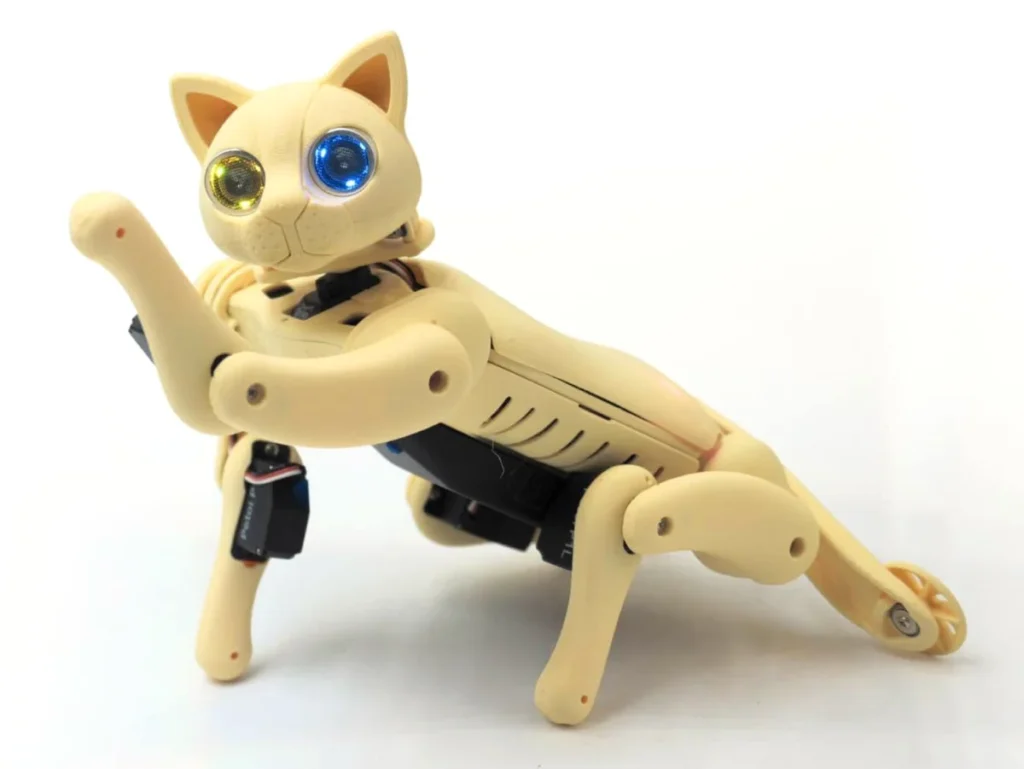
The core appeal of Petoi’s offerings lies in their dual functionality: immediate out-of-the-box entertainment coupled with profound potential for deep exploration and customization. Both Nybble Q and Bittle X V2 come equipped with built-in voice command responses, allowing users to interact with their robotic pets from the moment they are powered on. This initial ease of use serves as an engaging entry point, captivating new users and quickly demonstrating the robots’ capabilities. For instance, the Nybble Q cat is frequently cited as an impressive showpiece, capable of eliciting delight and curiosity from new guests with its responsive movements and interactive behaviors. This immediate gratification is strategically designed to hook users before they delve into the more complex, rewarding world of programming. A teacher friend, upon witnessing a brief demonstration of Nybble Q’s capabilities, was convinced of its educational potential and intended to acquire one for classroom use, highlighting its practical appeal in STEM environments.
Beyond their initial charm, the true power of these robots unfolds through their programmability. Petoi has ensured a versatile programming environment, catering to a wide range of skill levels. Users can program the robots via intuitive mobile and desktop applications, utilizing a spectrum of coding paradigms including Arduino, Python, and the visual block-based language Mind+. This multi-faceted approach ensures that beginners can start with simpler drag-and-drop coding while experienced programmers can leverage the full power of Python or Arduino for more complex algorithms and custom behaviors. Accompanying lessons further guide users through various programming challenges, effectively transforming the robots into dynamic, interactive learning platforms. The inclusion of sensors and flexible behaviors allows for a rich learning experience, where concepts of control systems, sensor integration, and artificial intelligence can be explored in a tangible, real-world context.
Nybble Q: The Agile Feline Robot
The Nybble Q, an evolution of the original wooden Nybble, stands out with its sleek, 3D-printed body and enhanced capabilities. Positioned as a premium option, it builds upon its predecessor’s features, which already included an extra servo for tail wagging, distance sensors, and color-changing eyes designed to indicate "good" or "evil" states – a charming touch that adds personality and aids in visual feedback. The "Q" iteration elevates this experience with an upgraded board and superior servos, contributing to smoother, more precise movements. Crucially, the Nybble Q integrates built-in voice control, making interactions more natural and immersive. The reviewer noted impressive accuracy in voice recognition, despite occasional amusing misinterpretations, such as "coffee table" becoming "be table," indicating a robust speech processing system for a device of its class. The ability to control the robot with verbal commands significantly enhances its appeal as an interactive companion and an educational tool for exploring natural language processing.

One of the significant improvements in the Nybble Q is the introduction of servo feedback control, a feature that allows users to manually manipulate the robot’s limbs to design and record custom actions. This intuitive method of programming offers a direct, kinesthetic way to teach the robot new tricks and movements, making complex motion sequencing more accessible. Furthermore, for users seeking to push the boundaries of the robot’s computational power, the Nybble Q offers compatibility with a Raspberry Pi. This integration allows for a distributed cognitive load, where the Raspberry Pi can handle more intensive computations like advanced AI algorithms or complex vision processing, while the primary BiBoard V1.0 manages real-time motor control and basic sensor processing. This expandability underscores Petoi’s commitment to providing a platform that grows with the user’s skills and ambitions.
The learning journey with Nybble Q is further supported by a comprehensive curriculum and an active online community. While the reviewer received pre-assembled units, acknowledging potential initial stumbles (like a disconnected servo plug that was quickly resolved), the vibrant community proved invaluable for troubleshooting and sharing insights. This peer-to-peer support network is a hallmark of successful open-source hardware projects, ensuring that users are never left stranded with technical challenges. The provided curriculum, a thoughtful addition, guides users through various projects and concepts, solidifying the educational value of the robot. This blend of cutting-edge hardware, flexible software, and strong community support makes the Nybble Q a highly effective tool for STEM education, particularly in areas like mechanical engineering, computer science, and robotics.
Bittle X V2: The Versatile Canine Robot
The Bittle X V2, the dog-like counterpart, mirrors many of the advancements seen in the Nybble Q, making it an equally compelling platform for robotics exploration. This version also features built-in voice control and an upgraded ESP32-based board, offering enhanced processing capabilities and connectivity. While it foregoes the Nybble Q’s ultrasonic eyes, the Bittle X V2 champions modularity, particularly around its "mouth" area. This design choice allows users to integrate a variety of sensors, including light, motion, and gesture sensors, and even an AI camera module. This modularity makes Bittle X V2 an excellent choice for projects requiring advanced environmental interaction, computer vision, or more sophisticated AI applications. The ability to swap out sensors encourages experimentation and provides a practical understanding of how different sensor inputs contribute to a robot’s perception and decision-making processes.
A unique and particularly engaging option for the Bittle X V2 is the inclusion of a robot arm, which replaces the traditional head. This configuration transforms the quadruped into a mini-industrial robot, capable of performing pick-and-place tasks. The reviewer expressed surprise at the arm’s strength, noting its ability to pick up and toss small toys. This feature introduces users to concepts of robotic manipulation, kinematics, and task automation. While the reviewer personally preferred the nimbleness and expandability of the Bittle with a head for broader applications, the robot arm option undeniably offers a distinct and valuable learning pathway for those interested in industrial robotics or more direct physical interaction with the environment. For educational settings, the arm provides a tangible demonstration of robotics in manufacturing or logistics. A Bittle X V2 kit is also available without the arm, offering a solid foundational robot for general robotics exploration.

Both Petoi robots are equipped with an Inertial Measurement Unit (IMU), which plays a crucial role in their ability to maintain balance and recover from falls. The IMU provides data on orientation, angular velocity, and gravitational forces, allowing the robot to detect when it has tipped over and attempt to right itself. This self-righting capability, though sometimes taking a few seconds to find its balance on smooth surfaces, demonstrates a fundamental concept in robotic locomotion and stability control. This feature not only adds to the robots’ robustness but also provides a practical example of sensor-driven feedback loops in action, a core principle in advanced robotics. The micro:bit-powered remote control, while less frequently used due to effective voice commands, offers an alternative input method and introduces users to another widely adopted microcontroller platform.
Technical Foundations and Educational Pedagogy
The underlying technical architecture of Petoi robots is designed to be robust yet accessible. The BiBoard V1.0, central to Nybble Q, and the ESP32-based board in Bittle X V2, serve as powerful microcontrollers capable of handling complex servo control, sensor data processing, and communication. The choice of ESP32, known for its Wi-Fi and Bluetooth capabilities, further enhances connectivity, enabling wireless programming and control. The integration of various programming environments—Arduino, Python, and Mind+—reflects a thoughtful pedagogical approach. Arduino is ideal for low-level hardware control and real-time operations, providing a gateway to embedded systems programming. Python, with its vast libraries and ease of use, opens doors to AI, data processing, and more complex algorithmic development. Mind+, a graphical block-based environment, caters specifically to beginners, making programming concepts intuitive and less intimidating. This tiered approach ensures that users can progress at their own pace, gradually tackling more advanced concepts as their skills develop.
The curriculum provided by Petoi is a critical component of its educational ecosystem. It is designed to guide users through a structured learning path, covering fundamental robotics principles, programming logic, and practical application. Such structured learning resources are vital for turning a sophisticated piece of hardware into an effective educational tool. In an era where STEM (Science, Technology, Engineering, and Mathematics) education is paramount, hands-on tools like Petoi robots offer an invaluable advantage. They transform abstract concepts into concrete experiences, fostering problem-solving skills, critical thinking, and computational literacy. The global market for educational robots is projected to grow significantly, driven by increasing demand for STEM skills and the adoption of gamified learning approaches. Reports from industry analysts suggest a compound annual growth rate (CAGR) exceeding 20% for the educational robotics market in the coming years, indicating a strong trend towards integrating such technologies into learning environments. Petoi’s offerings align perfectly with this trend, providing a tangible platform for students and hobbyists to engage with future technologies.
User Experience, Community Engagement, and the Maker Ethos
Petoi’s robots are not consumer products in the traditional sense, where every interaction is seamlessly pre-programmed and foolproof. Instead, they embody the spirit of an "intermediate project." This classification is crucial for understanding the target audience and the expected user journey. While they arrive preassembled, alleviating the initial hurdle of complex mechanical construction, they are designed with expandability and customizability in mind. This means users are encouraged to delve into their internal workings, whether it’s for troubleshooting a minor issue like a misconnected servo plug or integrating additional sensors and modules. The design allows for easy access to internal components, often tool-free, though this can expose delicate parts like ribbon cables, requiring a degree of careful handling. This approach empowers users to become true "makers" rather than just consumers, fostering a deeper understanding and appreciation for the engineering behind the robots.

The active online community surrounding Petoi robots is a testament to this maker ethos. It serves as a dynamic knowledge base, a troubleshooting forum, and a platform for sharing innovations and project ideas. This community support is invaluable, particularly for projects that encourage experimentation and modification. When hardware documentation might be confusing or a specific programming challenge arises, the collective intelligence of the community often provides rapid and effective solutions. This collaborative environment enhances the learning experience, encouraging users to engage with peers, learn from others’ experiences, and contribute their own findings. This community-driven development model is highly effective in sustaining interest and expanding the capabilities of open-source hardware platforms, offering a continuous source of inspiration and technical assistance that might otherwise be absent in more closed systems.
Broader Impact and Implications for Robotics Education
The Petoi Nybble Q and Bittle X V2 hold significant implications for the broader landscape of robotics education and hobbyist engagement. By offering sophisticated, programmable quadruped robots at an accessible price point (relative to industrial or research-grade robots), Petoi is effectively democratizing access to advanced robotics and AI learning. These robots are not just teaching tools; they are platforms for innovation. The ability to integrate Raspberry Pi for more advanced AI, add diverse sensors for environmental interaction, and program custom behaviors in multiple languages means that the learning potential is virtually limitless. This modularity and open-ended design encourage users to think creatively, solve problems, and develop their own unique applications, fostering a crucial skill set for the modern technological era.
The trend of integrating AI capabilities, such as voice control and AI camera modules, into educational robots is particularly noteworthy. It introduces users to the practical applications of artificial intelligence in areas like natural language processing, computer vision, and autonomous decision-making. As AI continues to permeate every aspect of technology, providing hands-on experience with AI-powered robotics from an early stage is crucial for preparing the next generation of engineers, scientists, and innovators. Petoi’s commitment to providing a comprehensive curriculum further solidifies its role as a leader in this space, ensuring that users not only have access to cutting-edge hardware but also the structured guidance needed to master complex concepts. The flexibility to choose between the Nybble Q’s integrated distance sensors for autonomous roaming or the Bittle X V2’s robust modularity for more physically interactive tasks, ensures that different learning objectives and project aspirations can be met. These robots exemplify the convergence of advanced technology with educational accessibility, making complex subjects engaging and actionable.
In conclusion, both the Petoi Nybble Q and Bittle X V2 stand as exemplary starting points for anyone interested in the captivating world of robotics. Whether one prefers the sleek feline agility of the Nybble Q with its distance sensors and expressive eyes, or the robust versatility of the Bittle X V2 with its modular sensor options and powerful robot arm add-on, Petoi offers a rich and rewarding experience. These robots are carefully crafted to balance immediate engagement with deep educational potential, fostered by flexible programming options, a supportive community, and a commitment to expandability. They are more than just robots; they are gateways to understanding the future of technology, providing invaluable hands-on experience in an increasingly automated and intelligent world. The continued evolution of products like these underscores the vital role of accessible, programmable hardware in shaping the technological literacy of tomorrow.