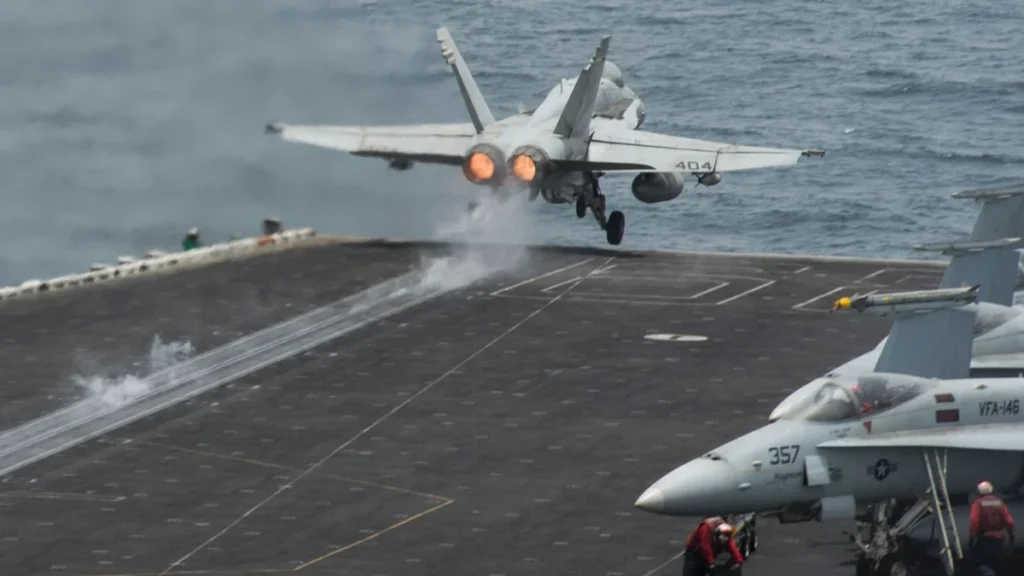
President Donald Trump has issued a definitive order mandating the U.S. Navy to revert to traditional steam-powered aircraft catapults for all future Ford-class aircraft carriers, effectively reversing the service’s long-standing strategic pivot towards the advanced Electromagnetic Aircraft Launch System (EMALS). This directive marks a significant and contentious shift in naval shipbuilding policy, impacting carriers already deep into their development cycles and raising substantial questions regarding cost, schedule, and technological direction. The Pentagon has been given a stringent 60-day deadline to formulate and present a comprehensive plan detailing the replacement of EMALS with steam catapults on the forthcoming USS Doris Miller (CVN-81) and all subsequent carriers in the class.
Background of the Ford-Class and EMALS Adoption
The Gerald R. Ford-class aircraft carriers represent the pinnacle of modern naval engineering, designed to be the backbone of the U.S. Navy’s global power projection for the 21st century. Introduced as the successor to the venerable Nimitz-class, the Ford-class was envisioned to integrate a suite of next-generation technologies aimed at enhancing operational efficiency, reducing manning requirements, and increasing sortie generation rates. Central to this technological leap was the Electromagnetic Aircraft Launch System (EMALS) and its companion Advanced Arresting Gear (AAG).
Development of EMALS began in the late 1990s, driven by the Navy’s desire to overcome the inherent limitations of steam catapults. Traditional steam catapults, while reliable and proven over decades of service, require massive amounts of high-pressure steam, complex plumbing, and a significant freshwater supply. They also exert considerable stress on aircraft airframes due to their instantaneous, high-impact launch. EMALS, by contrast, utilizes a linear induction motor to gradually accelerate aircraft, offering a smoother, more controlled launch profile. This electromagnetic system promised several key advantages: a wider range of launch capabilities for diverse aircraft weights, including lighter unmanned aerial vehicles (UAVs); reduced maintenance and personnel requirements; lower energy consumption compared to steam generation; and the elimination of freshwater demands for launch operations, thereby freeing up significant onboard resources.
The first three carriers of the class—USS Gerald R. Ford (CVN-78), USS John F. Kennedy (CVN-79), and USS Enterprise (CVN-80)—were designed from their inception around EMALS and AAG. The USS Gerald R. Ford, commissioned in 2017, became the first carrier to integrate these systems. However, the path to implementation has been fraught with challenges. Both EMALS and AAG experienced significant developmental delays and cost overruns during testing and integration. Initial reports indicated issues with system reliability and software complexities, leading to periods of reduced operational availability and fueling criticism from various quarters, including then-candidate Donald Trump.
Presidential Criticism and the Directive
President Trump has been a vocal critic of EMALS for years, frequently lambasting the system as overly complex, exorbitantly expensive, and less reliable than the battle-tested steam catapults it was designed to replace. His skepticism has been a consistent theme, often highlighted during public addresses and military events. He has repeatedly expressed a preference for proven, robust technologies, questioning the wisdom of adopting unproven systems that introduce significant risk and cost into critical defense programs.
The latest directive underscores this long-standing position. It explicitly calls for the Navy to develop a plan to replace EMALS with traditional steam catapults on the future USS Doris Miller and all subsequent Ford-class carriers. The Doris Miller, slated to be the fourth carrier in the class, is currently well into its development phase. Its keel is scheduled to be laid by the end of 2026, with an anticipated delivery date in 2034. The decision to mandate a technological reversion at this advanced stage of design and planning is highly unusual and has sparked immediate debate within defense circles, the Navy, and industry.
The EMALS System: A Deeper Dive into Advantages and Challenges
At its core, EMALS represents a significant leap in aircraft launch technology. Instead of the piston-and-cylinder mechanism driven by high-pressure steam, EMALS employs a series of linear induction motors that generate a powerful electromagnetic field. This field propels a shuttle attached to the aircraft down the flight deck, accelerating it to takeoff speed with precision and control.
-
Advantages:
- Versatility: EMALS can launch a wider array of aircraft, from the heaviest manned fighters to much lighter unmanned systems, by precisely controlling the launch force. This adaptability is crucial for future air wings that are expected to incorporate more diverse platforms.
- Reduced Stress: The smoother, more gradual acceleration provided by EMALS reduces stress on aircraft airframes, potentially extending their operational life and reducing maintenance requirements for the aircraft themselves.
- Efficiency: While the initial power requirements are substantial, EMALS systems are designed to be more energy-efficient in the long run, reducing the need for constant steam generation and the associated demands on the ship’s propulsion system.
- Reduced Manning: Automation within EMALS aims to reduce the number of personnel required for launch operations compared to steam catapults.
- Sustainability: Eliminating the need for thousands of gallons of freshwater daily for steam generation is a significant logistical and resource advantage, particularly during extended deployments.
-
Challenges and Criticisms:
- Reliability Issues: Early operational testing on the USS Gerald R. Ford revealed lower-than-expected reliability rates, leading to concerns about the system’s ability to maintain high sortie generation rates in combat scenarios. While the Navy and General Atomics (the primary contractor) have worked to improve these metrics, initial performance lagged behind expectations.
- Cost Overruns: The development and integration of EMALS and AAG contributed significantly to the Ford-class program’s overall cost escalation. The total development cost for EMALS and AAG alone reportedly exceeded $3.5 billion, with significant additional costs for integration and testing.
- Complexity: The system’s advanced electronics and software-driven controls are inherently complex, requiring specialized training and infrastructure for maintenance and troubleshooting. Critics argued this complexity made the system more vulnerable to failures and harder to repair at sea.
- Single Point of Failure Concerns: While designed with redundancy, concerns were raised about the potential for system-wide failures impacting launch capabilities.
The Reversal’s Immediate and Long-Term Implications
The presidential directive to switch back to steam catapults on the USS Doris Miller and subsequent carriers presents a monumental engineering and logistical challenge. The Doris Miller is not merely on paper; its design has progressed significantly, with core architectural decisions already made around the integration of EMALS.
-
Extensive Redesign: Accommodating steam catapults necessitates a fundamental redesign of vast sections of the carrier. This includes:
- Machinery Spaces: Reconfiguring propulsion and auxiliary machinery spaces to house the massive boilers, steam accumulators, and associated piping required for steam generation. The Ford-class was designed with a more compact power plant, optimizing for EMALS’ electrical demands.
- Piping and Water Systems: Integrating an extensive network of high-pressure steam pipes and freshwater systems for catapult operations. This impacts hull integrity, internal layouts, and the ship’s overall weight and balance.
- Electrical Systems: While steam catapults primarily rely on steam, they still require electrical power for controls and support systems. Reverting means moving away from the integrated power system (IPS) architecture that was specifically designed to support the high electrical loads of EMALS and other advanced systems.
- Deck Configuration: Minor adjustments to the flight deck structure and catapult troughs will be necessary to fit the physical dimensions and operational requirements of steam catapults.
-
Cost and Schedule Impact: The most immediate and significant concern is the potential for substantial cost overruns and protracted delays. Defense analysts and industry sources, including General Atomics, have warned that such a mid-development change could add billions of dollars to the program’s cost. Estimates for redesign work, re-procurement of older systems, and integration could range from $1 billion to $3 billion per ship, not including the opportunity cost of delays. The scheduled keel laying for the Doris Miller by late 2026 and its 2034 delivery date are now under severe threat. Each year of delay for a carrier program can cost hundreds of millions, if not billions, in escalated construction costs and deferred operational capability.
-
Industrial Base Re-tooling: The Navy has spent years, if not decades, gradually phasing out its reliance on steam-powered catapults, leading to a natural attrition of specialized skills, manufacturing capabilities, and supply chains for these older systems. Reverting to steam means the Navy and its contractors will need to rebuild parts of this industrial ecosystem, including sourcing components, training personnel, and potentially restarting production lines for parts that were considered obsolete. This presents a complex challenge, as many suppliers may have shifted focus or exited the market for steam-related naval components.
Strategic and Geopolitical Ramifications
The decision carries significant strategic and geopolitical weight, particularly in the context of global naval power projection.
- Perception of Technological Leadership: The U.S. has long been at the forefront of naval innovation. The Ford-class, with EMALS, was touted as a symbol of this technological edge. Reverting to older technology could be perceived as a step backward, potentially impacting the perception of U.S. naval superiority, especially as competitors advance their own capabilities.
- China’s Advancement: The irony of the U.S. decision is stark when viewed against China’s naval modernization efforts. China’s third aircraft carrier, the Fujian, notably features an electromagnetic launch system, mirroring the very technology the U.S. is now moving away from for future carriers. This development suggests that China is embracing the advantages of EMALS, making the U.S. reversal particularly conspicuous in the ongoing carrier aviation race between the two powers. It could raise questions about which nation is truly leading in future naval technology.
- Naval Modernization Strategy: The directive challenges the Navy’s long-term modernization strategy, which has consistently aimed at integrating advanced technologies to maintain a qualitative advantage. It forces a reassessment of risk tolerance for new systems versus the perceived reliability of older, proven ones.
Official and Industry Reactions (Inferred)
While no official public statements directly contradicting the President have been made, the implications are likely generating significant internal discussion and concern within the Navy and defense industry.
- Navy Officials: Faced with a direct presidential order, the Navy’s immediate task is compliance. However, senior naval officers and engineers are undoubtedly grappling with the practicalities of the directive. Their 60-day plan will need to meticulously detail the engineering challenges, cost estimates, and schedule impacts. It’s plausible that their plan, while adhering to the directive, will also highlight the extensive difficulties and potential consequences.
- General Atomics: As the primary developer and manufacturer of EMALS, General Atomics stands to lose substantial future contracts. The company has previously warned about the significant financial and schedule disruptions of removing EMALS from already-designed carriers. They would likely emphasize the system’s continuous improvements and maturing reliability, advocating for its retention.
- Defense Analysts and Congressional Oversight: Defense analysts are likely to echo concerns about the efficiency and cost-effectiveness of the reversal, highlighting the sunk costs in EMALS development and the future expenditures on redesign and re-tooling. Congressional oversight committees would likely demand detailed justifications for the change, focusing on its budgetary impact and implications for national defense readiness.
The Path Forward
The Navy now faces a complex dilemma. The question is no longer merely whether EMALS works as designed, but whether replacing a technically advanced, albeit initially troubled, system with an older, mature technology, after the carrier was fundamentally designed around the newer one, makes strategic and economic sense at this late stage of construction.
The 60-day deadline for the Pentagon to produce a replacement plan will be critical. This plan will not only outline the technical roadmap for reverting to steam catapults but also lay bare the projected costs, potential delays, and the broader impact on the Ford-class program and the Navy’s long-term shipbuilding strategy. The decision on the Doris Miller will set a precedent for all subsequent Ford-class carriers, effectively bifurcating the class into those with EMALS and those with steam catapults. This split could introduce additional logistical and operational complexities for maintenance, training, and parts commonality across the fleet.
Ultimately, President Trump’s directive represents a powerful assertion of presidential authority over defense procurement, prioritizing perceived reliability and cost-effectiveness over cutting-edge innovation. The coming months will reveal the full extent of the engineering, financial, and strategic repercussions of this significant reversal in U.S. naval policy.






