In the vast and continuously evolving landscape of electrical engineering, the classification of electric motors often delves into their fundamental operational principles and structural designs. These classifications typically hinge on factors such as their power source (AC or DC), their construction methodologies, or, critically, the intricate properties of their magnetic circuits. Among the most common distinctions are radial flux and axial flux machines, terms that describe the orientation of the magnetic flux relative to the motor’s axis of rotation. However, a distinct and increasingly relevant category, transverse flux motors, presents a unique set of magnetic flux characteristics that position them as a compelling alternative for demanding applications.
The overwhelming majority of electric motors encountered in industrial and domestic settings today are radial flux designs. In these machines, the magnetic flux traverses perpendicularly to the axis of rotation. Visualizing a conventional AC synchronous motor or a standard DC motor, one imagines a central motor shaft—an integral part of the internal rotor—enclosed within a stationary stator. Here, the magnetic field lines radiate outwards or inwards, perpendicular to the rotational path of the rotor. This design has been perfected over more than a century, offering robust performance, established manufacturing processes, and a wide range of power outputs suitable for countless applications from pumps and fans to electric vehicles.
Conversely, axial flux motors are engineered so that their magnetic flux travels parallel to the axis of rotation. This distinct arrangement often results in a flatter, more compact physical profile compared to their radial flux counterparts. The archetypal example of an axial flux motor is the "pancake-style" motor, characterized by its thin, disc-like shape. This geometry is particularly advantageous in applications where space is at a premium, such as in certain automotive designs, drone propulsion systems, and integrated robotics where a low profile is essential for design flexibility and packaging constraints. While offering a higher power density in terms of volume, axial flux motors can sometimes present challenges in terms of thermal management due to their compact structure.
Transverse flux motors represent a radical departure from both radial and axial designs, featuring a magnetic flux path that is fundamentally transverse to the axis of rotation. This means the magnetic flux flows across the axis rather than perpendicular to it or parallel with it. In practical terms, this innovative architecture typically involves a single winding for each phase, circumferentially wound around the stator, or the axis of rotation itself. This unique winding configuration facilitates a multi-directional flow of magnetic flux, allowing it to propagate axially across the stator, along the circumference of the rotor, and radially through the air gap separating these components. This complex, three-dimensional flux path is a defining characteristic and a key enabler of their exceptional performance attributes.
The Evolution of Motor Design and the Rise of Novel Architectures
The quest for more efficient, powerful, and compact electric motors has been a continuous thread throughout the history of electrical engineering. From Faraday’s early experiments to Tesla’s AC induction motor and Edison’s DC machines, each era has seen innovations driven by technological needs. The early 20th century solidified the dominance of radial flux designs due to their simplicity, manufacturability, and scalability. However, as industries evolved, particularly with the advent of automation, robotics, and electric mobility, the limitations of conventional designs began to emerge. The demand for higher torque density, improved efficiency, and reduced size in direct-drive applications spurred research into alternative topologies like axial flux and, more recently, transverse flux motors.
The concept of transverse flux machines isn’t entirely new, with theoretical groundwork laid decades ago. However, the practical realization and commercial viability have been hampered by their inherent complexity in design and manufacturing. Advances in material science, computational modeling, and precision manufacturing techniques have recently made it possible to overcome these historical hurdles, bringing transverse flux technology closer to mainstream adoption, particularly in niche, high-performance segments.
Unpacking the Advantages: High Torque Density and Efficiency
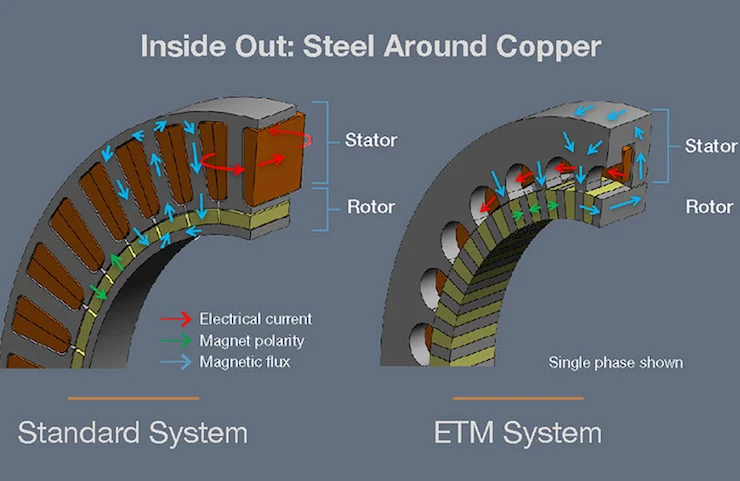
The primary and most significant advantage of transverse flux motors lies in their remarkably high torque density and superior efficiency. This prowess stems directly from their distinctive magnetic circuit and winding arrangement. By winding a single coil for each phase around the circumference of the stator, the design effectively decouples the number of machine poles from the physical size of the windings. In conventional radial flux motors, increasing the number of poles or the desired torque often necessitates larger windings, which in turn increases the motor’s overall size and thermal losses. The decoupling in transverse flux motors allows for a significantly higher number of poles to be incorporated without a proportional increase in winding volume, leading to a much stronger magnetic field interaction for a given motor size.
This ability to pack more magnetic poles into a smaller volume translates directly into an unparalleled torque density. For applications requiring high torque at low speeds, such as direct-drive systems, this is revolutionary. Direct-drive applications aim to eliminate the need for mechanical gearboxes, which are notorious for introducing backlash, friction, wear, and efficiency losses. By providing high torque directly, transverse flux motors can simplify mechanical systems, reduce maintenance, improve precision, and enhance overall system efficiency. The inherent efficiency of these motors is also a crucial factor, as it translates into lower energy consumption and reduced heat generation, prolonging component life and allowing for operation in more confined spaces.
Industry Impact: ETM’s Breakthrough in Robotics
The potential of transverse flux motor technology is now making tangible waves, particularly within the burgeoning robotics industry. Robotics demands motors that are not only powerful and efficient but also compact, precise, and capable of operating without the added bulk and complexity of gearboxes. Traditional robotic joints often rely on high-ratio gearboxes to achieve the necessary torque, which can introduce compliance, friction, and limitations in dynamic response.
In a significant development, ETM, an innovative engineering company, has recently introduced transverse flux motors into the robotics market. ETM’s foray into this sector highlights the transformative potential of this motor technology. The company has articulated that its motor design fundamentally eliminates the long-standing trade-offs between efficiency and size, a critical dilemma for robotics engineers. By effectively decoupling the magnetic flux paths from the electrical windings, ETM’s technology enables the high torque density typically associated with high-ratio geared systems, but with the superior efficiency and thermal reliability characteristic of low-ratio, direct drives. This claim is substantial, with ETM stating that its patented architecture delivers up to 10 times greater torque density compared to conventional motors.
This level of performance could reshape the design paradigms for robotic manipulators, collaborative robots (cobots), and even mobile robotic platforms. Imagine a robotic arm with lighter, more powerful joints, capable of more precise movements without the inherent compliance of gear trains. This translates to faster cycle times, greater payload capacity relative to the robot’s size, and improved energy efficiency for battery-powered systems. The enhanced thermal management characteristics also mean robots can operate longer under strenuous conditions without overheating, expanding their operational envelopes.
Addressing the Challenges: Drawbacks and Complexities
Despite their impressive advantages, transverse flux motors are not without their inherent drawbacks and engineering challenges. These include commonly cited issues such as cogging torque and ripple torque. Cogging torque refers to the periodic variation in torque when the motor is unenergized and the rotor’s magnetic poles align with the stator’s magnetic structure. Ripple torque, on the other hand, is the variation in torque output during normal operation, often caused by imperfections in the magnetic field distribution or current commutation. Both phenomena can lead to vibrations, noise, and reduced precision, which are particularly undesirable in high-precision applications like robotics. Mitigating these issues often requires sophisticated control algorithms and careful mechanical design, adding to the overall complexity.
Furthermore, the mechanical design of transverse flux motors is inherently more intricate than that of radial or axial flux machines. The unique, three-dimensional magnetic flux paths and the circumferential winding require specialized manufacturing techniques and tighter tolerances. This complexity directly contributes to higher design and manufacturing costs, making them more expensive to produce than mass-market conventional motors. For applications where cost is a primary driver and performance requirements are less extreme, these motors may not be the most economical choice.
Another significant disadvantage is their non-linear dynamics, which complicates the modeling of motor behavior. The complex interaction of magnetic fields and currents makes it challenging to predict and control their performance accurately using conventional linear models. This necessitates more advanced control strategies and more intensive computational resources for simulation and real-time operation. Finally, transverse flux motors often exhibit a low power factor. A low power factor indicates that the motor draws more apparent power (measured in kVA) than real power (measured in kW) from the supply. This can lead to increased losses in the power supply system, larger cable requirements, and potentially higher electricity bills for industrial users, though this can often be corrected with power factor correction techniques.
The Broader Implications and Future Outlook
The emergence and refinement of transverse flux motor technology underscore a broader trend in engineering: the continuous pursuit of optimized energy conversion and motion control. While still a niche technology compared to radial flux motors, the distinct advantages offered by transverse flux designs position them for significant growth in specific, high-value sectors. Beyond robotics, potential applications include:
- Electric Vehicles (EVs): High torque density could enable more compact and powerful direct-drive wheel motors, eliminating heavy and inefficient drivetrains. The efficiency gains could extend range.
- Aerospace: Lighter, more powerful motors for aircraft actuators, drone propulsion, and satellite positioning systems.
- Renewable Energy: Direct-drive generators for wind turbines, improving efficiency by removing gearboxes that are prone to failure and require significant maintenance.
- Industrial Automation: High-precision machine tools, packaging machinery, and other systems where precision, speed, and compact size are critical.
The ongoing research and development efforts are likely to focus on mitigating the current drawbacks. Advances in magnetic materials, additive manufacturing (3D printing), and sophisticated control algorithms could help reduce cogging and ripple torque, simplify mechanical designs, and lower manufacturing costs. As these challenges are addressed, the cost-benefit ratio for transverse flux motors will continue to improve, expanding their market penetration.
The ability to decouple electromagnetic design parameters offers unprecedented flexibility for engineers. This allows for the independent optimization of torque, speed, and efficiency, tailoring motors precisely to the demands of specific applications. This level of customization could foster a new generation of high-performance, application-specific electric motors that were previously unachievable with conventional designs.
In conclusion, transverse flux motors represent a fascinating and impactful innovation in electric motor technology. While their complex architecture and higher manufacturing costs present certain hurdles, their exceptional torque density and efficiency, particularly in direct-drive scenarios, offer compelling solutions for the most demanding applications in robotics, automation, and potentially electric mobility. As technological advancements continue to address their inherent challenges, transverse flux motors are poised to play an increasingly vital role in shaping the future of motion control and energy conversion. For a more detailed technical account of transverse flux motors, researchers often refer to comprehensive papers from organizations like the IEEE, which delve into the intricate physics and engineering aspects of these sophisticated machines. The ongoing exploration of novel motor technologies ensures a dynamic and innovative future for electromechanical systems worldwide.