In 2022, global production of construction materials accounted for more than 7 percent of total carbon emissions, a stark reminder of the built environment’s significant environmental footprint. This figure, highlighted by the International Energy Agency (IEA), underscores the urgent need for innovative approaches to reduce the material intensity of construction. A groundbreaking development from MIT researchers promises to do just that, by making a powerful design technique called topology optimization more accessible and practical for real-world engineering applications.
Topology optimization, a computational method, can design structures that dramatically minimize material usage, with potential reductions of up to 90 percent in certain applications. Such a widespread adoption could translate into a multi-gigaton reduction in building-related emissions, a critical step towards global climate goals. However, historically, the intricate, often organic-looking designs generated by topology optimization have been largely confined to research labs and specialized fields like 3D printing. The primary barrier to their broader implementation in large-scale construction projects, such as buildings and bridges, has been their perceived difficulty in terms of constructability, cost-effectiveness, and adherence to project timelines – factors paramount to the construction industry.
Addressing this critical gap, a team of MIT researchers has engineered a novel framework that bridges the divide between theoretical optimization and practical construction. Their innovative approach, detailed in a new paper published today in the journal Automation in Construction, empowers engineers to impose specific constraints on algorithmically generated structures, thereby limiting their complexity and ensuring they are feasible for conventional construction methods.
"There’s an interplay between the materials you’re using, the constructability of designs, and the optimization of the structure," explains senior author Josephine Carstensen, MIT’s Gilbert W. Winslow (1937) Career Development Professor in Civil Engineering. "You need to be able to address all three at the same time. That’s what we tried to do here."
The new framework allows users to define crucial parameters, such as the maximum number of components that can converge at any given point in a design, and the minimum acceptable size for structural elements. This level of control ensures that the optimized designs remain within the realm of what is realistically buildable. Furthermore, the research builds upon previous advancements by incorporating the ability to design with multiple materials and to meticulously account for each material’s unique properties. This allows for optimized load distribution and precise specification of part connections, moving beyond single-material considerations.
Bridging the Gap: From Digital Designs to Tangible Structures
The researchers have demonstrated the efficacy of their framework by designing various truss structures for buildings and bridges using steel, wood, and combinations of both. These designs, optimized for load-bearing capacity, showed significant variations in associated carbon emissions depending on the specific constraints applied. The team is optimistic that their framework will pave the way for topology optimization to become a standard tool in the real-world construction industry.
"In the literature, there’s sometimes been a disconnect between the carbon savings you can achieve on a computer and the realistic carbon savings you can achieve for built structures – especially when it comes to design technologies like topology optimization," Carstensen notes. "The problem lies in the lack of constructability of designs. These designs have been perceived as too difficult to make with conventional methods, so they are never even attempted. That’s what is exciting about our approach: We can add constraints so that you will never be in a situation where the design that comes out is too hard to make."
The paper’s first author is Zane Schemmer, a PhD student in civil and environmental engineering at MIT, who collaborated closely with Professor Carstensen on this transformative research.
The Evolution of Topology Optimization for Practicality
Topology optimization, a concept that has been around for decades, utilizes sophisticated computer algorithms to determine the most efficient distribution of material within a given volume. The objective is to achieve maximum strength or stiffness with minimum weight. The resulting structures often possess an organic, lattice-like appearance, which, while structurally ingenious, has posed significant challenges for traditional construction methods.
"A big question Josephine and I were asking is why isn’t industry using it?" Schemmer recalls. "What are the obstacles that prevent industry from designing things more efficiently, and how can we fill the gaps between research and real life?"
In recent years, the academic community has seen a surge in efforts to make topology optimization more user-friendly and adaptable to industrial needs. Schemmer and Carstensen’s work represents a significant step forward by consolidating and enhancing these prior efforts. A key innovation is the seamless integration of multi-material design capabilities, an area that has previously presented considerable hurdles in the field of topology optimization.
"A big aspect of sustainability going forward will be not only using less material, but also implementing materials efficiently based on considerations like where you are in the world, your access to materials, and each of their associated carbon costs," Schemmer elaborates. This nuanced approach acknowledges that the most sustainable material choice is not universal but context-dependent.
A Novel Algorithmic Approach to Design
The foundation of their framework lies in a class of mathematical tools known as mixed-integer algorithms. These algorithms are adept at making binary decisions, which are crucial for determining material choices and connection types within a complex structure.
"You can’t have a part that’s 72 percent timber and 28 percent steel," Schemmer explains, illustrating the discrete nature of material assignments. "Instead, it says, ‘This truss or cable is going to be made out of this,’ and then based on that decision, how do we make sure all of these connections meet their strength standards?"
The system’s decision-making process also deeply integrates material properties. For instance, the model understands that while steel is excellent for compressive loads (struts), it is less suitable for tensile loads (cables) compared to materials like steel cables or certain composites. Furthermore, the framework incorporates more realistic modeling of how different structural components connect, a critical departure from simpler 3D printing paradigms.
"In 3D printing, the way things come together is easy," Carstensen points out. "In construction, that’s not the case. If you’re building with timber there’s a certain rule set, versus steel has a different rule set." The MIT framework respects these distinct construction "rule sets," ensuring that connections are designed according to established engineering practices for each material.
Users can fine-tune the design complexity by setting constraints on the number of connections at each joint and the minimum angle between connected components. The inclusion of minimum size limits for parts further enhances the practicality and constructability of the generated designs.
"It’s tough to give a contractor these complex, intricate designs because it’s going to be super difficult to build," Schemmer emphasizes. "A lot of times contractors won’t pick up a project like that to begin with." By making designs inherently more buildable, the researchers aim to eliminate this barrier.
Case Studies: Demonstrating the Power of Constrained Optimization
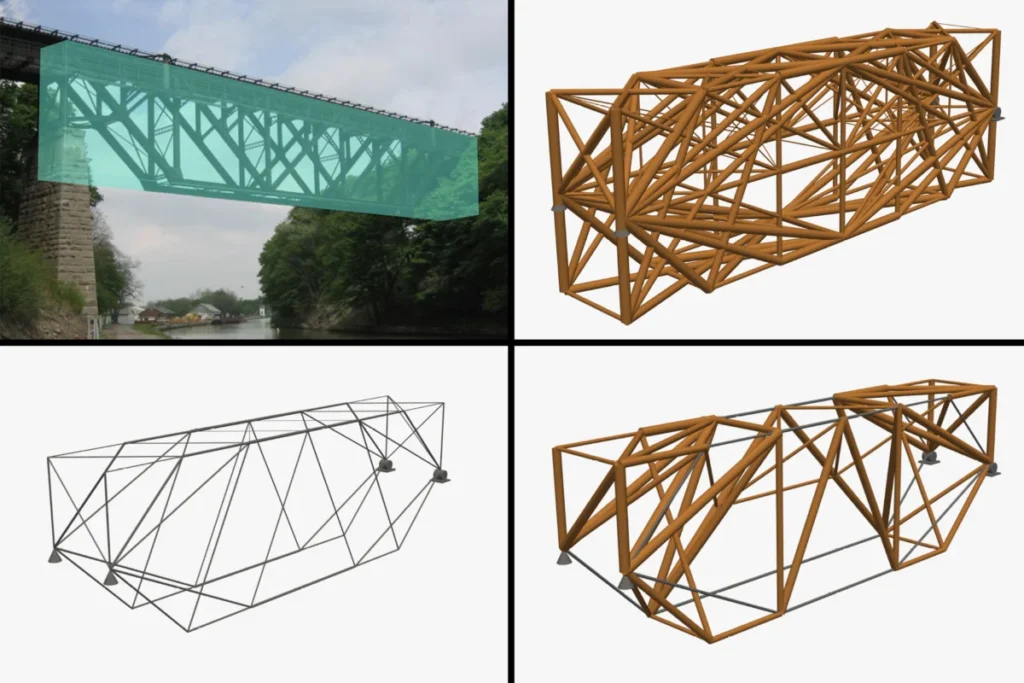
To illustrate the impact of their approach, the researchers applied it to designs for the Lockport "Upside-Down Bridge" near Buffalo, New York. By systematically applying individual constraints, such as minimum angles for part connections or minimum part sizes, to the bridge’s truss design, they were able to observe and quantify how each constraint influenced the final structural form and material distribution. This empirical approach provides clear insights into the trade-offs involved in optimizing for constructability.
Subsequently, the team generated truss designs utilizing wood exclusively, steel exclusively, and a hybrid of wood and steel. These comparisons clearly demonstrated how different material combinations and design choices offer distinct trade-offs between environmental impact (carbon emissions) and constructability.
"We saw how the system knew that you could design a bridge of pure steel, but that might not be best from a carbon standpoint," Schemmer shares. "Or you could design a bridge out of purely timber, but that might not be the strongest. But these materials can work together, so you use timber for the carbon savings and steel where you need extra strength, and there’s a balance you can find in these structures." This highlights the framework’s ability to find optimal solutions that consider multiple, often competing, objectives.
Towards Widespread Industry Adoption
While the computational demands of this approach are higher than some simpler optimization methods, the researchers found that it was feasible to run their programs on a standard MacBook Pro. They are confident that the computational requirements are well within the reach of most civil engineering firms, especially with the increasing availability of powerful computing resources and optimization software.
"It’s computationally a little tougher to solve, but there’s a lot of tools coming out nowadays that make these problems a lot more feasible," Schemmer states. "This approach has been avoided by industry in the past, but now we think it’s a practical way to solve problems dealing with variable constraints."
The researchers envision that with greater computational power, their framework could be extended to handle a wider array of materials and to design much larger and more complex structures, far beyond homes, small buildings, and bridges, potentially encompassing entire city infrastructure projects.
Looking ahead, Professor Carstensen indicated that the team plans to construct scaled-down physical models based on their designs. This crucial step will serve to further validate the accuracy and reliability of their computational predictions in real-world scenarios. Their future work also includes integrating additional constraints into the model, aiming to make it even more intuitive and seamless for civil engineers to incorporate into their design workflows for the world’s infrastructure.
"As a structural engineer by training, I was never taught how to design for low-carbon," Schemmer reflects. "To tackle a problem as big as climate change, addressing the built environment is a great place to start. One of the most tangible things we can do is work at the layer of construction, at the design stage, because that’s a fundamental step that we can control. There’s a lot of decisions we make early on that lead us to use extra material we don’t need."
The research was generously supported by the MIT Morningside Academy for Design, underscoring the institution’s commitment to fostering interdisciplinary innovation in critical areas like sustainable development.
Broader Implications for Global Sustainability
The implications of this MIT research extend far beyond optimizing individual structures. By making topology optimization a more practical and accessible tool, this framework has the potential to catalyze a paradigm shift in the construction industry.
Reduced Material Consumption and Carbon Footprint: The most direct impact is the significant reduction in the quantity of materials required for construction. Less material means less extraction, processing, transportation, and manufacturing, all of which are energy-intensive and contribute to greenhouse gas emissions. This directly addresses the substantial portion of global carbon emissions attributed to construction materials.
Enhanced Resource Efficiency: Beyond simply using less, the optimized designs ensure that materials are used more effectively, placed precisely where they are needed to bear loads. This maximizes structural performance while minimizing waste, contributing to a more circular economy in construction.
Innovation in Material Use: The framework’s ability to handle multi-material designs encourages the intelligent use of diverse materials. This could lead to greater adoption of sustainable and lower-carbon materials like timber, bamboo, or recycled composites, strategically combined with traditional materials like steel or concrete where their unique properties are indispensable for structural integrity.
Economic Benefits: While initial computational analysis might be more intensive, the long-term economic benefits of reduced material costs, potentially faster construction due to more predictable designs, and lower maintenance due to more robust and efficient structures could be substantial.
Addressing Climate Change: The built environment is a major contributor to climate change. By providing engineers with tools to design more sustainably, this research offers a tangible pathway to mitigate the environmental impact of infrastructure development. It empowers engineers to make design choices that have a direct positive effect on global carbon reduction efforts.
Technological Advancement in Engineering: This work represents a significant leap in computational engineering. It demonstrates how advanced algorithms can be tailored to meet the practical constraints of traditional industries, fostering a closer integration of cutting-edge research with established engineering practices.
Future Outlook: As this technology matures and gains wider adoption, it could influence building codes, material standards, and engineering education. The emphasis on low-carbon design, integrated with structural performance and constructability, will likely become a cornerstone of future architectural and engineering practices. The successful validation through physical prototypes and further integration into industry workflows will be critical next steps in realizing the full potential of this groundbreaking research.