The landscape of quantum information science is undergoing a transformative shift as researchers move from basic proofs of concept toward the practical engineering of quantum states. At the forefront of this evolution, a team of theoretical physicists at the University of Chicago’s Pritzker School of Molecular Engineering (PME) has unveiled a new method for generating and controlling highly entangled quantum states. Published in the prestigious journal Physical Review X, the study introduces a theoretical framework that bypasses the need for the hyper-specialized, often prohibitively complex hardware typically required for quantum manipulation. By utilizing standard laboratory tools—lasers and magnetic fields—the researchers have demonstrated that complexity can be born from simplicity, offering a new roadmap for the development of ultra-precise sensors and the exploration of exotic physical phenomena.
Quantum entanglement, a state where particles become so intrinsically linked that the condition of one instantaneously influences the other regardless of distance, is the "engine" of the second quantum revolution. While entanglement has been understood in principle since the early 20th century, creating specific, multi-particle entangled states remains one of the most significant hurdles in modern physics. These states are notoriously fragile, prone to "decoherence"—the process where quantum information is lost due to interaction with the external environment. The UChicago PME team’s approach addresses this fragility by rethinking the fundamental architecture of Cavity Quantum Electrodynamics (QED), a staple of modern physics research.
The Symmetry Problem in Cavity Quantum Electrodynamics
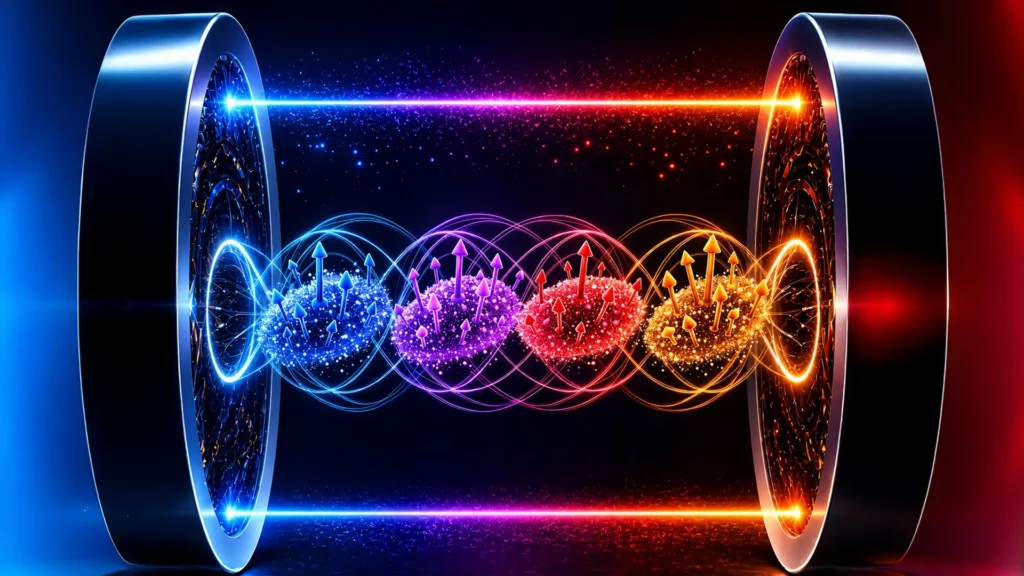
To understand the breakthrough, one must first look at the traditional setup of a Cavity QED system. In these experiments, atoms or other quantum emitters are placed within a microscopic hall of mirrors known as an optical cavity. Light is bounced back and forth between these mirrors, interacting repeatedly with the atoms. This interaction allows the atoms to "talk" to one another through the medium of the trapped photons. However, a persistent bottleneck in these systems has been the presence of excessive symmetry.
In a standard cavity, every atom is positioned such that it interacts with the light in an identical fashion. From the perspective of the photons, the atoms are indistinguishable. While this uniformity makes the system easier to model, it severely limits the variety of quantum states that can be generated. When every atom reacts the same way, the system is constrained to a narrow subset of "symmetric" states. Professor Aashish Clerk, a senior author of the study and a leading figure in molecular engineering, noted that this symmetry acts as a restrictive cage. To perform complex tasks, such as high-resolution sensing or advanced computation, scientists need a way to make the atoms behave differently—to break the symmetry without losing control over the system.
A Novel Approach to Symmetry Breaking
The solution proposed by Clerk’s team, including first author and postdoctoral researcher Anjun Chu, is elegantly simple. Rather than redesigning the physical cavity or inventing new types of atoms, the team suggested using external fields to "offset" the energy levels of specific groups of atoms. In a quantum system, atoms exist in a ground state or an excited state, separated by a specific energy gap. By applying secondary lasers or magnetic fields, the researchers can shift these energy gaps.
The innovation lies in the arrangement: atoms are organized into pairs where one atom’s energy gap is shifted upward by a specific amount, while its partner’s gap is shifted downward by the exact same amount. This creates a "balanced imbalance." While the system as a whole remains predictable and theoretically manageable, the individual atoms now possess distinct identities based on their energy offsets. This simple modification allows for the creation of "non-symmetric" entangled states that were previously thought to be inaccessible in standard cavity setups.
According to the researchers, this method is "dissipative," meaning the system naturally settles into the desired entangled state over time as it interacts with the light in the cavity. This is a departure from "active" methods that require perfectly timed pulses of energy. Instead, a scientist can "turn the lasers on and wait," as Anjun Chu described, until the system stabilizes into a highly entangled, useful configuration.
Advancing the Frontier of Quantum Sensing
One of the most immediate and impactful applications of this theoretical framework is in the realm of quantum sensing. Modern sensors, such as those used in MRI machines or GPS systems, rely on classical physics. Quantum sensors, however, leverage entanglement to detect changes in magnetic, gravitational, or electric fields with a level of precision that is fundamentally impossible for classical devices.
A major challenge in quantum sensing is the trade-off between sensitivity and noise. Because entangled states are so sensitive, they often pick up "background noise"—random fluctuations in the environment—that obscures the signal the scientist is trying to measure. The UChicago PME team demonstrated that their energy-offset method can create a "gradient sensor" that is inherently resistant to such noise.
By splitting atoms into two groups placed at different locations, the system can be tuned to be sensitive only to the difference in the field between those two spots. If a background noise source (like a nearby power line) affects both groups of atoms equally, the system ignores it. However, if there is a tiny change in the gravitational or magnetic field that is stronger at one location than the other, the entangled state will react immediately. This "common-mode rejection" allows for the creation of sensors that are both exquisitely sensitive and remarkably robust—two qualities that are usually mutually exclusive in the quantum world.
Exploring Fundamental Physics: The AKLT State
Beyond practical sensing applications, the research provides a new tool for experimental physicists to explore the "zoo" of theoretical quantum states. One such state is the AKLT state, named after physicists Affleck, Kennedy, Lieb, and Tasaki, who proposed it in 1987. The AKLT state is a "many-body" entangled state that is used to describe the physics of one-dimensional magnetic materials and is a cornerstone of our understanding of "topological phases of matter."
For decades, creating a stable AKLT state in a controlled laboratory environment has been a complex undertaking. The UChicago team showed that their cavity QED method could naturally stabilize an AKLT state. This opens the door for scientists to study how quantum information moves through complex materials and could provide insights into "fault-tolerant" quantum computing, where the topological properties of a state protect information from being corrupted.
Historical Context and the Road to Implementation
The work by Clerk and Chu arrives at a pivotal moment in the timeline of quantum research. The field has moved through several distinct eras:
- The Theoretical Era (1900s–1970s): Where the mathematical foundations of entanglement were laid by Planck, Bohr, Einstein, and Bell.
- The Proof-of-Concept Era (1980s–2010s): Where experiments, such as those by 2022 Nobel Laureates Alain Aspect and Anton Zeilinger, proved that entanglement was a physical reality.
- The Engineering Era (2020s–Present): Where the focus has shifted to "scaling up" and finding reliable ways to create entanglement for industry-level applications.
This new research fits squarely into the Engineering Era. By focusing on "simple ingredients," the UChicago team is addressing the scalability problem. If entanglement can be generated using tools already found in most physics labs—rather than requiring bespoke, multi-million dollar installations—the "barrier to entry" for quantum technology drops significantly.
The research was conducted under the umbrella of Q-NEXT, one of five National Quantum Information Science Research Centers established by the U.S. Department of Energy in 2020. Led by Argonne National Laboratory, Q-NEXT aims to develop the next generation of quantum interconnects and sensors. The involvement of such a center underscores the strategic importance of this work to the national quantum infrastructure.
Implications for the Future of Quantum Computing
While the immediate focus of the PME study is on sensing and fundamental physics, the implications for quantum computing are profound. Current quantum computers are in the "Noisy Intermediate-Scale Quantum" (NISQ) phase, where errors are frequent and qubits (quantum bits) are difficult to maintain. The "resilience" mentioned by Professor Clerk—the ability of these entangled states to withstand noise—is exactly what is needed to move toward more reliable quantum processors.
Furthermore, the ability to tune the system to produce different states without changing the hardware is a hallmark of a versatile technology. In a future quantum network, a single cavity QED node could serve multiple functions: acting as a high-precision clock at one moment and a quantum memory storage device the next, simply by adjusting the frequency and intensity of the control lasers.
Conclusion and Next Steps
As the UChicago team moves forward, the transition from theory to experiment is the next logical step. The researchers are already in discussions with experimental groups to implement these energy-offset designs in physical labs. Because the proposal uses standard components, the timeline for experimental verification is expected to be shorter than that of more radical hardware proposals.
The work of Clerk and Chu serves as a reminder that in the complex world of quantum mechanics, the most powerful solutions are often those that find clever ways to use existing tools. By breaking the symmetry of the atom-light interaction, they have unlocked a new level of control over the quantum world, bringing the "dream" of a quantum-integrated society one step closer to reality. The ability to generate such complex and useful states from "minimal ingredients" suggests that the quantum revolution may not require a total overhaul of our laboratories, but rather a more sophisticated way of orchestrating the tools we already have.