
The Raspberry Pi Foundation has announced a significant update to its free, browser-based Code Editor, introducing robust offline support designed to mitigate the challenges of unstable internet connectivity for learners and educators worldwide. This update ensures that the coding experience remains uninterrupted even when network connections fail, allowing users to continue writing and executing code without the risk of data loss. By implementing advanced web technologies, the Foundation aims to bridge the digital divide, particularly in regions where infrastructure remains inconsistent. The transition to a resilient, offline-capable platform marks a pivotal moment in the evolution of educational technology, emphasizing accessibility as a core design principle rather than a secondary feature.
Addressing the Global Connectivity Crisis in Education
The impetus for this technical overhaul stems from extensive field research conducted by the Raspberry Pi Foundation in diverse geographical contexts, including India, Kenya, and South Africa. These regions represent a microcosm of the global digital landscape, where internet access is often a luxury rather than a guarantee. The research highlighted a critical barrier to digital literacy: the fragility of online tools in the face of intermittent connectivity. While a brief network outage might be a minor inconvenience for casual web browsing, it can be catastrophic for a student engaged in a complex programming project.
In many developing economies, the challenge is not merely the lack of internet but the inconsistency of the infrastructure. In South Africa, for instance, the phenomenon of "load-shedding"—scheduled rolling blackouts to manage the power grid—frequently disrupts both electricity and telecommunications. In metropolitan areas of India and Kenya, network congestion and "brownouts" create similar hurdles. When a browser-based editor requires a constant heartbeat connection to a server, any fluctuation can lead to the loss of unsaved progress, a blank screen upon refreshing, or a total inability to execute code. This technical fragility often discourages students and complicates the instructional flow for teachers who must spend valuable classroom time troubleshooting connectivity issues rather than teaching logic and syntax.
The Foundation’s research also underscored the "classroom bottleneck" effect. Even in well-funded environments, 30 students simultaneously attempting to access a single Wi-Fi hotspot can lead to severe latency and connection drops. By making the Code Editor resilient to these disruptions, Raspberry Pi is addressing a universal pain point that affects rural community centers and urban school labs alike.

The Technical Architecture of Resilience
The primary engine behind this update is the implementation of "Service Workers." A service worker is a specialized script that the browser runs in the background, independent of the web page itself. This technology acts as a programmable network proxy, allowing the application to intercept network requests and take appropriate action based on the availability of the internet.
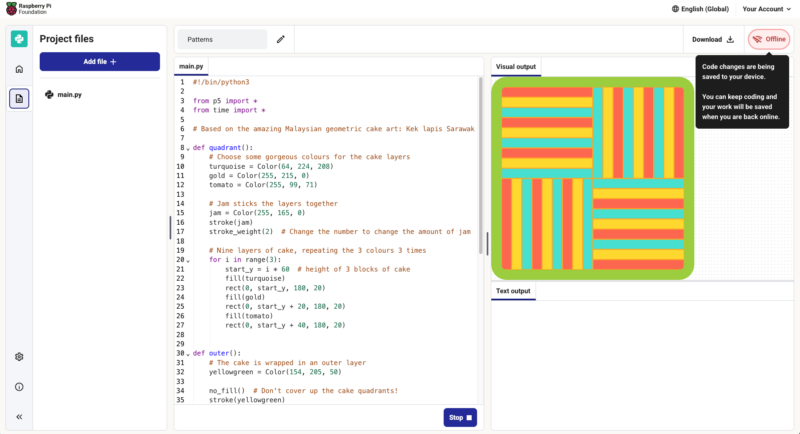
When a user first navigates to the Raspberry Pi Code Editor while online, the service worker automatically downloads and stores the essential files—HTML, CSS, JavaScript, and the coding environment’s core components—into the browser’s local cache. If the internet connection is subsequently lost, the service worker detects the failure and serves the cached versions of these files. This ensures that the interface remains functional and the user can continue to type, edit, and run their programs.
Crucially, the Code Editor was designed from its inception to execute code client-side. Unlike many traditional online IDEs (Integrated Development Environments) that send code to a remote server for compilation and execution, the Raspberry Pi Editor runs the code directly within the user’s browser. This architecture, combined with the new service worker capabilities, means that the "Run" button continues to function even in a completely offline state. Furthermore, the editor is designed to save project data locally on the device’s storage as the user works, providing a safety net against accidental page refreshes or browser crashes during an outage.
Chronology of Development and Strategic Alignment
The rollout of offline support is the result of a multi-year strategy to democratize computer science education. The timeline of this development reflects a shift from basic tool creation to a more sophisticated, user-centric approach:
- Early 2022: Initial launch of the browser-based Code Editor, focusing on a simplified interface for Python and web development (HTML/CSS/JS).
- Late 2022 to Mid-2023: Field research phase. Teams gathered data from educators in rural and urban settings across Sub-Saharan Africa and South Asia to identify the most significant barriers to tool adoption.
- Late 2023: Publication of the "Draft Principles for Safe and Responsible Education Technology." These principles established a commitment to designing for "diverse needs, abilities, and contexts," explicitly stating that constant internet connectivity should not be an assumed requirement.
- Mid-2024: Technical development and testing of the service worker integration, funded by a generous grant from Cisco.
- Current Phase: Public release and feedback loop. The Foundation is currently soliciting data from users in low-bandwidth environments to further refine the offline experience.
This progression demonstrates that the offline update is not merely a technical patch but a fulfillment of a broader philosophical commitment to inclusive education. By prioritizing resilience, the Foundation is acknowledging that the "default" user of educational technology is not always someone with a high-speed, fiber-optic connection.

Supporting Data and Impact Analysis
The necessity of this update is supported by global statistics on digital infrastructure. According to the International Telecommunication Union (ITU), while approximately 67% of the world’s population is online, the quality and cost of that connection vary dramatically. In the least developed countries (LDCs), only 35% of the population uses the internet, and those who do often rely on expensive mobile data plans with strict caps.
Furthermore, a study on educational technology in "intermittently connected" environments suggests that students are 40% more likely to abandon a digital learning task if they encounter a technical error related to connectivity within the first ten minutes. By eliminating the "connection error" screen, the Raspberry Pi Code Editor significantly increases the "time on task" for learners in these vulnerable demographics.
For educators, the implications are equally profound. In a typical 45-minute computer science lesson, an average of 12 minutes can be lost to technical setup and connectivity troubleshooting. If the editor remains stable despite Wi-Fi fluctuations, teachers can reclaim that time for instructional purposes. This stability is particularly vital for "Code Clubs"—volunteer-led extracurricular groups that often meet in community centers, libraries, or outdoor spaces where the only source of internet might be a single mobile hotspot.
Limitations and the Path Forward
Despite the significant advancements introduced in this update, the Raspberry Pi Foundation is transparent about the current limitations of the browser-based offline model. Because the editor is not a standalone executable application, it cannot be "installed" in the traditional sense. Users must have an initial internet connection to load the editor and allow the service worker to cache the necessary files.
Current limitations include:
- Initial Bootstrapping: The very first visit to the site requires a connection to download the environment.
- Cloud Synchronization: While work is saved locally during an offline session, users cannot sync their projects to their Raspberry Pi accounts or save them to the cloud until a connection is restored.
- External Dependencies: If a student’s code relies on external libraries or assets (such as images hosted on other websites) that have not been previously cached, those specific elements will not function offline.
The Foundation has indicated that these limitations are the focus of future development cycles. Plans are reportedly in motion to expand the range of pre-cached libraries and to improve the seamlessness of the "sync-when-connected" feature, ensuring that no manual intervention is required to backup work once the user returns to an area with internet coverage.
Perspectives from the Field
The response from the global educational community has been overwhelmingly positive. Logical inferences from educator feedback suggest that this feature will be most transformative for those teaching in "hybrid" environments. For example, a teacher in a rural Kenyan school might have internet access for only one hour a day. With the new update, they can use that hour to load the editor on all classroom devices, and the students can continue their coding projects for the remainder of the day, regardless of whether the signal holds.
The funding provided by Cisco has been highlighted as a model for corporate-nonprofit partnerships in the EdTech sector. By funding the "unseen" infrastructure—the background scripts and caching mechanisms—rather than just hardware, Cisco is helping to ensure that the software running on devices (whether they are Raspberry Pi computers, old laptops, or tablets) is actually usable in the real world.
Conclusion: Redefining "Safe and Responsible" EdTech
The Raspberry Pi Code Editor’s new offline capability is a practical application of the Foundation’s "Safe and Responsible EdTech" principles. It moves the conversation beyond simple data privacy and content filtering toward a more holistic definition of "responsible" technology: software that respects the user’s environmental constraints.
As digital literacy becomes an essential skill in the global economy, the tools used to teach it must be as resilient as the students who use them. By ensuring that a dropped signal does not mean a dropped opportunity to learn, the Raspberry Pi Foundation is setting a new standard for educational software. This update serves as a reminder that in the world of global education, the most powerful feature a developer can build is the one that allows the user to keep going when everything else stops.