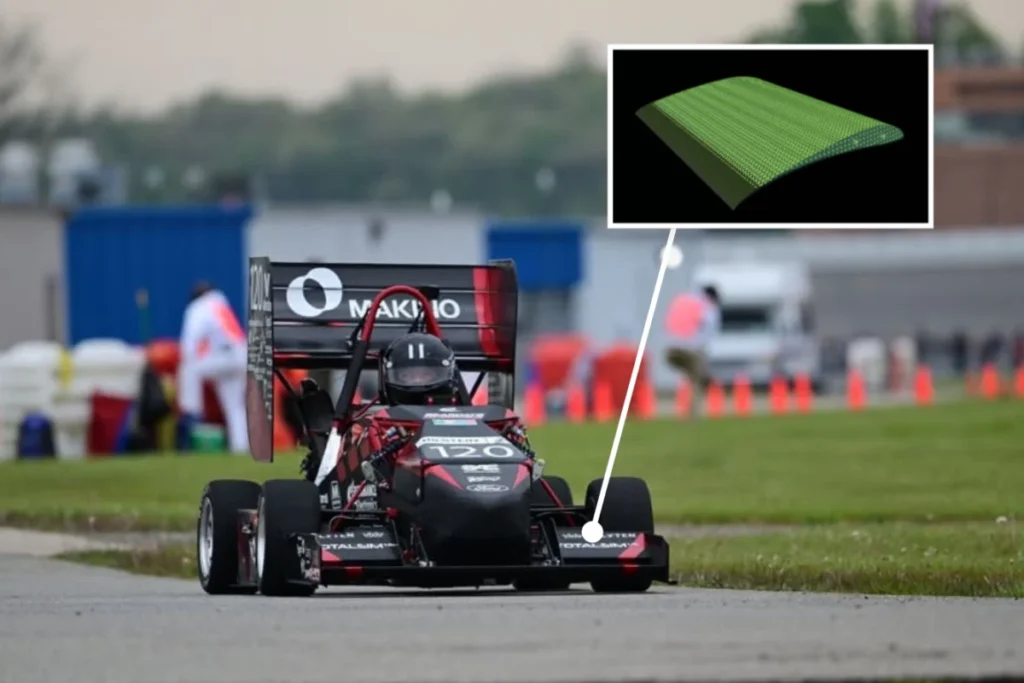
The University of Cincinnati Bearcats Motorsports team has achieved a significant breakthrough in their Formula SAE racing program with the successful integration of a 3D printed front wing second element, dramatically reducing weight, manufacturing time, and assembly complexity while enhancing structural integrity. This innovative component, developed in collaboration with Vixiv, GZero Additive, and Lyten, represents a paradigm shift in how collegiate racing teams can leverage advanced additive manufacturing technologies to gain a competitive edge.
The original front wing second element, a critical aerodynamic and structural component, was crafted from a combination of carbon fiber and aluminum. This traditional manufacturing approach demanded a substantial investment of approximately 65 hours dedicated to design, fabrication, and assembly. The finished part tipped the scales at 621 grams. In the demanding world of Formula SAE, where every gram counts and efficiency is paramount, this weight represented a considerable performance bottleneck. The need for a lighter, more streamlined solution became apparent as the Bearcats Motorsports team sought to optimize their vehicle’s aerodynamics and overall performance envelope.
A Collaborative Endeavor in Advanced Manufacturing
The genesis of this advanced component lies in the strategic partnership formed between Bearcats Motorsports and three key industry leaders in the additive manufacturing ecosystem. The project began with Vixiv, a specialist in design optimization and generative design software. Vixiv’s role was to take the existing, albeit heavier, design of the front wing second element and reimagine it for 3D printing. Utilizing their sophisticated, cloud-based AI engine, Vixiv was able to analyze the structural requirements and aerodynamic contours of the component.
Vixiv’s proprietary software is designed to intelligently fit lattice structures and optimized geometries within a defined volume, adhering to user-specified parameters such as maximum load-bearing capacity and desired shell thickness. For the Bearcats Motorsports’ front wing airfoil, this process was remarkably swift. Vixiv’s AI engine processed the existing design and generated a novel, 3D printable iteration in an astonishing 34 seconds. This rapid design optimization phase underscores the transformative potential of AI-driven design tools in accelerating product development cycles, particularly in time-sensitive engineering environments like collegiate racing.

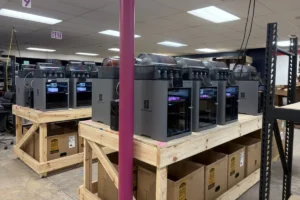
Following the design optimization by Vixiv, the digital blueprint was seamlessly transferred to GZero Additive, a prominent provider of large-format additive manufacturing (LFAM) solutions and 3D printing services. GZero Additive’s expertise in handling large-scale 3D printing projects was instrumental in bringing the optimized design to life. They utilized their advanced LFAM platform to produce the front wing second element.
The material choice was equally critical to the success of this project. GZero Additive employed a specialized filament developed by Lyten, a materials science company known for its innovative work with advanced composites. Specifically, a graphene-reinforced nylon filament was selected. The incorporation of graphene into the nylon matrix significantly enhances the material’s mechanical properties, including its strength-to-weight ratio, stiffness, and thermal resistance, all crucial attributes for a high-performance automotive component subjected to extreme stresses.
Performance and Durability Under Fire
The impact of this 3D printed component was immediately evident during its maiden competition at FSAE Michigan. The new front wing second element not only met but exceeded expectations in terms of performance and resilience. Throughout the rigorous competition, it successfully sustained significant structural loads, ranging from 60 to 80 pounds-force (lbf). This demonstrates the component’s ability to withstand the substantial aerodynamic forces and dynamic stresses inherent in high-speed racing.
Perhaps the most compelling testament to the 3D printed wing’s robustness came during an unexpected incident. In a critical moment of the competition, an impact occurred that caused the endplates of the first element of the front wing to fracture. In many racing scenarios, such a failure could lead to immediate disqualification or, at the very least, a severe detriment to the vehicle’s handling and aerodynamic stability. However, the 3D printed second element performed an unforeseen but vital secondary function. It effectively held the broken assembly of the first element aloft, preventing it from dragging on the track. This crucial intervention allowed the Bearcats Motorsports car to continue participating in the event for its remainder, a testament to the unexpected resilience and structural integrity imparted by the advanced 3D printing process and materials.
A New Benchmark in Efficiency and Cost-Effectiveness
The transition from traditional manufacturing to additive manufacturing for this critical component yields remarkable improvements across multiple metrics. The most striking is the weight reduction. The 3D printed front wing second element weighs in at a mere 395 grams, a substantial decrease from the original 621-gram carbon fiber and aluminum part. This 36% reduction in weight directly translates to improved acceleration, better fuel efficiency, and enhanced overall vehicle dynamics.

Beyond the weight savings, the manufacturing process itself has been radically streamlined. The elimination of complex assembly steps, which were inherent in the multi-material construction of the original component, means that the 3D printed part requires zero assembly time. This not only saves valuable engineering hours but also reduces the potential for assembly-related errors, further enhancing reliability.
The combined reduction in design, manufacturing, and assembly time is also significant. While the original component required approximately 65 hours, the new process, powered by Vixiv’s AI and GZero Additive’s LFAM, represents a dramatic acceleration. The design optimization by Vixiv took less than a minute, and the 3D printing process itself, while variable based on print size and complexity, is inherently faster than traditional multi-stage manufacturing and assembly for such intricate parts. This rapid iteration capability allows teams to design, test, and refine components much more efficiently, a crucial advantage in the competitive landscape of Formula SAE.
The Broader Implications for Collegiate and Professional Motorsport
The success of the Bearcats Motorsports team with their 3D printed front wing second element has far-reaching implications, not just for collegiate racing but also for the broader automotive industry, including professional motorsport.
Democratization of Advanced Manufacturing: This project demonstrates that cutting-edge additive manufacturing technologies are increasingly accessible to smaller teams and organizations with limited budgets. The collaborative model, leveraging specialized expertise from companies like Vixiv, GZero Additive, and Lyten, allows university teams to tap into advanced capabilities that might otherwise be prohibitively expensive. This democratizes access to high-performance engineering solutions.
Accelerated Innovation Cycles: The speed at which Vixiv’s AI optimized the design is a powerful indicator of how additive manufacturing, coupled with AI, can dramatically shorten product development cycles. In motorsports, where fractions of a second can determine victory, the ability to rapidly iterate on designs and implement improvements is a game-changer. This project serves as a compelling case study for professional racing teams looking to enhance their R&D agility.

Material Science Advancements: The use of graphene-reinforced nylon filament by Lyten highlights the ongoing evolution of 3D printable materials. As materials science continues to advance, the performance envelopes of 3D printed components will only expand, enabling them to meet increasingly demanding applications in aerospace, automotive, and other high-stress industries.
Sustainability and Resource Efficiency: While not explicitly detailed in the initial reporting, additive manufacturing inherently offers potential sustainability benefits. By printing parts on demand and optimizing designs for material usage (e.g., through infill strategies), waste can be reduced compared to subtractive manufacturing methods. Furthermore, the lighter weight of the component contributes to improved fuel efficiency, a growing concern across the automotive sector.
Enhanced Structural Design and Performance: The ability to create complex, optimized geometries that are difficult or impossible to achieve with traditional manufacturing techniques allows engineers to design components that are both lighter and stronger. The lattice structures generated by Vixiv, for instance, can be tailored to distribute stress more effectively, leading to improved performance and durability.
A Glimpse into the Future of Motorsport Engineering
The University of Cincinnati Bearcats Motorsports team’s achievement with their 3D printed front wing second element is more than just a successful engineering project; it is a tangible demonstration of how advanced digital manufacturing technologies are reshaping the future of vehicle design and performance. As additive manufacturing continues to mature, and as collaborative ecosystems between academic institutions and industry partners flourish, we can expect to see even more groundbreaking innovations emerge from the world of motorsport, pushing the boundaries of speed, efficiency, and engineering excellence. This project serves as an inspiration, showcasing the power of innovation and collaboration in achieving peak performance.