The transition from a novice to a proficient programmer is often characterized by a shift in how one perceives and processes complex problems. While experienced educators and software engineers often approach a coding challenge with a sense of automaticity, beginning learners frequently encounter a "blank screen" paralysis, where the sheer volume of decisions required to start a project becomes cognitively overwhelming. To address this pedagogical gap, the Raspberry Pi Foundation has recently highlighted the efficacy of subgoal labels—a scaffolding technique designed to decompose complex programming tasks into manageable, conceptual chunks. This approach aims to bridge the divide between the intuitive mental models of experts and the fragmented understanding of students, providing a structured roadmap for problem-solving in the computer science classroom.
The Cognitive Challenge of Programming Education
In the field of computer science education, the phenomenon of "expert blindness" often complicates the instructional process. Experienced programmers have developed robust schemas—mental frameworks that allow them to categorize problems and retrieve solutions almost instantaneously. For these experts, decisions such as variable naming, loop structure, and data organization require little conscious effort. However, for a student, every one of these decisions represents a high-stakes cognitive load.
Research into Cognitive Load Theory (CLT) suggests that the human working memory has a limited capacity. When a student is asked to solve a programming problem, they must simultaneously manage the syntax of the language, the logic of the algorithm, and the overall architecture of the solution. If these elements are not structured, the cognitive load exceeds the student’s processing capacity, leading to frustration and stalled learning. Subgoal labels serve as an external memory aid and a structural guide, allowing students to focus on one logical segment of a problem at a time without losing sight of the broader objective.
Defining Subgoal Labels as Instructional Scaffolding
Subgoal labels are concise, descriptive tags or instructions assigned to specific stages of a task. Rather than presenting a student with a completed block of code, an educator provides a framework where the code is grouped under functional headings. These labels act as signposts, indicating the "purpose" of a code segment rather than just its "function."
For example, in a standard introductory task involving "Turtle" graphics—a common tool for teaching geometry and logic through programming—a student might be tasked with drawing a specific shape at a specific location. Without scaffolding, the student may struggle to know whether to define the color, move the sprite, or start the loop first. By applying subgoal labels, the task is reorganized into a logical sequence:
- Initialize Environment: Set the starting coordinates and clear the screen.
- Configure Aesthetics: Define the pen color and line thickness.
- Define Geometry: Execute the loop that draws the sides and angles of the shape.
- Finalize Output: Lift the pen and move the sprite to a neutral position.
By categorizing the code in this manner, the student learns not just the syntax of the commands, but the underlying logic of how a program is constructed. This method encourages "computational thinking," a core competency in modern curricula that emphasizes decomposition, pattern recognition, and abstraction.
The Evolution of Subgoal Labeling Research
The concept of subgoal labeling is rooted in instructional design research dating back to the late 1990s, most notably the work of Richard Catrambone. Catrambone’s studies demonstrated that students who used worked examples with subgoal labels were significantly better at solving "transfer problems"—tasks that required applying learned concepts to new, unfamiliar contexts—than those who studied traditional worked examples.
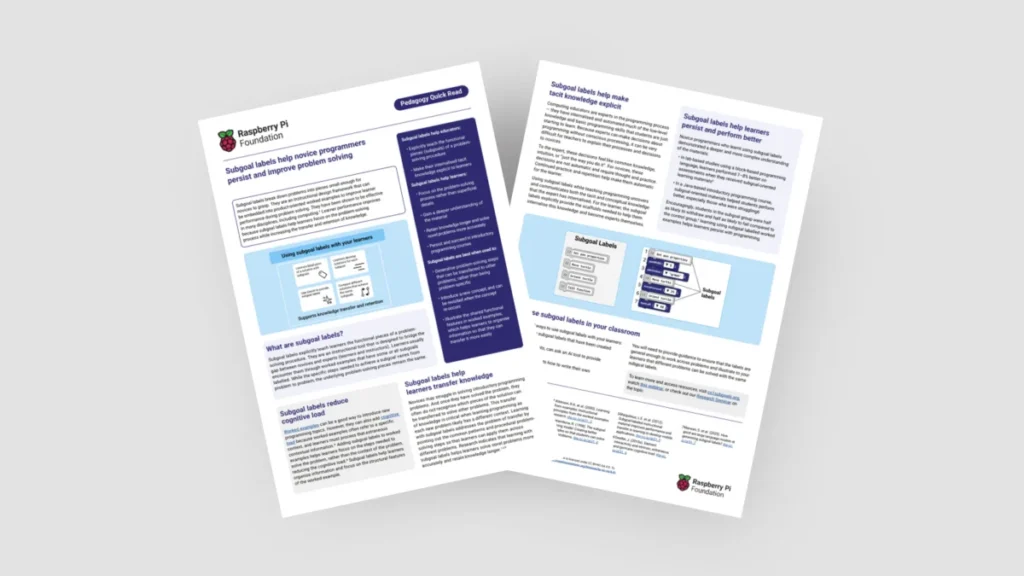
In the context of computer science, the Raspberry Pi Foundation and other educational research bodies have adapted these findings to address the unique challenges of coding. The foundation’s recent release of the "Subgoal Labels Quick Read" (part of their ongoing pedagogy series) marks a concerted effort to formalize these strategies for K-12 educators. This initiative follows a timeline of increasing sophistication in CS pedagogy, moving away from the "sink or swim" coding marathons of the early 2000s toward a more structured, evidence-based approach.
Implementation Strategies for the Classroom
The Raspberry Pi Foundation outlines three primary methods for integrating subgoal labels into computing lessons without requiring a total overhaul of existing curricula:
1. Enhancing Worked Examples
Worked examples are a staple of math and science education, where a teacher demonstrates a problem-solution pair. In computing, educators are encouraged to add subgoal labels to these examples. Instead of simply showing a finished Python script or Scratch project, the teacher labels the functional blocks. This helps students recognize that a program is a collection of parts working in concert, rather than a monolithic wall of text.
2. Planning and Pseudo-coding
Before a single line of code is written, students can use subgoal labels to plan their approach. This involves writing out the labels as a series of comments or high-level steps. By focusing on the "what" and "why" before the "how," students reduce the likelihood of logical errors. This practice also mirrors industry standards, where software architects design system components before developers begin the implementation phase.
3. Debugging and Troubleshooting
Subgoal labels provide a diagnostic framework for when things go wrong. If a program fails to execute, a student can use the labels to isolate the fault. Instead of saying "the code doesn’t work," a student can identify that the "Initialize Environment" subgoal was successful, but the "Define Geometry" subgoal contains a logic error. This targeted approach builds student confidence and reduces the emotional toll of debugging.
Supporting Data and Educational Impact
Preliminary data from educational studies in secondary schools suggest that scaffolding techniques like subgoal labeling can lead to a measurable improvement in student outcomes. In a study comparing novice programmers, those provided with subgoal-labeled materials showed a 30% to 40% increase in performance on subsequent independent tasks. Furthermore, these students reported lower levels of "perceived difficulty," suggesting that the labels effectively managed their cognitive load.
Educators who have piloted these methods report that subgoal labels are particularly effective for diverse classrooms. Students with different learning speeds or those who are neurodivergent often benefit from the explicit structure that labels provide. By making the implicit thought processes of experts explicit, teachers can create a more inclusive environment where the "hidden curriculum" of problem-solving is accessible to everyone.
Institutional Responses and Global Trends
The push for subgoal labeling is part of a broader global trend toward "literacy-based" computing education. Organizations such as the National Centre for Computing Education (NCCE) in the United Kingdom and various STEM initiatives in the United States are increasingly emphasizing the importance of reading and decomposing code before writing it.
The Raspberry Pi Foundation’s commitment to providing free, downloadable resources like the "Subgoal Labels Quick Read" reflects a strategic goal to support non-specialist teachers. As many countries face a shortage of qualified computer science educators, providing simplified, high-impact pedagogical tools is essential for maintaining the quality of CS instruction.
Analysis of Implications for Future Learning
As Artificial Intelligence (AI) becomes more integrated into the coding process, the role of the human programmer is shifting from syntax writer to system architect. Tools like GitHub Copilot can generate syntax in seconds, but they cannot always determine the underlying subgoals of a complex project. In this new landscape, the ability to decompose a problem into subgoals is more critical than ever.
Students who are trained using subgoal labels are effectively learning how to "prompt" and structure logic—skills that are directly transferable to AI-assisted development. By focusing on the conceptual hierarchy of a program, educators are preparing students for a future where high-level design thinking is the primary value add of a human developer.
Conclusion
The introduction of subgoal labels into computing education represents a significant step forward in the professionalization of CS pedagogy. By acknowledging the cognitive hurdles faced by beginners and providing a structured, evidence-based solution, the Raspberry Pi Foundation is helping to demystify the art of programming. As these techniques become more widespread, the goal is to transform the computing classroom from a place of "overwhelming thought" into an environment of structured, successful problem-solving. For educators, the message is clear: breaking down the automatic steps of the expert is the key to unlocking the potential of the novice.