The James Webb Space Telescope (JWST) has fundamentally altered our understanding of the cosmos since its first images were released in 2022, but few discoveries have been as persistent or as puzzling as the "little red dots." These tiny, ruby-colored specks appear in almost every deep-space observation the telescope conducts, representing objects that existed when the universe was only a few hundred million years old. Now, a team of researchers led by the Massachusetts Institute of Technology (MIT) believes they have identified the true nature of at least one of these objects, potentially solving a major cosmological mystery. According to a new study published by Rohan Naidu and his colleagues, these dots may not be traditional galaxies at all, but rather "black hole stars"—colossal structures consisting of a massive central black hole enshrouded in a solar-system-sized cocoon of hydrogen gas.
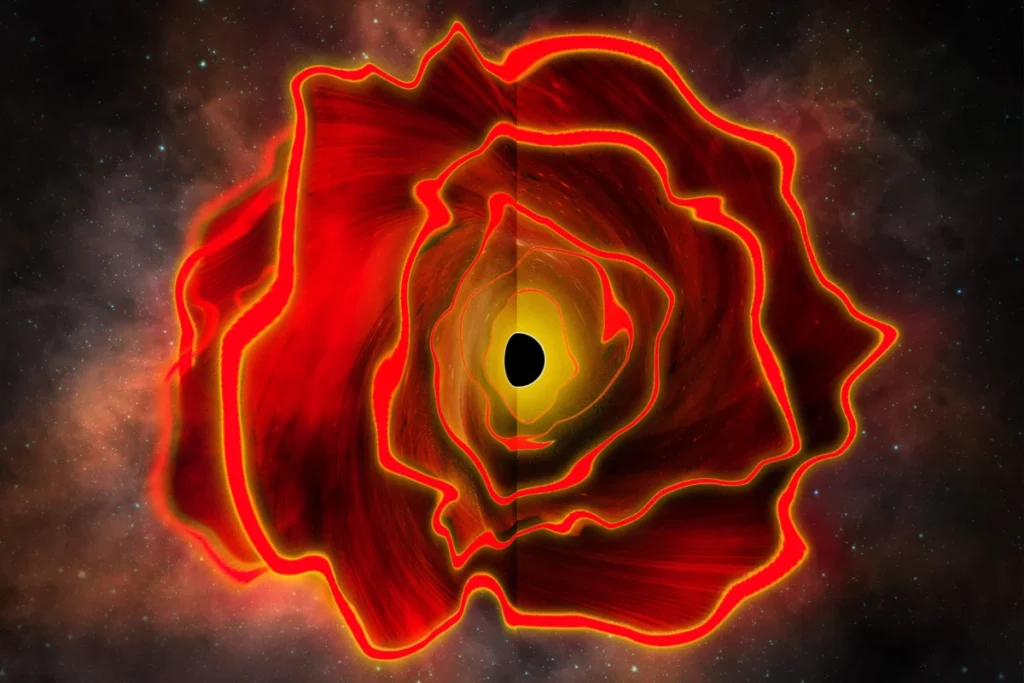
The lead author of the study, Rohan Naidu, a NASA Hubble Fellow and Pappalardo Fellow at MIT’s Kavli Institute for Astrophysics and Space Research (MKI), explains that the team’s perception of these objects is shifting with unprecedented speed. The object in question, designated MoM-BH*-1, appears to harbor a central black hole approximately 100,000 times as massive as our sun. However, unlike the "naked" black holes or quasars typically observed in the later universe, this black hole is surrounded by an incredibly dense and extended envelope of gas. This envelope is so large that it mimics the appearance of a single star the size of our solar system, creating a "mirage" of a bright, early galaxy.
The Mirage or Miracle Survey: A New Frontier in Deep Space
The discovery was made as part of a specialized survey titled "Mirage or Miracle" (MoM). The primary objective of the MoM survey was to investigate a persistent tension in modern astrophysics: the presence of unexpectedly bright galaxies in the very early universe. According to standard cosmological models, galaxies should have taken a significant amount of time to accumulate mass and luminosity. However, JWST has consistently found objects that appear far too bright and well-developed for their age, leading some to call them "miracles" of cosmic formation.
Naidu and his team, including MKI Director Robert Simcoe and MIT student Wendy Sun, set out to determine if these objects were truly massive early galaxies or if they were "mirages"—astrophysical phenomena that appear to be one thing while actually being another. By utilizing the infrared sensitivity of the JWST, the team peered back to an era just a few hundred million years after the Big Bang. In the process of scanning these deep-field images, they located a specific source that was both exceptionally red and exceptionally bright, standing out from the surrounding celestial backdrop.
Deciphering the Spectral Signature of MoM-BH*-1
In astronomy, a red hue often serves as a proxy for distance or the presence of interstellar dust. Robert Simcoe, the Bruno B. Rossi Professor of Experimental Physics at MIT, compares this phenomenon to atmospheric conditions on Earth. He notes that just as wildfire smoke can turn the sky over a city like Boston a deep, hazy red, cosmic dust can scatter shorter wavelengths of light, leaving only the longer, redder wavelengths to reach the telescope. Initially, the team suspected that the red dot was simply a young galaxy obscured by a thick veil of soot and ash-like dust.
However, upon closer inspection of the spectral data, the dust hypothesis began to fail. The team observed a "Balmer break," a specific pattern in the light spectrum where the intensity drops off sharply below certain wavelengths. This signature is typically found in the atmospheres of stars that are several hundred million years old, such as Vega. In these stars, dense hydrogen gas absorbs specific photons, creating a distinct "break" in the light.
The Balmer break observed in MoM-BH*-1 was the deepest ever recorded in any astronomical object. This finding ruled out ordinary stars or standard galaxy formations as the source. It suggested that the researchers were witnessing a "stellar atmosphere" on a scale never before imagined. Furthermore, the light from the red dot showed almost no traces of heavy metals or complex elements. It consisted almost entirely of hydrogen and helium, the primary ingredients of the early universe.
The Physics of the Black Hole Star
To reconcile the object’s extreme brightness with its unusual spectral signature, the MIT team turned to advanced computer simulations. They sought to determine if it was possible to produce such a deep red color and a significant Balmer break using only hydrogen, without the presence of dust. The simulations confirmed that an extremely dense screen of hydrogen could indeed produce these effects. This screen would need to be so dense that it would function more like the photosphere of a giant star than a translucent nebula.
While this explained the color and the spectral break, it introduced a new problem: the energy source. MoM-BH*-1 is approximately 100 billion times brighter than a typical star. Nuclear fusion, the process that powers the sun and all other known stars, is physically incapable of generating that level of luminosity within a single object of that scale.
The only known mechanism capable of producing such immense energy is an active, accreting black hole. Black holes generate heat and light as they pull in surrounding matter, compressing and heating it to millions of degrees before it crosses the event horizon. When the researchers integrated a 100,000-solar-mass black hole into their simulations and surrounded it with a dense hydrogen cocoon, the resulting model perfectly matched the observations from JWST.
This hybrid structure—a black hole core with a star-like hydrogen shell—was dubbed a "black hole star." In this configuration, the black hole provides the raw power, while the surrounding hydrogen acts as a transformer, absorbing the high-energy radiation and re-emitting it as the bright, red light observed by the telescope.
Implications for the "Little Red Dot" Mystery
The identification of MoM-BH*-1 provides a potential Rosetta Stone for understanding the "little red dots" that have populated JWST images since the mission began. These objects have been the subject of intense debate within the astronomical community. Some researchers argued they were "hidden" quasars, while others suggested they were compact, dust-enshrouded galaxies.
The MIT study suggests that many, if not all, of these dots could be black hole stars. While MoM-BH*-1 is unique because it is bright enough to completely outshine its host galaxy, other little red dots may represent the same phenomenon on a smaller or more distant scale. If this hypothesis holds, it would mean that the early universe was populated by these exotic "mirages" rather than the "miracle" galaxies that seemed to defy the laws of physics.
"Every little red dot is consistent with being a black hole star, embedded in a generic early galaxy," Naidu says. This discovery helps align JWST’s observations with existing cosmological theories. If these bright sources are black hole stars rather than massive galaxies, then the timeline for galaxy growth remains intact, and the "miracle" galaxies are revealed to be a misunderstood class of black hole-driven objects.
Chronology and Context of the Discovery
The timeline of this discovery reflects the rapid pace of the JWST era:
- December 2021: JWST launches, carrying the most advanced infrared sensors ever sent into space.
- July 2022: The first deep-field images are released, revealing thousands of "little red dots" that puzzle the scientific community.
- 2023: The "Mirage or Miracle" survey is initiated by MIT researchers to investigate these anomalies.
- Late 2023 – Early 2024: The team identifies MoM-BH*-1 and conducts intensive spectral analysis and computer modeling.
- 2024: The team publishes their findings, proposing the "black hole star" model as a solution to the LRD mystery.
Scientific and Broader Impact
The implications of this research extend beyond the identification of a single object. It provides a new framework for understanding the "Seed Black Hole" problem—the question of how supermassive black holes at the centers of galaxies grew so large so quickly. If black hole stars were common in the early universe, they may have served as the massive seeds that eventually grew into the billion-solar-mass monsters we see in the hearts of modern galaxies.
Furthermore, the study highlights the importance of multi-institutional collaboration and the power of simulation in modern astrophysics. The research was supported by the MIT Department of Physics, NASA, and the Space Telescope Science Institute (STScI).
As astronomers continue to analyze data from JWST, the focus will now shift to finding more objects like MoM-BH*-1. Confirming the existence of a population of black hole stars would rewrite the textbooks on early cosmic evolution. It suggests that the transition from the "dark ages" of the universe to the era of stars and galaxies was far more complex and exotic than previously thought, defined by gargantuan structures that blurred the line between stars and black holes. For now, the little red dots remain a primary target for the world’s most powerful telescope, as scientists peel back the layers of the early universe to separate cosmic mirages from the miracles of creation.