The recent total solar eclipse, a celestial spectacle that captivated millions worldwide, delivered more than just a breathtaking visual experience. In a remarkable twist, atmospheric conditions over Spain transformed the Sun’s ethereal outer atmosphere, the corona, into a stunning golden hue, a phenomenon rarely observed and thoroughly documented by dedicated astronomers and skywatchers. This unusual coloration, distinct from the typical pearly white or silvery appearance, provided a unique scientific opportunity and a visually unforgettable event for those fortunate enough to witness it.
The Corona: A Glimpse into the Sun’s Fiery Expanse
During a total solar eclipse, the Moon aligns perfectly with the Sun, obscuring its brilliant disc. This alignment acts as a natural filter, allowing the much fainter solar corona, the Sun’s extremely hot outermost atmosphere, to become visible. The corona is a dynamic and complex region, characterized by temperatures reaching millions of degrees Celsius, driven by the Sun’s intense magnetic fields. Typically, during eclipses, the corona presents a familiar, almost ghostly, white or silvery glow. This is due to the high-energy particles and plasma that emit light across a broad spectrum, which our eyes perceive as a neutral, bright white.
However, the total solar eclipse that traversed parts of North America, Europe, and Africa on April 8, 2024 (though the golden effect was primarily noted in Spain due to specific timing and atmospheric conditions), offered a departure from this norm for some observers. While many across the path of totality reported seeing the classic pearly corona, those situated in Spain were treated to a surprisingly rich, warm golden color. This deviation sparked immediate scientific interest and public fascination, prompting a deeper investigation into the underlying causes.
The Celestial Mechanics of a Golden Hue
The key to understanding this striking golden appearance lies in a confluence of astronomical timing and terrestrial atmospheric phenomena. In Spain, the crucial phase of totality occurred at a specific point in the day: as the Sun was nearing the horizon, preparing for sunset. This low angle of the Sun is critical. When the Sun is close to the horizon, its light must traverse a significantly greater thickness of Earth’s atmosphere to reach an observer on the ground.
This extended journey through the atmosphere is the primary driver behind the color shift. Earth’s atmosphere is composed of various gases and particles that interact with sunlight. Shorter wavelengths of visible light, such as blue and violet, are more susceptible to scattering by these atmospheric molecules. This phenomenon, known as Rayleigh scattering, is the very same process that imbues sunsets with their iconic orange and red hues. As sunlight passes through a larger portion of the atmosphere, more of the blue light is scattered away in all directions, leaving the longer, warmer wavelengths – reds, oranges, and yellows – to dominate the light that reaches our eyes. In the context of the eclipse, this atmospheric filtering effectively "removed" the bluer components of the coronal light, amplifying the inherent warmer tones.
Amplifying the Effect: Smoke as a Natural Filter
Adding another significant layer to the golden corona phenomenon was the presence of an unusually high concentration of smoke particles in the Spanish atmosphere on the day of the eclipse. This smoke, originating from nearby forest fires that had been affecting the region in the preceding weeks, acted as an additional, potent atmospheric filter. Smoke particles are larger than the gas molecules responsible for Rayleigh scattering and are highly effective at scattering light across a wider range of wavelengths, including those that contribute to blues and greens.
This enhanced scattering effect further diminished the amount of blue and green light reaching observers, intensifying the dominance of the remaining warmer colors. The smoke particles, in essence, amplified the natural sunset effect, pushing the corona’s visible light spectrum even further towards the yellow and golden end. This synergistic combination of a low-angled Sun and a smoke-laden atmosphere created the perfect conditions for the corona to display its unexpected and captivating golden radiance.
A Timeline of Observation and Scientific Engagement
The total solar eclipse itself was a precisely timed celestial event. The path of totality began in Mexico, crossed through the United States, and then moved over eastern Canada and parts of Europe. For Spain, the eclipse’s path of totality was relatively brief, occurring in the late afternoon of April 8, 2024. Precise timings for the onset of totality in specific Spanish locations, such as Benavente, were crucial for astronomical observations.
- Early Afternoon (UTC): The Moon began its transit across the Sun, marking the start of the partial eclipse phase for many observers in Europe.
- Late Afternoon (UTC): Totality commenced in Spain. During this period, the Sun was positioned low on the western horizon. For locations like Benavente, totality occurred for a few minutes, offering a window for observation.
- Post-Totality: As the Moon moved off the Sun, the partial eclipse phase resumed, and the Sun’s brightness gradually returned, making the corona once again invisible to the naked eye.
Following the eclipse, astronomical institutions and amateur astronomers immediately began processing the data and images captured. Initial reports from Spain highlighted the unusual golden hue of the corona, prompting further analysis by atmospheric scientists and astrophysicists. The data gathered from this specific region is now being compared with observations from other parts of the eclipse path to better understand the interaction of solar light with different atmospheric conditions.
Supporting Data and Scientific Analysis
The visual impact of the golden corona was not merely anecdotal. Scientific analysis of the light spectra captured during the eclipse in Spain is providing concrete evidence for the atmospheric filtering. Spectroscopic data would reveal a measured decrease in the intensity of shorter wavelengths (blue and violet) compared to longer wavelengths (yellow, orange, and red) in the light reaching the ground from the corona. This would align with the expected effects of Rayleigh scattering and Mie scattering (which is more dominant for larger particles like smoke).
While precise quantitative data on the smoke particle density and composition from the specific time and location of the eclipse in Spain is still being compiled and analyzed by meteorological agencies, the visual correlation is strong. Satellite imagery from the days leading up to the eclipse would likely show the extent of smoke plumes originating from forest fires and their drift towards the eclipse observation sites in Spain. This would provide a clear contextual link to the enhanced atmospheric filtering.
The Sun’s corona itself is a source of constant scientific study. Data from missions like NASA’s Parker Solar Probe and the European Space Agency’s Solar Orbiter are continuously providing unprecedented insights into the Sun’s atmosphere. While these missions study the corona up close, ground-based observations during eclipses offer a unique perspective on how the corona’s light interacts with Earth’s atmosphere. The golden corona event in Spain serves as a valuable natural experiment, complementing data from these advanced spacecraft.
The Art of Capturing the Celestial Phenomenon
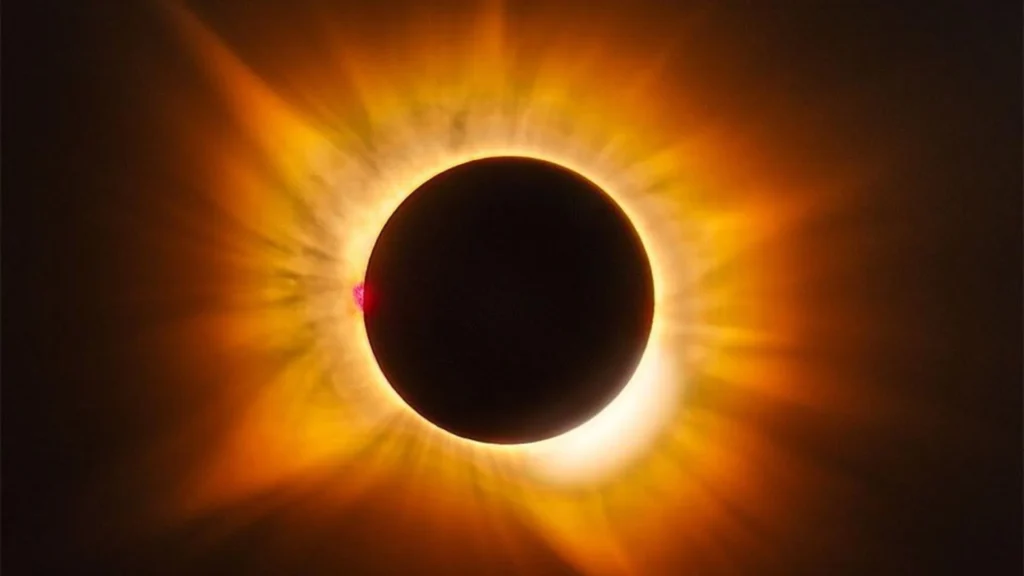
The remarkable featured image, showcasing the golden corona with a distinct pink prominence, is a testament to advanced photographic techniques. The creation of such images often involves High Dynamic Range (HDR) processing. HDR imaging is a technique that combines multiple photographs taken at different exposure levels. This allows for the preservation of detail in both the brightest and darkest areas of a scene. In the context of an eclipse, this is crucial because the corona, while visible, is far fainter than the Sun’s disc, and prominences can have varying brightness. By layering exposures, photographers can capture the subtle gradients and intricate structures of the corona and its associated features without overexposing the brighter elements or underexposing the fainter ones.
The photograph, captured from Benavente, Spain, illustrates the successful application of these techniques. The processing not only enhanced the golden hue but also ensured that other subtle features, like the pink solar prominence, remained vividly visible.
A Striking Pink Prominence Against a Golden Backdrop
While the corona painted a golden masterpiece, another celestial feature stood out with its own distinct color: a large solar prominence. Located along the Sun’s left edge, this enormous structure of glowing plasma remained visible and retained its characteristic bright pink hue. Solar prominences are spectacular eruptions of superheated gas, guided by the Sun’s powerful magnetic fields. They can extend thousands of kilometers above the Sun’s surface.
The reason this prominence maintained its pink color, even amidst the golden corona, lies in its composition and the light it emits. Prominences are rich in hydrogen, and when hydrogen atoms are excited by the Sun’s energy, they emit light strongly in specific wavelengths, notably those associated with the red part of the spectrum. This emission is so powerful that it can often overpower the general scattering effects of the atmosphere, allowing its intrinsic color to shine through. Against the unusually warm, golden backdrop of the filtered corona, the vivid pink of the prominence created an even more dramatic and aesthetically striking visual contrast, making this particular eclipse a truly rare and memorable event.
Reactions and Broader Implications
The visual spectacle of the golden corona garnered widespread attention from the scientific community and the public alike.
Dr. Elena García, an astrophysicist at the Instituto de Astrofísica de Andalucía, commented on the event, stating, "While we expect variations in coronal appearance due to atmospheric conditions, the intensity of the golden hue observed in Spain was remarkable. It underscores the critical role of atmospheric composition and light scattering in shaping our perception of celestial events. This provides valuable data for atmospheric modeling."
Amateur astronomer Javier López, who witnessed the eclipse from a rural area near Benavente, described the experience: "It was unlike any eclipse I’ve seen before. The corona wasn’t just bright; it had a warmth to it, a deep golden glow that made it feel almost tangible. The pink prominence was like a jewel against that backdrop. It was truly breathtaking."
The implications of this observation extend beyond mere aesthetic appreciation. For atmospheric scientists, the event serves as a real-world validation of scattering models. The ability to quantify the extent of light filtering due to both natural atmospheric components and anthropogenic factors like smoke can improve our understanding of atmospheric optics and even contribute to air quality monitoring and analysis.
For astrophysicists, observing the corona under such unique atmospheric conditions provides a subtle but important check on how we interpret coronal observations made from Earth. It highlights the need to account for terrestrial atmospheric effects when analyzing the light from the Sun’s outer atmosphere.
Furthermore, the event underscores the importance of public engagement with science. The widespread sharing of stunning images and personal accounts of the golden corona not only inspires awe but also fosters a greater appreciation for the complex interplay between celestial bodies and our own planet. It serves as a reminder that even seemingly common astronomical events can reveal novel and scientifically significant phenomena under the right circumstances.
In conclusion, last week’s total solar eclipse, particularly as observed from Spain, offered a profound reminder of the dynamic and often surprising nature of our universe. The unprecedented golden corona, a product of precise celestial alignment and Earth’s atmospheric artistry, transformed a familiar astronomical spectacle into an extraordinary visual and scientific event, leaving an indelible mark on all who witnessed its radiant, golden embrace.