In a discovery that challenges half a century of nuclear physics dogma, researchers utilizing the STAR detector at the Relativistic Heavy Ion Collider (RHIC) have uncovered evidence suggesting that the "baryon number"—a fundamental quantum property of protons and neutrons—may not be carried by quarks alone. Instead, new data indicates that this property may reside within a complex, Y-shaped arrangement of gluons known as a "gluon junction." This finding, recently published in the journal Science, offers a transformative look at the internal architecture of the building blocks of the universe and provides a potential answer to long-standing mysteries regarding the stability of matter and the imbalance between matter and antimatter in the cosmos.
For decades, the standard model of particle physics has taught that protons and neutrons (collectively known as baryons) are composed of three "valence" quarks. According to this traditional view, each of these three quarks carries exactly one-third of the baryon number, totaling a net value of one. This integer value is strictly conserved in particle interactions, acting as a cosmic accounting rule that ensures the number of protons and neutrons in the universe remains stable over billions of years. However, the latest results from the STAR collaboration suggest that this "bookkeeping" might be managed not by the quarks themselves, but by the field of gluons—the force-carrying particles that bind quarks together through the strong nuclear force.
The Quantum Architecture of the Proton
To understand the significance of this discovery, one must look at the internal environment of a nucleon. While a simplified textbook model depicts a proton as three static dots (quarks) connected by springs (gluons), the reality is a chaotic, high-energy "soup" of virtual particles. Within this environment, gluons are constantly being emitted and absorbed, and pairs of quarks and antiquarks are perpetually popping in and out of existence.
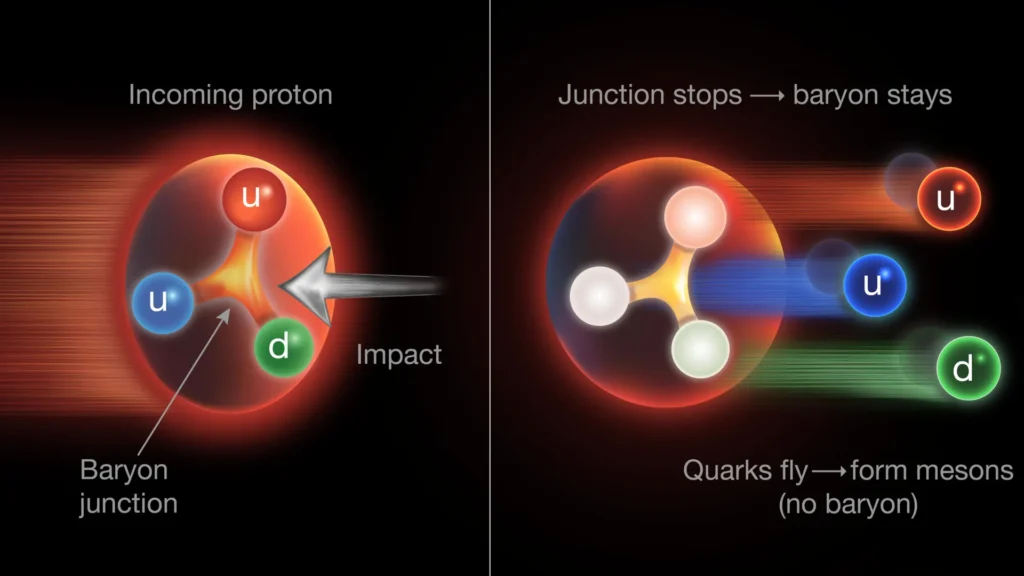
Quantum Chromodynamics (QCD), the theory governing the strong force, describes how gluons carry a "color charge" and can interact with one another. This unique ability allows gluons to form intricate structures. In the 1970s, theoretical physicists first proposed the existence of a baryon junction, a Y-shaped configuration where gluon fields from the three valence quarks meet at a central point. For years, this junction was viewed merely as a structural necessity to maintain color neutrality. However, in 1996, Dmitri Kharzeev, a theoretical physicist at Stony Brook University and Brookhaven National Laboratory, proposed a radical alternative: that the junction itself was the true carrier of the baryon number.
This hypothesis remained largely untested for nearly thirty years because of the extreme difficulty in isolating the behavior of the junction from the quarks it connects. The STAR collaboration at RHIC, a U.S. Department of Energy (DOE) Office of Science user facility, finally developed a methodology to distinguish between the two.
Experimental Methodology: Collisions at Nearly the Speed of Light
The Relativistic Heavy Ion Collider, located at Brookhaven National Laboratory on Long Island, is uniquely suited for this research. It is the only facility in the world capable of colliding polarized protons as well as heavy ions like gold, which contain large numbers of protons and neutrons. When these nuclei are accelerated to 99.995% of the speed of light and smashed together, the resulting temperatures and pressures are so intense that the individual quarks and gluons are "melted" into a state of matter known as quark-gluon plasma—a substance that filled the universe microseconds after the Big Bang.
In these high-energy collisions, thousands of new particles are created from the pure energy of the impact. The STAR (Solenoidal Tracker at RHIC) detector acts as a massive digital camera, recording the trajectories and identities of these particles. The research team specifically looked for "midrapidity" baryons—protons and neutrons that emerge from the collision at angles perpendicular to the original beamline.
The logic behind the experiment was rooted in the conservation of momentum. When two nuclei collide, most of the valence quarks continue moving forward at high speeds. If the baryon number were tied strictly to these quarks, very few baryons should be found "stopped" in the center of the detector. However, if the baryon number is carried by the gluon junction, which carries less momentum than the quarks at high energies, it would be much easier for the collision to "stop" the junction while the quarks continue their forward flight.
The Electric Charge Test: A Decisive Comparison
To prove that the baryon number was being transported independently of the quarks, the STAR team compared the distribution of baryon number with the distribution of electric charge. Quarks carry electric charge (up quarks have +2/3, down quarks have -1/3), whereas gluons and the proposed gluon junction are electrically neutral.
By measuring the net electric charge of particles emerging perpendicular to the beam, the researchers could track exactly how many valence quarks were "stopped" during the impact. "Measuring the electric charge coming out perpendicular to the collision gives you a definitive way of measuring how many quarks are stopped and transformed into new particles," explained Zebo Tang, a professor at the University of Science and Technology of China and a lead researcher on the project.
The results revealed a significant discrepancy. The researchers observed a substantial excess of baryon number compared to the amount of electric charge being stopped. Specifically, the data showed roughly twice as many baryons as would be expected if the baryon number were tied to the valence quarks. This mismatch provides the strongest evidence to date that the baryon number is associated with a neutral carrier—the gluon junction—rather than the charged quarks.
A Chronology of Discovery
The path to this discovery has spanned over half a century of theoretical and experimental milestones:
- 1970s: Theoretical physicists first describe the "baryon junction" as a topological feature of QCD to explain how three quarks are bound together.
- 1996: Dmitri Kharzeev publishes a paper suggesting that the baryon junction, not the quarks, carries the baryon number, proposing that this could be tested in high-energy collisions.
- 2000: RHIC begins operations at Brookhaven National Laboratory, providing the high-energy environment necessary to probe the subatomic structure of nucleons.
- 2020: Nicole Lewis, then a postdoc at Brookhaven Lab, begins the specific data analysis project within the STAR collaboration to look for the gluon junction signature.
- 2022-2023: The STAR collaboration analyzes data from various collision systems, including gold-gold and isobar collisions (ruthenium and zirconium), to refine the measurement of charge vs. baryon transport.
- 2024: The results are finalized and published in Science, marking a major shift in the understanding of nucleon structure.
Broader Implications: From Proton Stability to the Big Bang
The discovery that gluons may be the true carriers of baryon number has profound implications for our understanding of the universe. One of the most significant is the mystery of matter-antimatter asymmetry. Standard cosmological models suggest that the Big Bang should have produced equal amounts of matter and antimatter, which would have annihilated each other, leaving behind an empty universe of pure radiation. The fact that we live in a matter-dominated universe suggests that some process favored the survival of baryons over antibaryons.
"The reasons for this conservation are not well understood. It’s one of the mysteries of the universe," said Nicole Lewis, now a STAR physicist at Rice University. Understanding the mechanism of baryon transport and conservation through the lens of gluon junctions may provide new clues into how the early universe evolved.
Furthermore, this research reinforces our understanding of proton stability. Protons are remarkably long-lived; if they decayed quickly, atoms could not exist, and the universe would be a soup of subatomic particles. The baryon junction acts as a topological "knot" that is incredibly difficult to undo, explaining why the baryon number is so strictly conserved and why the proton’s lifetime is estimated to be longer than the age of the universe itself.
The Future of Nuclear Physics at Brookhaven
The STAR detector’s findings come at a pivotal time for Brookhaven National Laboratory. As RHIC approaches the end of its operational life in the mid-2020s, the facility is being prepared for a massive upgrade into the Electron-Ion Collider (EIC). The EIC will use high-energy electrons to "scan" the internal structure of protons and nuclei with unprecedented precision, much like a subatomic MRI.
"This new understanding reshapes how we think about the structure of matter," said Rongrong Ma, a Brookhaven Lab physicist. The EIC will allow scientists to map the gluon junctions directly, confirming the STAR results and exploring how the distribution of gluons changes with energy and momentum.
The research was a massive international effort, supported by the DOE Office of Science, the U.S. National Science Foundation, and agencies in China, India, and Europe. It utilized the Open Science Grid and high-performance computing clusters at Lawrence Berkeley National Laboratory to process the petabytes of data generated by RHIC.
As textbooks are rewritten to reflect that the proton is more than just a trio of quarks, the scientific community moves one step closer to solving the fundamental riddle of why matter exists at all. The Y-shaped junction, once a mathematical curiosity, now stands at the center of our understanding of the physical world.