In the first few millionths of a second following the Big Bang, the universe was not filled with the stars, planets, or galaxies we observe today. Instead, it was an unimaginably hot, dense, and turbulent environment where temperatures soared to trillions of degrees. In this extreme state, the fundamental building blocks of matter—quarks and gluons—were not yet confined within protons and neutrons. Instead, they moved freely in a substance known as quark-gluon plasma (QGP). Often referred to as the "primordial soup," this material represented the universe’s first liquid state. Recent breakthroughs at CERN’s Large Hadron Collider (LHC) have finally allowed scientists to observe how this exotic substance behaves at the most granular level, revealing that it responds to high-speed particles by creating wakes, ripples, and splashes, much like a liquid in the macroscopic world.
A research team led by physicists from the Massachusetts Institute of Technology (MIT), working within the CMS (Compact Muon Solenoid) Collaboration, has provided the first direct evidence of these "quark wakes." By utilizing a sophisticated new detection method involving Z bosons, the team has confirmed that quark-gluon plasma acts as a unified, nearly "perfect" fluid rather than a collection of independent particles. This discovery, published in the journal Physics Letters B, marks a significant milestone in our understanding of high-energy nuclear physics and the evolution of the early cosmos.
The Nature of the Primordial Soup
To understand the significance of this discovery, one must look back nearly 13.8 billion years. During the universe’s first microseconds, the energy density was so high that even the strong nuclear force—the force that usually glues quarks together—could not maintain the structure of subatomic particles. In this environment, quarks and gluons formed a plasma that existed for a fleeting moment before the universe expanded and cooled enough for "hadronization" to occur, the process where these particles combined to form the protons and neutrons that make up the atomic nuclei of everything we see today.
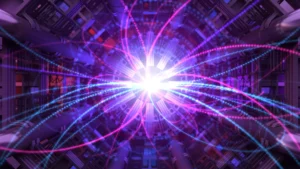
For decades, the goal of heavy-ion physics has been to recreate these conditions on a miniature scale. At CERN, located on the border of France and Switzerland, the Large Hadron Collider achieves this by accelerating heavy ions, such as lead nuclei, to 99.9999% of the speed of light. When these ions collide, the kinetic energy is converted into heat and density so intense that it melts the protons and neutrons, briefly recreating a droplet of quark-gluon plasma. These droplets are incredibly tiny—roughly the size of an atomic nucleus—and exist for less than a quadrillionth of a second.
The Quest for the Perfect Liquid
Since the early 2000s, experiments at the Relativistic Heavy Ion Collider (RHIC) in the United States and subsequently at the LHC have suggested that QGP is not a gas, as originally predicted, but a liquid. Specifically, it is described as a "perfect liquid" because it possesses the lowest possible ratio of shear viscosity to entropy density allowed by the laws of quantum mechanics. This means the plasma flows with almost zero internal friction, allowing energy and momentum to move through it with extraordinary efficiency.
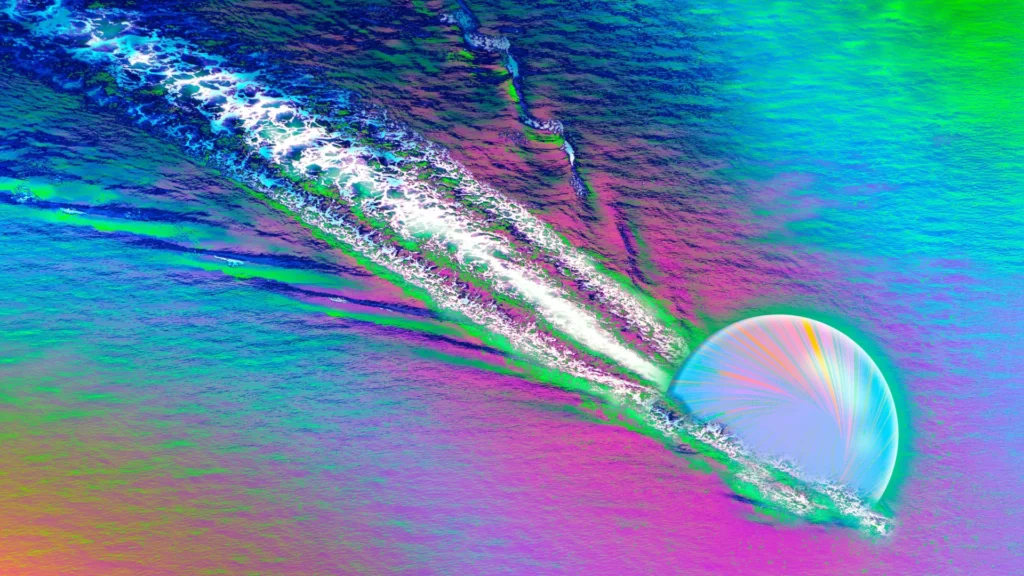
However, proving that QGP responds like a fluid to the passage of individual particles has been a persistent challenge. Theoretical models, most notably the "hybrid model" developed by Krishna Rajagopal and his colleagues at MIT, predicted that if a high-energy quark were to shoot through this plasma, it should create a "wake" behind it. This phenomenon is analogous to the bow wave created by a boat moving through a harbor or the ripples left by a duck swimming across a pond. Until now, identifying these wakes among the chaotic debris of billions of particle collisions was considered one of the "holy grails" of the field.
Overcoming the Interference Problem
The primary obstacle in detecting quark wakes has been the nature of particle production in high-energy collisions. Typically, quarks are produced in pairs—a quark and an antiquark—moving in opposite directions to conserve momentum. When these pairs are generated within a droplet of QGP, both particles create wakes as they exit the plasma.
"When you have two quarks produced, the problem is that, when the two quarks go in opposite directions, the one quark overshadows the wake of the second quark," explains Yen-Jie Lee, a professor of physics at MIT and a lead author of the study. This overlapping interference made it nearly impossible to isolate the specific fluid-like response of the plasma to a single source of disturbance.
To solve this, the MIT-led team looked for a rarer type of event involving the Z boson. The Z boson is an elementary particle that mediates the weak nuclear force. Unlike quarks, which carry "color charge" and interact strongly with the quark-gluon plasma, the Z boson is "color-blind." It passes through the dense primordial soup as if it weren’t there, unaffected by the strong nuclear force.
The Z Boson as a Cosmic Tag
In rare instances during a lead-ion collision, a Z boson and a single high-energy quark are produced simultaneously, flying off in opposite directions. This provided the researchers with a "clean" experiment. The Z boson serves as a reference point—a "tag"—that tells scientists exactly where the collision occurred and what the initial energy was. Because the Z boson does not interact with the plasma, any disturbance observed on the opposite side of the collision can be attributed solely to the single quark traveling through the medium.
"In this soup of quark-gluon plasma, there are numerous quarks and gluons passing by and colliding with each other," says Lee. "Sometimes when we are lucky, one of these collisions creates a Z boson and a quark, with high momentum."
Working in collaboration with Professor Yi Chen’s group at Vanderbilt University, the researchers analyzed data from approximately 13 billion lead-ion collisions recorded by the CMS detector. Out of these billions of events, they identified roughly 2,000 instances where a high-momentum Z boson was produced in conjunction with a quark jet.
Evidence of Swirls, Splashes, and Waves
By meticulously mapping the energy distribution in the direction opposite the Z boson, the team found exactly what the fluid dynamics models had predicted. They observed a distinct redistribution of energy that indicated the plasma was being "dragged" along by the quark. As the quark pushed through the medium, it lost energy, which was then converted into a collective motion of the plasma.
The data revealed patterns of splashing and swirling motion—direct evidence that the QGP was behaving as a unified liquid. These observations perfectly matched the predictions of the hybrid model, which combines the principles of quantum chromodynamics (QCD) with fluid dynamics.
"We’ve gained the first direct evidence that the quark indeed drags more plasma with it as it travels," Lee notes. "This will enable us to study the properties and behavior of this exotic fluid in unprecedented detail."
Chronology of Discovery and Technical Context
The discovery is the culmination of over two decades of international collaboration.
- 2005: Researchers at RHIC first announced that QGP behaved more like a liquid than a gas, surprising the physics community.
- 2010: The LHC began its heavy-ion program, providing higher energy densities and more stable droplets of QGP.
- 2014: Theoretical frameworks like the hybrid model began to mature, providing a roadmap for what researchers should look for in terms of jet-medium interactions.
- 2018-2023: The CMS Collaboration collected and processed petabytes of data from Run 2 of the LHC, focusing on rare probes like Z bosons and Higgs bosons in heavy-ion environments.
- 2024: The MIT-led team finalized the analysis of the Z-tagged jet events, leading to the current publication.
The technical achievement of the CMS detector cannot be overstated. Weighing 14,000 tons and sitting 100 meters underground, the CMS uses a massive superconducting solenoid to create a magnetic field 100,000 times stronger than the Earth’s. This allows physicists to track the paths of particles with sub-millimeter precision, a necessity when trying to reconstruct the "splashes" of a liquid that exists for only a fraction of a second.
Broader Implications and Future Research
The ability to measure the characteristics of these wakes—their size, velocity, and how quickly they dissipate—gives scientists a new set of tools to probe the fundamental properties of matter. Specifically, it allows for a more precise measurement of the "transport coefficients" of the early universe, such as its viscosity and thermal conductivity.
Krishna Rajagopal, whose theoretical work laid the foundation for this search, emphasizes the importance of this milestone. "This is something that many of us have argued must be there for a good many years, and that many experiments have looked for," he says. The confirmation of the hybrid model suggests that the mathematical tools used to describe both black holes (through gauge/gravity duality) and particle physics are converging on a unified understanding of extreme matter.
Looking ahead, the team plans to apply this Z-boson tagging technique to even larger datasets. With the High-Luminosity LHC upgrade on the horizon, the number of Z-tagged events is expected to increase significantly. This will allow physicists to perform "tomography" of the quark-gluon plasma, using quarks as probes to map out the density and temperature gradients of the primordial soup.
Beyond the realm of subatomic particles, this research provides a window into the birth of the universe. By understanding how the first liquid responded to energy, scientists can better model how the universe transitioned from a hot, chaotic plasma into the structured world of atoms. The "snapshot" of the primordial quark soup taken by Lee and his colleagues is not just a triumph of particle physics; it is a vital piece of the puzzle in the story of our cosmic origins.
This work, supported in part by the U.S. Department of Energy, demonstrates the power of international collaboration in tackling the most fundamental questions of existence. As the CMS Collaboration continues to sift through the debris of high-energy collisions, each "splash" in the primordial soup brings us one step closer to understanding the fabric of reality itself.