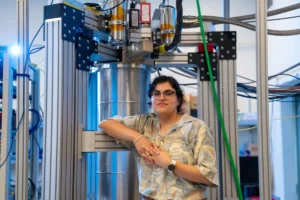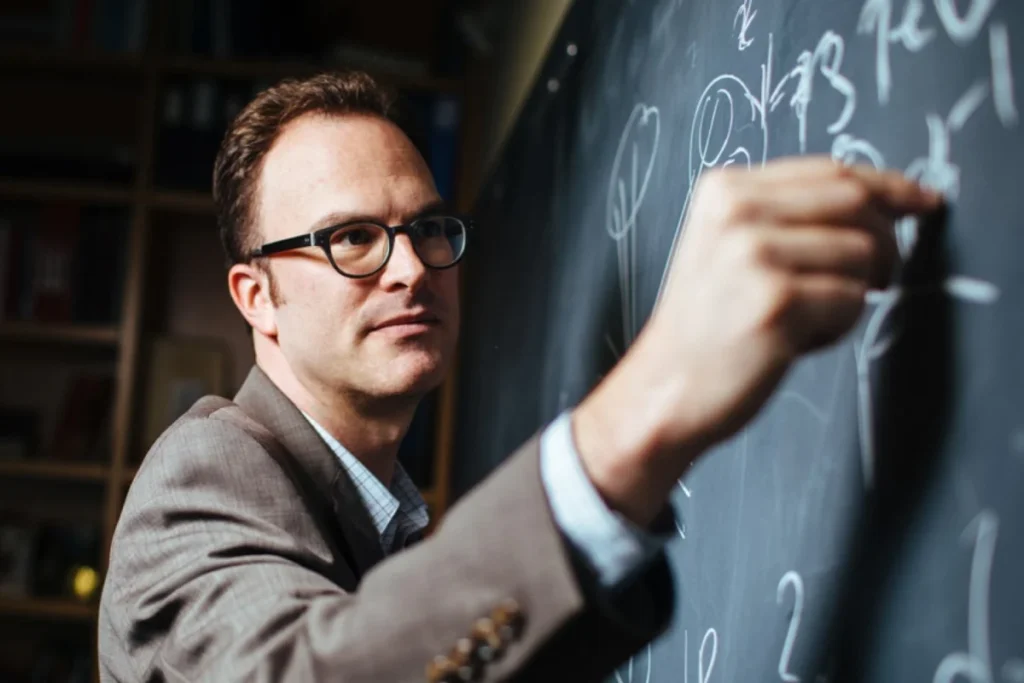
Professor Jesse Thaler, a distinguished theoretical particle physicist and a pioneer in the application of artificial intelligence to fundamental science, has been appointed as the director of the Massachusetts Institute of Technology (MIT) Laboratory for Nuclear Science (LNS), effective August 1. Thaler succeeds Professor Bolek Wyslouch, who has concluded a decade of leadership at the helm of one of the world’s premier research institutions for nuclear and particle physics. This leadership transition marks a pivotal moment for the laboratory as it increasingly integrates machine learning and advanced computational techniques into the study of the universe’s most fundamental components. Thaler, who currently serves as the William and Emma Rogers Professor of Physics within the MIT Center for Theoretical Physics—a Leinweber Institute (CTP-LI)—brings a wealth of experience in bridging the gap between high-energy physics and data science.
The appointment was announced by Nergis Mavalvala, the Dean of the MIT School of Science and the Curtis and Kathleen Marble Professor of Astrophysics. In her statement, Dean Mavalvala highlighted Thaler’s unique ability to merge traditional quantum field theory with modern machine learning architectures. She noted that Thaler has performed pioneering work on particle jets at the Large Hadron Collider (LHC) and has emerged as a global leader in the intersection of AI and particle physics. According to Mavalvala, the collaborative nature of Thaler’s research programs is expected to be a cornerstone of his directorship, guiding the LNS as the scientific community enters an era defined by AI-driven discovery and multi-institutional cooperation.
A Legacy of Excellence: The Mission of the Laboratory for Nuclear Science
The MIT Laboratory for Nuclear Science is a cornerstone of the university’s research infrastructure. Established in 1946, shortly after the end of World War II, the LNS was created to provide a centralized framework for the study of nuclear and particle physics, which were then burgeoning fields. Over the nearly eight decades since its founding, the laboratory has expanded its scope significantly. While its origins were rooted in the study of the atomic nucleus, it now encompasses a vast array of research areas, including cosmology, gravity, field theory, and quantum information science.
LNS serves as a hub for both experimental and theoretical physics. It supports major experimental efforts at international facilities, most notably the European Organization for Nuclear Research (CERN) in Switzerland, where the Large Hadron Collider is located. The laboratory is also deeply involved in projects at the Brookhaven National Laboratory on Long Island and the Thomas Jefferson National Accelerator Facility in Virginia. Under the directorship of Bolek Wyslouch, the LNS maintained its status as a leader in high-energy heavy-ion physics and particle detection technology. Thaler’s arrival as director is expected to maintain this momentum while pivoting toward the computational challenges of the 21st century.
The Intersection of AI and Fundamental Physics
The appointment of Jesse Thaler is particularly significant given his role as the inaugural director of the National Science Foundation (NSF) AI Institute for Artificial Intelligence and Fundamental Interactions (IAIFI). Since 2020, IAIFI has functioned as a multi-institutional endeavor involving researchers from MIT, Harvard, Northeastern, and Tufts. The institute’s mission is to develop AI technologies that are "physics-informed," meaning the algorithms are designed to respect the laws of nature, such as symmetries and conservation laws, rather than acting as "black boxes."
In June 2024, the NSF renewed support for IAIFI for another five years, a testament to the institute’s success under Thaler’s guidance. As Thaler moves into his new role at LNS, the directorship of IAIFI will be assumed by Mike Williams, a professor of physics at MIT who has also been a key figure in the integration of machine learning into experimental data analysis.
Thaler’s research focus—particle jets—illustrates the necessity of AI in modern physics. When protons collide at nearly the speed of light within the LHC, they produce sprays of particles known as jets. Analyzing these jets allows physicists to work backward to understand the fundamental particles produced in the collision, such as the Higgs boson or potentially undiscovered dark matter particles. However, the volume of data generated by these collisions is staggering. The LHC produces approximately one petabyte of raw data per second. Even after hardware-level filtering, the "data deluge" requires sophisticated algorithms to identify rare events that could signal new physics.
"In my own field of particle physics, researchers are developing cutting-edge AI algorithms to handle the data deluge from collider experiments and to perform heroic theoretical calculations," Thaler remarked. He emphasized that while these tools are developed for physics, their utility often extends into other sectors, including medical imaging, finance, and climate modeling.
The Genesis Mission and DOE Collaboration
The transition in leadership at LNS coincides with new opportunities funded by the United States Department of Energy (DOE). The LNS is currently positioned to pursue innovative research through the DOE’s Genesis Mission. This initiative is specifically focused on AI-enabled scientific discovery, aiming to utilize artificial intelligence to accelerate the pace of research in the physical sciences.
The Genesis Mission represents a broader federal strategy to maintain American leadership in science and technology by leveraging the "AI revolution." For the LNS, this means more than just using faster computers; it involves a fundamental shift in how hypotheses are generated and tested. AI can assist in performing "heroic" theoretical calculations—mathematical problems so complex that they were previously considered intractable for human researchers or traditional computing methods. By automating parts of the mathematical derivation and simulation process, LNS researchers can explore theoretical models of the early universe or subatomic interactions with unprecedented precision.
Educational Innovation and Interdisciplinary Frameworks
One of Thaler’s most significant contributions during his tenure at IAIFI, which he plans to bring to the LNS, is the creation of interdisciplinary educational pathways. In collaboration with the MIT Institute for Data, Systems, and Society (IDSS), IAIFI leadership established a specialized doctoral program that integrates physics, statistics, and data science. This program recognizes that the next generation of physicists must be as proficient in coding and data architecture as they are in quantum mechanics.
Furthermore, Thaler championed the creation of dedicated postdoctoral fellowships. These fellowships provide early-career researchers with the intellectual freedom to work across traditional departmental boundaries. Thaler believes that giving young scientists the space to build connections across domains and universities is transformative. "Giving young scientists space to build connections across domains, universities, and career stages has been transformative within IAIFI," Thaler noted. He intends to implement similar frameworks within the LNS to foster a more collaborative and agile research environment.
Philanthropic Support and the Leinweber Institute
As the head of LNS, Thaler will also oversee the Center for Theoretical Physics—a Leinweber Institute (CTP-LI). The center recently benefited from a landmark philanthropic gesture from the Leinweber Foundation. In 2023, the foundation provided a substantial gift to establish a network of theoretical physics research institutes, aimed at fostering global collaboration and supporting high-risk, high-reward theoretical work.
According to the Science Philanthropy Alliance, this gift represents the largest philanthropic commitment ever made specifically to the field of theoretical physics. This funding ensures that MIT remains at the forefront of the "Leinweber Network," a group of elite institutions dedicated to solving the most profound mysteries of the physical world, from the nature of gravity to the origins of the vacuum. This financial backing provides Thaler with a robust foundation to expand the laboratory’s theoretical reach while simultaneously pushing the boundaries of experimental AI applications.
Chronology of Jesse Thaler’s Career
Jesse Thaler’s academic trajectory reflects a consistent focus on the mathematical foundations of the physical world. He earned his Bachelor of Science in math and physics from Brown University in 2002. He then moved to Harvard University, where he completed his PhD in physics in 2006. His doctoral work focused on supersymmetry and new models of electroweak symmetry breaking, topics that remain central to the search for physics beyond the Standard Model.
Following his PhD, Thaler was awarded a prestigious fellowship at the Miller Institute for Basic Research in Science at the University of California, Berkeley, where he conducted research from 2006 to 2009. He joined the faculty of the MIT Department of Physics in 2010. Over the past 14 years, he has risen through the ranks, becoming a full professor and eventually the William and Emma Rogers Professor of Physics. His work has been recognized with numerous awards, including the 2016 Henry Primakoff Award for Early Career Particle Physics from the American Physical Society and various teaching awards at MIT.
Broader Implications and the Future of Discovery
The appointment of an AI specialist to lead the Laboratory for Nuclear Science signals a broader shift in the scientific landscape. As experiments like the LHC plan for high-luminosity upgrades—which will increase the rate of particle collisions even further—the traditional methods of data analysis will no longer suffice. The future of nuclear science is increasingly digital, and Thaler’s leadership suggests that MIT intends to be the primary architect of this new methodology.
The implications of this shift extend beyond the walls of the LNS. By developing AI that can understand the "language" of physics, Thaler and his colleagues are creating a template for other scientific disciplines. If an AI can be taught to respect the laws of thermodynamics while analyzing a fluid dynamics problem, or to respect charge conservation while analyzing a chemical reaction, the reliability of AI in all scientific fields will increase.
As Professor Thaler takes the reins of the LNS on August 1, the scientific community will be watching closely. The laboratory is not just a place for studying the past successes of nuclear physics, but a testing ground for the future of the scientific method itself. With the backing of the NSF, the DOE, and the Leinweber Foundation, and under the guidance of a director who views AI as a partner in discovery, the MIT Laboratory for Nuclear Science is poised to lead the next wave of breakthroughs in our understanding of the fundamental laws of nature.