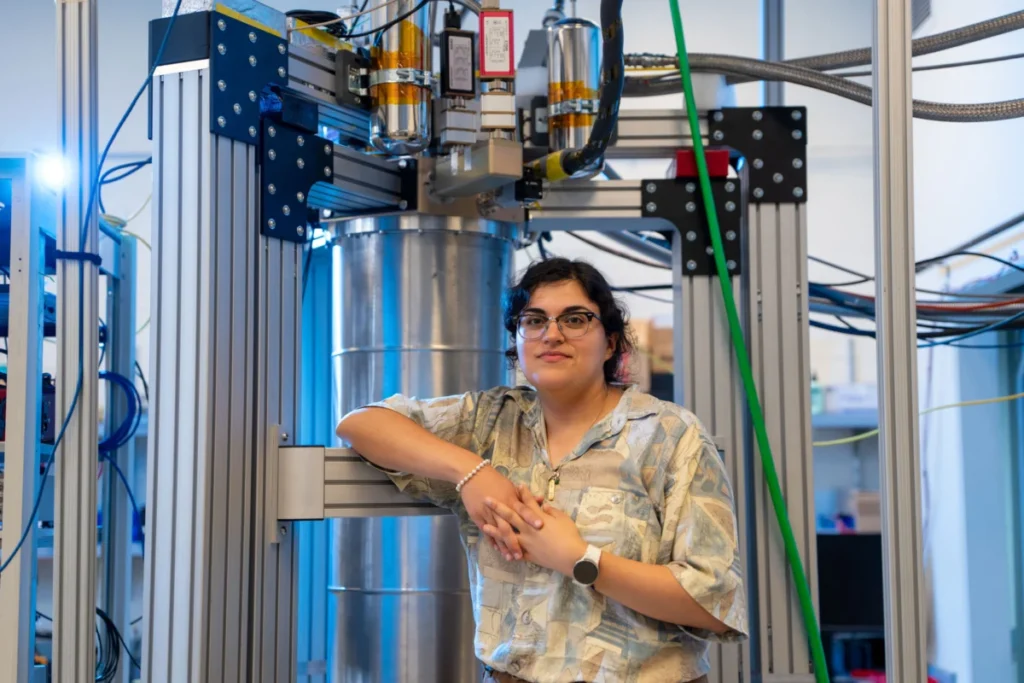
In the high-stakes world of experimental particle physics, the quest to understand the fundamental building blocks of the universe often hinges on the study of its most elusive inhabitants. At the Massachusetts Institute of Technology (MIT), Reyes, a sixth-year PhD candidate in the Formaggio Group within the Laboratory for Nuclear Science, is currently spearheading research into neutrinos—subatomic particles so ghost-like that trillions of them pass through the human body every second without leaving a trace. Her work, centered on the international Ricochet neutrino experiment, represents a critical effort to probe the limitations of the Standard Model and uncover the "new physics" that governs the cosmos.
The Enigma of the Neutrino and the Standard Model
To appreciate the significance of Reyes’ research, one must first understand the framework she seeks to challenge. The Standard Model of particle physics is the most robust theory in science, describing three of the four fundamental forces—electromagnetism, the strong nuclear force, and the weak nuclear force—while categorizing all known elementary particles. However, the model has long been recognized as an incomplete "map" of reality. It fails to account for gravity, the nature of dark matter, and the observed matter-antimatter asymmetry in the universe.
Neutrinos are central to these mysteries. For decades, the Standard Model assumed neutrinos were massless. However, the discovery of neutrino oscillations—the ability of these particles to change "flavors" as they travel—proved they possess a vanishingly small but non-zero mass. This discrepancy is one of the primary indicators that the Standard Model must be expanded. Neutrinos are produced in abundance during radioactive decay and nuclear fusion, such as the processes fueling the sun or occurring within the cores of nuclear reactors. Despite their ubiquity, their interaction cross-section is so small that detecting them requires incredibly sensitive instruments and environments shielded from cosmic interference.
Reyes’ research focuses on a specific, rare interaction known as Coherent Elastic Neutrino-Nucleus Scattering (CEvNS). In this process, a low-energy neutrino interacts with an entire atomic nucleus rather than individual protons or neutrons. This "coherent" interaction results in a tiny nuclear recoil, which, if measured accurately, can provide a high-precision test of the Standard Model’s predictions.
The Ricochet Collaboration: A Global Scientific Endeavor
Reyes is a pivotal member of the Ricochet experiment, an international collaboration that brings together researchers from the United States, France, and other global institutions. The experiment is situated at the Institut Laue-Langevin (ILL) in Grenoble, France, home to one of the most intense sources of neutrinos available to researchers: a high-flux research reactor.
The Ricochet experiment aims to utilize ultra-low-threshold cryogenic detectors to observe CEvNS with unprecedented precision. By placing these detectors in close proximity to the ILL reactor, scientists can capitalize on the massive flux of antineutrinos produced during nuclear fission. The goal is to search for "non-standard interactions"—deviations from predicted behaviors that could signal the existence of new particles, such as sterile neutrinos, or new forces of nature.
For Reyes, the path to the heart of this experiment was not linear. Her journey reflects the often-unpredictable nature of high-level scientific research, where technical delays and shifting priorities require a high degree of adaptability.
Chronology of Research: From MIT to the Heart of the French Alps
The evolution of Reyes’ doctoral work serves as a case study in the resilience required for modern experimental physics. When she first joined the Formaggio Group, her initial focus was on a domestic project based at MIT. However, as is common in large-scale experimental physics, the project faced timelines that did not align with the constraints of a PhD candidacy. Recognizing the need to pivot, Reyes shifted her focus to the Ricochet experiment in France.
This transition marked the beginning of a multi-year international odyssey. Her first visit to Grenoble lasted three months, during which she immersed herself in the fundamental mechanics of the experiment’s detectors. At that stage, Ricochet was in its infancy, operating with only two detectors. Reyes’ role involved the painstaking, routine labor of characterization—understanding the "noise" of the environment, the sensitivity of the sensors, and the baseline performance of the hardware.
As the experiment scaled up, so did Reyes’ responsibilities. The project expanded from two detectors to nine, and eventually to an array of 18. This increase in hardware complexity created a data management bottleneck. The manual analysis and monitoring that Reyes performed for two detectors became unsustainable for 18.
Identifying this challenge, Reyes and a colleague took the initiative to develop a comprehensive software framework. This system was designed to automate low-level data analysis and real-time detector monitoring. By "building her own replacement," as she describes it, Reyes did more than just save time; she created a vital infrastructure that allowed the entire collaboration to process data more efficiently. This contribution transitioned her from a student learning the ropes to a leader guiding the technical direction of the experiment.
Technical Innovation and the Chateaubriand Fellowship
The sophistication of the Ricochet experiment relies on bolometric technology—detectors that measure the tiny increase in temperature resulting from a neutrino-nucleus collision. These detectors must operate at temperatures near absolute zero to minimize thermal noise. Reyes’ work in automating the monitoring of these systems was essential for maintaining the stability of the experiment over long periods.
Her expertise was further recognized when she was awarded the Chateaubriand Fellowship, a prestigious grant from the Embassy of France in the United States. This fellowship allowed her to spend nine months in Grenoble, working directly alongside French collaborators. This period was transformative, both scientifically and personally. Being physically present at the Institut Laue-Langevin allowed for real-time troubleshooting and closer coordination across different branches of the collaboration, which is often difficult when separated by the Atlantic Ocean.
Inferred Perspectives and Collaborative Dynamics
While the technical achievements of the Ricochet experiment are paramount, the human element is equally vital. In the field of high-energy physics, where papers often feature hundreds of co-authors, the ability to "wrangle people" and coordinate across cultures is a necessary skill.
Colleagues and mentors within the Laboratory for Nuclear Science have noted that the success of projects like Ricochet depends on researchers like Reyes, who can bridge the gap between theoretical physics and hands-on engineering. The transition from a student who "waits for instructions" to a physicist who "proposes scientific ideas" is a hallmark of a successful PhD, and Reyes’ journey exemplifies this growth. Her collaborators at the ILL have expressed a high degree of trust in her judgment, particularly regarding the integration of her automated software into the main experimental pipeline.
Broad Implications: Why CEvNS Matters
The implications of Reyes’ work extend far beyond the laboratory in Grenoble. Understanding CEvNS is not merely an academic exercise; it has practical applications and profound theoretical consequences.
- Supernova Detection: Neutrinos are the first particles to escape a collapsing star during a supernova. A better understanding of CEvNS could allow physicists to use Earth-based detectors to observe the "neutrino burst" from a distant supernova, providing a real-time warning to astronomers and offering a glimpse into the internal dynamics of stellar death.
- Nuclear Non-Proliferation: Because neutrinos are produced by nuclear reactors and cannot be shielded, they offer a way to monitor reactor activity from outside a facility. High-precision CEvNS detectors could eventually be used by international regulatory bodies to ensure that nuclear reactors are being used for peaceful energy production rather than plutonium breeding.
- Dark Matter Searches: CEvNS represents a "neutrino floor" for dark matter experiments. As dark matter detectors become more sensitive, they will eventually start picking up background signals from solar and atmospheric neutrinos. Understanding the CEvNS process is essential for distinguishing between a dark matter hit and a neutrino interaction.
Analysis: The Future of Particle Physics Research
Reyes’ experience highlights a broader trend in modern science: the necessity of the "physicist-programmer." As experiments grow in scale, the ability to write custom software to manage hardware becomes as important as understanding the underlying quantum mechanics. The automation framework developed by Reyes is a prime example of how graduate students are driving the technical evolution of the field.
Furthermore, her story underscores the importance of international fellowships like the Chateaubriand. In an era where scientific challenges are too large for any one nation to solve, fostering a generation of "scientific diplomats" who are comfortable working in diverse cultural and professional environments is crucial.
As Reyes prepares to complete her doctorate and seeks a postdoctoral position, she leaves behind a more robust Ricochet experiment. Her work has contributed to a foundation that may one day reveal a "fifth force" or a new particle that fundamentally changes our understanding of the universe.
Conclusion: The Tangible and the Elusive
For a researcher who spends her days contemplating particles that have "vanishingly little mass," Reyes finds balance in the tangible. Her hobbies—crocheting and video games—provide a necessary counterweight to the abstract nature of particle physics. In crocheting, she creates something physical and permanent; in physics, she pursues the invisible and the transient.
As the Ricochet experiment continues its run at the Institut Laue-Langevin, the data gathered will be a testament to the adaptability and leadership of the researchers involved. Reyes’ journey from MIT to the French Alps illustrates that the pursuit of fundamental truth is not just about looking through a microscope or a detector—it is about the confidence to lead, the ingenuity to automate, and the persistence to follow the data, wherever in the world it may lead.