At the heart of modern electronic warfare, advanced satellite communications, and sophisticated Earth observation systems lies a deceptively simple component: a miniature black chip. This unassuming microchip, barely larger than a grain of rice, possesses the extraordinary ability to steer radio beams with remarkable precision, a capability that forms the bedrock of phased array antennas. Unlike their predecessors that relied on cumbersome mechanical tilting to maintain communication links, phased array antennas leverage these specialized microchips to electronically direct radio waves, eliminating moving parts and ushering in an era of unparalleled agility, reliability, and miniaturization in antenna technology.
The fundamental innovation behind phased array antennas lies in their ability to manipulate the phase and amplitude of radio signals. Instead of physically rotating a dish, beamforming integrated circuits (ICs) within the antenna array precisely control the timing and strength of the signals emitted or received by individual antenna elements. By subtly adjusting these parameters across hundreds or even thousands of elements, the antenna can effectively "steer" a focused beam of radio energy in any desired direction. This electronic beamforming process allows for near-instantaneous switching between targets, adaptive tracking, and the simultaneous transmission or reception of multiple beams, capabilities that were previously unattainable with mechanical systems.
The evolution of these beamforming ICs has been intrinsically linked to advancements in silicon semiconductor technology. As the manufacturing processes for integrated circuits have become more sophisticated, these chips have shrunk in size, increased in performance, and become more cost-effective. This miniaturization has been a critical enabler for the widespread adoption of phased array antennas, making them compact, robust, and affordable enough for a diverse range of applications. From ensuring seamless connectivity for global satellite constellations and high-precision navigation systems to facilitating detailed Earth observation and powering ambitious deep-space missions, phased array antennas are now indispensable.
The European Space Agency (ESA) has long recognized the strategic importance of this technology. For decades, ESA has been at the forefront of research and development in beamforming, actively exploring innovative approaches to electronically steer radio beams for both space-based and terrestrial applications. This commitment is underscored by the words of Vclav Valenta, an ESA engineer and a leading expert in phased array technology. "For decades, ESA has been at the forefront of beamforming technology, exploring innovative ways to electronically steer radio beams for space and terrestrial applications," Valenta stated. "Today, the focus is increasingly shifting towards highly integrated analogue and digital beamforming chips both designed and manufactured in Europe. These developments combine cutting-edge performance with the strategic advantage of a secure European supply chain."
A European Powerhouse in Beamforming Technology
Valenta’s assertion highlights a significant trend: the growing emphasis on developing advanced beamforming ICs within Europe. This strategic push aims not only to achieve peak performance in antenna technology but also to secure a sovereign and resilient supply chain for these critical components. The implications of this are far-reaching, particularly in a global landscape where technological independence is increasingly valued.
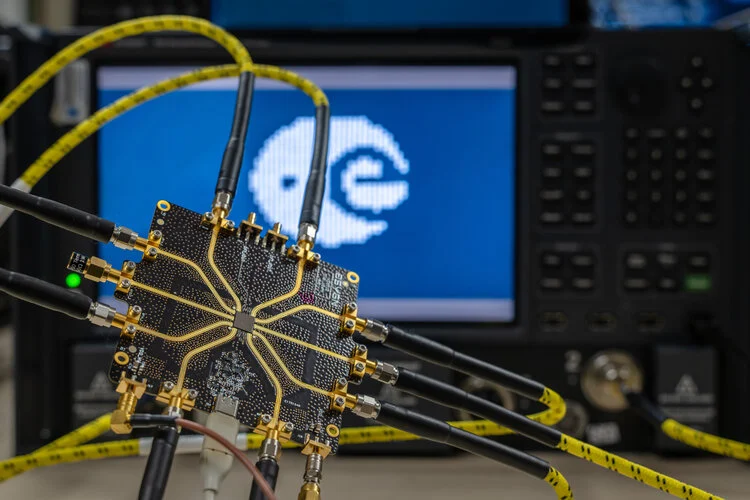
This drive for European innovation was recently showcased in a compelling technology demonstration at ESA’s RF Active Technology Laboratory at the European Space Research and Technology Centre (ESTEC) in the Netherlands. During this event, the French company Asygn unveiled its latest generation of beamforming integrated circuits, marking a significant milestone in the ongoing development of this vital technology.
Asygn’s Precision Beamforming: Visualizing the Unseen
To vividly illustrate the sophisticated control that Asygn’s microchips exert over the beamforming process, the company’s engineers presented a visually arresting demonstration. They orchestrated the creation of the blue-and-white ESA logo, not through conventional printing or display methods, but by precisely positioning hundreds of individual "dots" of radio energy. Each dot was meticulously placed by setting a specific amplitude and phase for the beamformer, effectively painting the logo in the radio frequency spectrum. This ingenious display served as a powerful, tangible representation of the microchip’s ability to sculpt and direct radio beams with astonishing accuracy.
Clement Jany, Radio Frequency Business Unit Co-Director at Asygn, elaborated on the company’s approach and its benefits. "By designing single-chip solutions dedicated to specific frequency bands – notably X and Ka – we achieve the very high levels of performance required for mission-critical satellite communication applications," Jany explained. "Our objective is to simplify system integration for phased array antenna manufacturers by delivering high-precision phase and amplitude control and an ultra-low noise figure on a single chip."
The X-band (typically 8 to 12 GHz) and Ka-band (typically 26.5 to 40 GHz) are crucial frequency ranges for satellite communications. X-band is widely used for satellite command and telemetry, while Ka-band offers higher bandwidths, enabling faster data transmission rates essential for broadband internet services, high-definition video streaming, and advanced data relay. By focusing on these bands, Asygn is directly addressing the needs of leading-edge satellite applications.
The Technical Edge: Miniaturization and Integration
The miniaturization of beamforming ICs is not merely about reducing physical size; it enables greater integration and higher functionality within a smaller footprint. Traditional phased array antennas could be large and complex, requiring numerous discrete components for signal processing and control. The advent of highly integrated beamforming chips allows for a reduction in component count, simplifying antenna design, reducing power consumption, and improving overall reliability.
The "ultra-low noise figure" mentioned by Jany is another critical performance metric. In radio frequency systems, noise refers to unwanted signals that can degrade the quality of the desired signal. A low noise figure is essential for maximizing the sensitivity of a receiver, allowing it to detect weaker signals from distant satellites or targets. By integrating low-noise amplification stages directly onto the beamforming chip, Asygn is further enhancing the performance and efficiency of phased array antennas.
Historical Context: The Evolution of Antenna Technology
The journey to modern phased array antennas began decades ago. Early radar systems, developed during World War II, often relied on mechanically steered parabolic dishes. While effective for their time, these systems were slow to reorient, prone to mechanical failure, and limited in their ability to track multiple targets simultaneously. The concept of electronically steering beams, known as "electronic scanning," emerged as a theoretical possibility.
The theoretical groundwork for phased arrays was laid in the mid-20th century, with significant contributions from scientists like Louis J. De Lathauwer and later research by companies like General Electric and Raytheon. However, the practical realization of these concepts was hampered by the limitations of semiconductor technology. The complex circuitry required for beamforming demanded high-performance transistors and intricate manufacturing processes that were not widely available or cost-effective.
The development of solid-state electronics, particularly the advent of integrated circuits in the 1960s and their subsequent miniaturization and performance enhancements through the 1980s and 1990s, provided the crucial enabler. This allowed for the integration of multiple beamforming functions onto a single chip. The widespread availability of silicon, coupled with sophisticated photolithography and etching techniques, paved the way for the mass production of increasingly complex and powerful beamforming ICs.
The space industry, with its stringent requirements for reliability, efficiency, and performance in harsh environments, has been a major driver for the advancement of phased array technology. Early applications included military radar and electronic warfare systems. Over time, as the technology matured and costs decreased, phased array antennas began to find their way into commercial satellite communications, including satellite television broadcasting and, more recently, broadband internet services.
The Impact on Future Space Missions and Terrestrial Applications
The advancements demonstrated by Asygn and supported by ESA have profound implications for the future of both space exploration and terrestrial communication infrastructure.
For Space Missions:
- Enhanced Satellite Communication: Next-generation satellites will be able to offer higher bandwidths and more reliable connectivity, supporting applications such as global internet access, remote sensing data dissemination, and inter-satellite communication links.
- Improved Earth Observation: Phased array antennas enable more frequent and higher-resolution imaging of the Earth’s surface, providing crucial data for climate monitoring, disaster management, and resource exploration.
- Deep Space Communication: The precise beam steering capabilities are vital for maintaining contact with spacecraft venturing further into the solar system, where signal strength diminishes significantly.
- Constellation Management: The agility of phased arrays is essential for managing large constellations of satellites, allowing for rapid re-tasking and efficient communication management.
For Terrestrial Applications:
- Next-Generation 5G/6G Networks: Phased array antennas are integral to the deployment of advanced mobile communication networks, enabling higher data speeds, lower latency, and the connection of a vast number of devices.
- Advanced Radar Systems: Beyond military applications, phased arrays are being used in autonomous vehicle radar, air traffic control, and weather forecasting.
- Scientific Instrumentation: In radio astronomy and other scientific fields, phased array telescopes offer enhanced sensitivity and the ability to observe the universe in unprecedented detail.
A Timeline of Key Developments:
- Mid-20th Century: Theoretical foundations of electronic scanning and phased array antennas are established.
- Late 20th Century: Advancements in semiconductor technology and integrated circuits begin to make phased array systems more feasible. Early military applications emerge.
- Early 21st Century: Miniaturization and increased performance of beamforming ICs lead to wider adoption in commercial satellite communications and radar. ESA intensifies its research in the field.
- Recent Years: Focus shifts towards highly integrated analogue and digital beamforming solutions with a strong emphasis on European design and manufacturing. Companies like Asygn develop next-generation ICs.
- Present Day: Technology demonstrations, such as the one at ESA’s ESTEC facility, showcase the cutting-edge capabilities of these new beamforming chips, paving the way for their integration into a new generation of advanced systems.
Broader Economic and Strategic Implications
The development of a robust European supply chain for beamforming ICs has significant economic and strategic ramifications. It reduces reliance on external suppliers, thereby enhancing technological sovereignty and national security. For European companies, this translates into opportunities for innovation, job creation, and leadership in a rapidly growing global market. The ability to design and manufacture these critical components domestically provides a competitive advantage and fosters a self-sufficient ecosystem for advanced aerospace and telecommunications industries.
The ESA’s continued investment in and collaboration with European industry partners like Asygn underscore a strategic vision for technological leadership. By supporting the development of such foundational technologies, ESA not only enables its own ambitious space missions but also stimulates innovation across a wide spectrum of industries, contributing to Europe’s economic competitiveness and its position in the global technological landscape. The miniature black chip, once a hidden component, is now at the forefront of a technological revolution, promising to redefine how we communicate, observe our planet, and explore the cosmos.