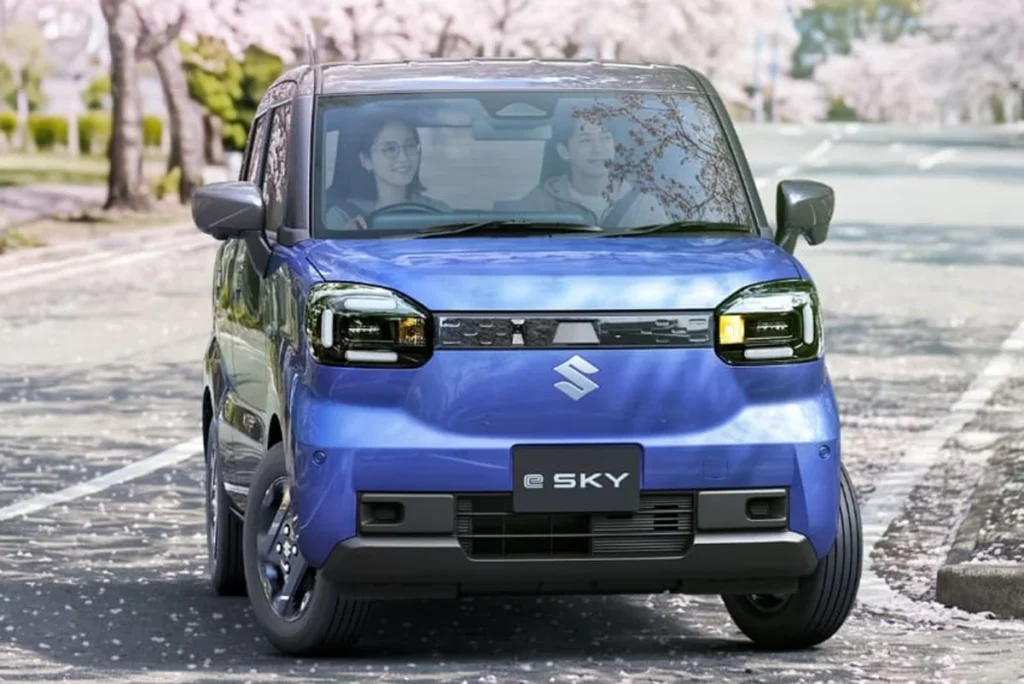
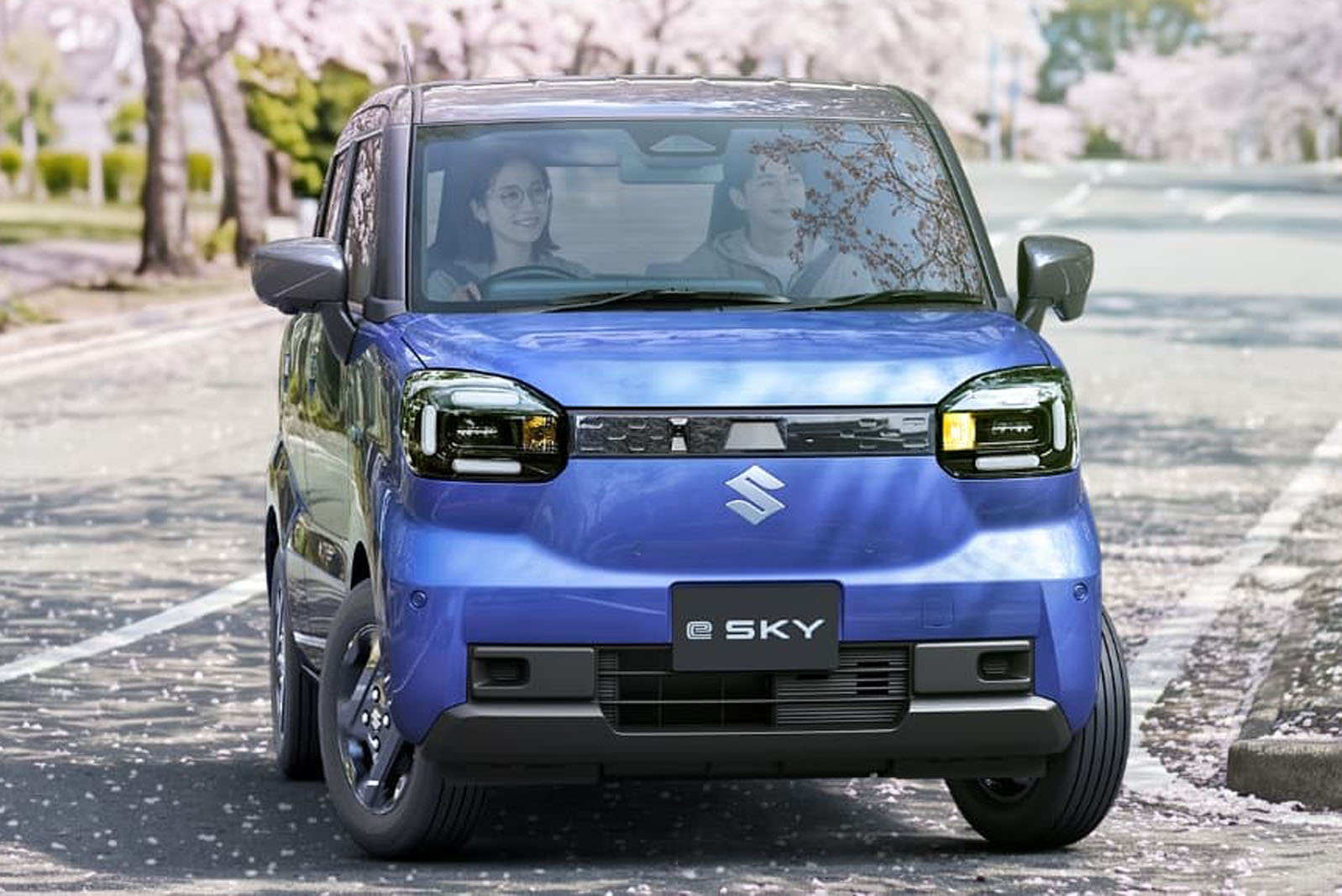
Suzuki has officially unveiled the e-Sky, its groundbreaking new all-electric city car poised to enter the UK market next year. This compact EV is set to challenge established players like the Renault Twingo and the Honda Super-N, aiming to carve out a significant niche in the burgeoning affordable electric vehicle segment. The e-Sky represents Suzuki’s inaugural foray into the electric kei car arena, adhering strictly to the size and dimensional regulations that define this distinctive Japanese automotive class. This adherence to kei car principles has dictated a decidedly boxy and upright exterior design, a deliberate choice engineered to maximize interior space within an exceptionally minimal physical footprint.
The production version of the e-Sky bears a striking resemblance to the concept car that captivated audiences at last year’s Tokyo motor show. The most discernible revision between the concept and the final product lies in the lighting system. The futuristic LED array of the concept has been replaced with a more robust and conventional lighting configuration, signaling a pragmatic approach to production and potential cost management. While Suzuki has remained tight-lipped regarding comprehensive technical specifications until the autumn, industry expectations, informed by kei car conventions, suggest the e-Sky will likely feature a single, front-mounted electric motor producing approximately 63bhp. This power output is typical for vehicles designed for urban environments where agility and efficiency are prioritized over outright performance.
Early reports emerging from Japanese automotive media indicate a projected driving range of 193 miles for the e-Sky. This figure, if accurate, would position the Suzuki significantly ahead of its reported rival, the Honda Super-N, which has a claimed range of 128 miles. It is important to note, however, that the Honda Super-N is not a pure kei car in the same vein as the e-Sky. The Super-N is derived from the Honda N-One E but has been specifically adapted for export markets, including the UK. These modifications reportedly include a more potent 94bhp motor and a wider, more assertive body design, suggesting a different target demographic and design philosophy compared to the e-Sky’s adherence to kei car norms. The question remains whether Suzuki will consider a similar adaptation for the e-Sky, potentially increasing its power output to cater to the preferences of UK buyers who may be accustomed to a slightly more dynamic driving experience.
The introduction of the e-Sky is not merely an expansion of Suzuki’s product portfolio; it signifies a pivotal element in the company’s strategic future plans for the UK market. David Kateley, the Suzuki UK boss, has previously articulated the critical importance of an A-segment battery-electric vehicle (BEV) to the brand’s long-term vision, expressing considerable optimism regarding its potential success. This emphasis underscores Suzuki’s commitment to electrifying its offerings and meeting evolving consumer demands and regulatory landscapes.
Strategic Positioning and Pricing
Suzuki is targeting a competitive price point for the e-Sky, with expectations that it will launch in the UK with a starting price below £20,000. This pricing strategy places the electric city car on par with the cost of the combustion-engined Suzuki Swift supermini, a popular and established model in the UK market. This aggressive pricing is a clear indicator of Suzuki’s intent to make electric mobility accessible to a broader segment of the car-buying public, thereby accelerating the adoption of zero-emission vehicles. The sub-£20,000 bracket is particularly significant as it falls within the reach of many first-time car buyers and those seeking an economical second vehicle for urban commuting.
The e-Sky is slated for an arrival in the UK next spring, a strategic timing that allows ample opportunity for market penetration before the end of the fiscal year. The sales performance of the e-Sky will play a crucial role in Suzuki’s efforts to meet the UK’s stringent zero-emission vehicle mandate. This mandate, which sets targets for the proportion of new vehicles sold that must be zero-emission, is a key driver for automotive manufacturers to increase their EV offerings. Successfully meeting these targets is essential for regulatory compliance and for avoiding potential penalties.
Beyond the e-Sky, Suzuki has outlined an ambitious roadmap for its electric vehicle expansion. Following the e-Sky’s launch, the company plans to introduce its third all-electric model approximately a year later. Mr. Kateley has confirmed that this subsequent EV will "definitely won’t be an electric Swift," hinting at a departure from the familiar supermini silhouette and potentially exploring different vehicle segments or body styles within the electric domain. This suggests a broader strategy to diversify its EV offerings beyond the compact city car segment.
Background: The Rise of the Kei Car and the Urban EV Revolution
The Suzuki e-Sky’s heritage as a kei car provides important context for its design and market positioning. Kei cars, or "light automobiles," emerged in Japan in the post-World War II era as a solution for affordable, economical personal transportation. They are characterized by strict regulations concerning their maximum dimensions (length, width, and height), engine displacement, and power output. These regulations were designed to promote fuel efficiency and reduce the burden on road infrastructure. Over the decades, kei cars have become immensely popular in Japan, accounting for a significant percentage of new vehicle sales. Their compact size makes them ideal for navigating crowded urban streets and for parking in tight spaces.
The appeal of kei cars has gradually extended beyond Japan, with manufacturers recognizing the potential for similar compact, efficient, and affordable vehicles in other global markets, particularly in densely populated urban centers. The e-Sky’s adaptation for the UK market signifies this broader trend of globalizing the kei car concept, albeit with potential modifications to suit local tastes and regulations.
The emergence of affordable electric city cars like the e-Sky is also a direct response to the accelerating global shift towards electrification and the increasing demand for sustainable transportation solutions. Governments worldwide are implementing policies to encourage EV adoption, including subsidies, tax incentives, and the establishment of zero-emission zones in urban areas. Consumers, in turn, are becoming more environmentally conscious and are actively seeking vehicles that reduce their carbon footprint and offer lower running costs. The combination of kei car efficiency and electric propulsion makes the e-Sky a compelling proposition for the modern urban dweller.
Technical Considerations and Competitive Landscape
While detailed technical specifications for the Suzuki e-Sky remain under wraps, the anticipated 63bhp output from a single front-mounted motor aligns with typical kei car performance characteristics. These vehicles are not designed for high-speed performance but rather for efficient and nimble operation within city limits. The focus is on providing adequate power for acceleration from traffic lights and maintaining a steady pace in urban traffic.
The battery capacity and charging capabilities of the e-Sky will be crucial factors influencing its practical usability. For a projected range of 193 miles, a battery capacity in the region of 25-30 kWh would be a reasonable expectation, although this is speculative. The availability of fast-charging options will also be important, allowing owners to replenish the battery quickly during short stops.
The competitive landscape for the e-Sky is intensifying. The Renault Twingo Electric, a strong contender in the European city EV market, offers a comparable size and urban-focused design. The Honda Super-N, as mentioned, presents a slightly different proposition with its modified powertrain and bodywork. Other potential rivals could emerge from various manufacturers looking to capitalize on the growing demand for affordable EVs. Suzuki’s strategic pricing, combined with its established reputation for reliability and value, could give the e-Sky a significant advantage.
Broader Implications for Suzuki and the UK EV Market
The introduction of the Suzuki e-Sky represents a significant strategic move for the brand in the UK. It allows Suzuki to tap into a rapidly expanding market segment and to proactively address the evolving regulatory environment. By offering an affordable EV, Suzuki is not only catering to a new demographic of buyers but also bolstering its credentials as a forward-thinking automotive manufacturer.
For the broader UK EV market, the e-Sky’s arrival signifies an increase in choice and competition, particularly in the sub-£20,000 bracket. This could put downward pressure on prices across the segment, making electric vehicles more accessible to a wider population. Furthermore, the success of the e-Sky could encourage other manufacturers to introduce similar compact and affordable EVs, accelerating the transition to a zero-emission future for personal transportation in the UK.
The e-Sky’s compliance with kei car regulations also highlights a potential avenue for future urban mobility solutions. As cities grapple with congestion and environmental concerns, the efficiency and compact nature of kei car-derived vehicles could offer a pragmatic path towards more sustainable urban transport. Suzuki’s commitment to this segment, starting with the e-Sky, positions them as a key player in shaping the future of urban electric mobility in the UK and beyond. The company’s proactive approach to electrification, demonstrated by its clear roadmap for future EV introductions, suggests a long-term commitment to this transformative technology.