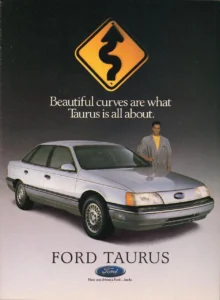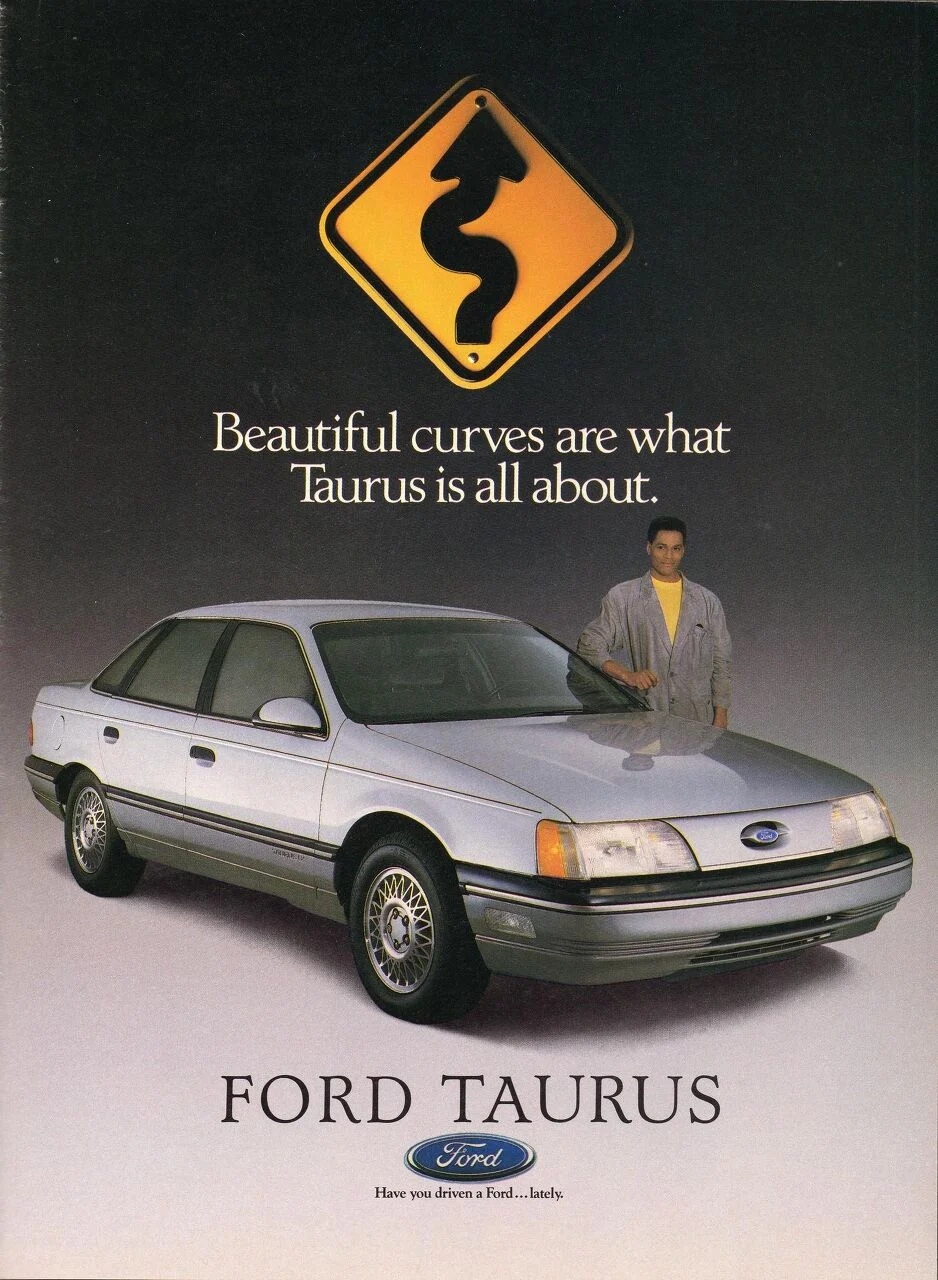
The Ford Taurus, upon its highly anticipated debut in 1986, immediately resonated with American consumers, quickly establishing itself as the benchmark for midsize family sedans. This groundbreaking vehicle, offered in a variety of trims and a plethora of standalone options often bundled into convenient Preferred Equipment Packages, represented a paradigm shift in automotive design and marketing. The first generation of the Taurus is widely regarded as its most successful iteration, a testament to Ford’s astute understanding of market demands and its bold embrace of innovation. Examining its impressive sales figures and accompanying pricing structures reveals the strategic brilliance behind its immediate and enduring appeal.
A New Era: Replacing Legacy Models with Modern Appeal
The introduction of the Taurus and its Mercury counterpart, the Sable, marked a significant departure from Ford’s established lineup. These new front-wheel-drive vehicles were designed to succeed the aging, rear-wheel-drive LTD and Marquis. In their final year of production as flagship models in 1985, the LTD had achieved sales of 205,526 units, while the Marquis, its slightly more upscale sibling, sold 101,498 units. The stark contrast in sales between these two nearly identical vehicles underscored a crucial lesson for Ford: styling and modern design played an increasingly pivotal role in consumer purchasing decisions.
The market’s reception to the Taurus was overwhelmingly positive, with buyers readily embracing its contemporary aesthetics and forward-thinking engineering. The Sable, while sharing the Taurus’s underlying platform, experienced a more lukewarm reception. Its distinctive "space-age" front fascia and more expansive glasshouse design, intended to convey a sense of futuristic luxury, proved less universally appealing than the Taurus’s cleaner, more conventional yet decidedly modern lines. In 1986, the Taurus sold an impressive 236,346 units, significantly outpacing the Sable’s 95,635 units. This sales disparity would only widen as the first generation progressed, solidifying the Taurus’s position as the star performer.
The initial success of the Taurus was more than just a triumph for a single model; it had a profound impact on Ford Motor Company’s overall financial health. In 1986, Ford sold a total of 2,066,507 passenger cars and 1,381,438 trucks. This surge in sales, largely driven by the Taurus’s popularity, contributed to Ford achieving greater profitability than its archrival, General Motors, for the first time since 1924. This financial turnaround signaled a significant shift in the automotive landscape and re-established Ford as a formidable competitor.
A Sales Juggernaut: The Taurus’s Ascent Through the Ranks
The momentum generated by the Taurus’s initial success continued unabated. Demand surged dramatically in 1987, following widespread critical acclaim from prominent automotive publications and a growing reputation among consumers. In 1987, production of the Taurus reached a remarkable 374,763 units, a substantial increase from its debut year. The Sable, while showing some improvement with 121,313 units sold, continued to lag significantly behind its Ford sibling, its sales now representing approximately one-third of the Taurus’s volume rather than the initial half.
The sales gap between the Taurus and Sable continued to widen in subsequent years. In 1988, the Taurus further solidified its dominance, with 387,577 examples sold. The Sable’s sales saw a minor dip to 121,285 units, a slight decrease from the previous year. The pinnacle of the first generation’s sales success arrived in 1989, when the Taurus achieved its highest annual sales figure, with 395,261 units sold. The Sable experienced a modest improvement in its fortunes, selling 130,657 units.
The Impact of Refreshes and Evolving Market Dynamics
The automotive market is characterized by constant evolution, and even successful models must adapt to remain competitive. A significant refresh of the Taurus and Sable occurred in 1990, which included updates to the dashboard and the introduction of a standard driver’s side airbag. While these enhancements were important for safety and modernity, the aging platform of the first generation began to show its effects on sales figures. Taurus sales dipped to 333,011 units in 1990, while the Sable managed to stay just above the six-figure mark with 103,749 units sold.
By its final model year in 1991, the first-generation Taurus experienced a further decline in sales, with a 10-percent drop to 303,833 units. The Sable also saw a smaller 7-percent slip, selling 96,698 units. Despite this tapering off, the overall sales volume of the first-generation Taurus remained exceptionally strong, cementing its legacy as a monumental success for Ford.
Navigating the Price Spectrum: From Value to Performance
The pricing strategy for the first-generation Ford Taurus was designed to appeal to a broad spectrum of buyers, offering a range of trims and options that accommodated various budgets. In 1986, the Taurus was available in four distinct trim levels: L, MT5, GL, and LX.
The Entry-Level Appeal: L Trim and Value Proposition
The most accessible model, the L sedan, was priced at a competitive $9,645 (approximately $29,651 in 2023 dollars, adjusted for inflation). This positioning allowed Ford to effectively target economy-minded buyers and compete directly with other entry-level sedans. It represented a modest increase over the top-trim Ford Tempo LX, which was priced at $9,175 ($28,206 adjusted).
The L wagon, however, carried a more substantial premium. This was largely due to its standard inclusion of the more powerful V6 engine and an automatic transmission, features not found on the base L sedan. The L wagon commanded a price of $10,763 ($33,088 adjusted), reflecting its enhanced powertrain and utility.
The Mid-Range Options: MT5 and GL Trims
The MT5 sedan occupied a space slightly above the L, with a price tag of $10,276 ($31,591 adjusted). The MT5 wagon was priced at $10,741 ($33,020 adjusted), maintaining a relatively small difference between the body styles.
Stepping up to the GL trim introduced a more significant price differentiation. The GL sedan started at $11,322 ($34,806 adjusted), while the GL wagon was priced at $11,790 ($36,245 adjusted). The approximate $500 ($1,537 adjusted) difference between the sedan and wagon at this trim level offered buyers a clear choice based on their cargo and passenger needs.
The Premium Experience: LX Trim and Performance Variants
For buyers seeking a more upscale experience, the Taurus LX sedan began at $13,351 ($41,044 adjusted). The LX wagon commanded a higher price of $13,860 ($42,609 adjusted). It’s important to note that these base prices did not account for the cost of optional equipment, such as Preferred Equipment Packages (PEPs) or standalone options. The addition of alloy wheels, an option on all models, cost approximately $300 ($922 adjusted), while air conditioning, standard only on the LX trim, was a significant feature worth $762 ($2,342 adjusted). These additional costs would typically add one to two thousand dollars to the final out-the-door price.
Evolution of Pricing: The 1989 Model Year and the SHO’s Arrival
By the 1989 model year, the automotive landscape had evolved, and so had the Taurus lineup. The MT5 trim was discontinued, and Ford introduced the performance-oriented Taurus SHO (Super High Output) to the lineup, significantly expanding the model’s appeal.
The pricing of the base L sedan in 1989 was $11,788 ($32,798 adjusted). The L wagon saw a more pronounced increase, priced at $13,143 ($36,568 adjusted), with the gap between sedan and wagon widening to approximately $1,300 ($3,617 adjusted). The GL sedan was priced at $12,202 ($33,949 adjusted), and the GL wagon at $13,544 ($37,683 adjusted).
The LX trim continued to represent the upper echelon of the standard Taurus offerings. The LX sedan started at $15,282 ($42,519 adjusted), and the LX wagon at $16,524 ($45,975 adjusted).
The SHO: A Performance Statement
The introduction of the Taurus SHO marked a significant departure in terms of both performance and pricing. With its unique engine, distinctive styling, and sport-tuned suspension, the SHO commanded a base price of $19,739 ($54,920 adjusted). Despite its higher price point, the SHO came standard with a comprehensive list of equipment, justifying its premium.
Powertrain Options and Luxury Derivatives
For buyers seeking enhanced performance within the GL and LX trims, the larger 3.8-liter V6 engine was available as an option for an additional $1,072 ($2,982 adjusted). This same engine was standard on the Lincoln Continental, a luxury sedan based on the Taurus platform. The Continental, reflecting its premium positioning, carried a significantly higher price range, from $28,032 ($77,944 adjusted) to $30,434 ($84,677 adjusted) for the Signature trim.
The Final Chapter of the First Generation: 1991 Pricing
As the first generation of the Taurus approached its conclusion in 1991, pricing adjustments reflected market conditions and the model’s established position. The basic L sedan was priced at $13,352 ($33,423 adjusted), with the L wagon at $14,874 ($37,233 adjusted). The price gap between the L and GL sedans had narrowed, with the GL sedan listed at $13,582 ($33,999 adjusted). The GL wagon was priced at $14,990 ($37,524 adjusted).
The LX sedan in 1991 was priced at $17,373 ($43,489 adjusted), and the LX wagon, which came standard with the 3.8 V6, was $18,963 ($47,469 adjusted). The base price of the SHO saw an increase to $22,071 ($55,249 adjusted), with limited-run variants like the Plus version likely commanding even higher figures.
Sable Pricing: A Premium Proposition
Throughout its run, the Mercury Sable offered a more premium alternative to the Taurus, reflected in its pricing structure. Only two trims were available: GS and LS, broadly equivalent to the Taurus’s GL and LX. This meant there was no entry-level "cheap" option for Sable buyers.
In 1991, the base Sable GS sedan was priced at $15,821 ($39,604 adjusted), representing a 15 percent premium over the basic Taurus L sedan. The GS wagon was $16,766 ($41,969 adjusted), while the LS sedan asked $16,823 ($42,112 adjusted) and the LS wagon $17,794 ($44,543 adjusted). Notably, the more potent 3.8-liter V6 engine was never standard on any Sable model and remained an optional extra, costing $555 ($1,389 adjusted). This pricing strategy, coupled with its distinct styling, positioned the Sable as a more upscale offering within the midsize segment, though it never achieved the sales volumes of its Ford counterpart.
The Road Ahead: Evolution, Not Revolution
The immense success of the first-generation Ford Taurus set a high bar for its successor. Ford approached the redesign for the 1992 model year with caution, opting for an evolutionary rather than revolutionary approach. While the new Taurus and Sable utilized the same platform and even shared doors with the 1986 models, Ford meticulously refined the design and engineering to build upon the established strengths of the original. This strategic decision underscored Ford’s understanding of what consumers had come to love about the Taurus and its commitment to not disrupt a winning formula. The story of the Taurus’s evolution would continue, building on the foundation of automotive excellence laid by its groundbreaking first generation.