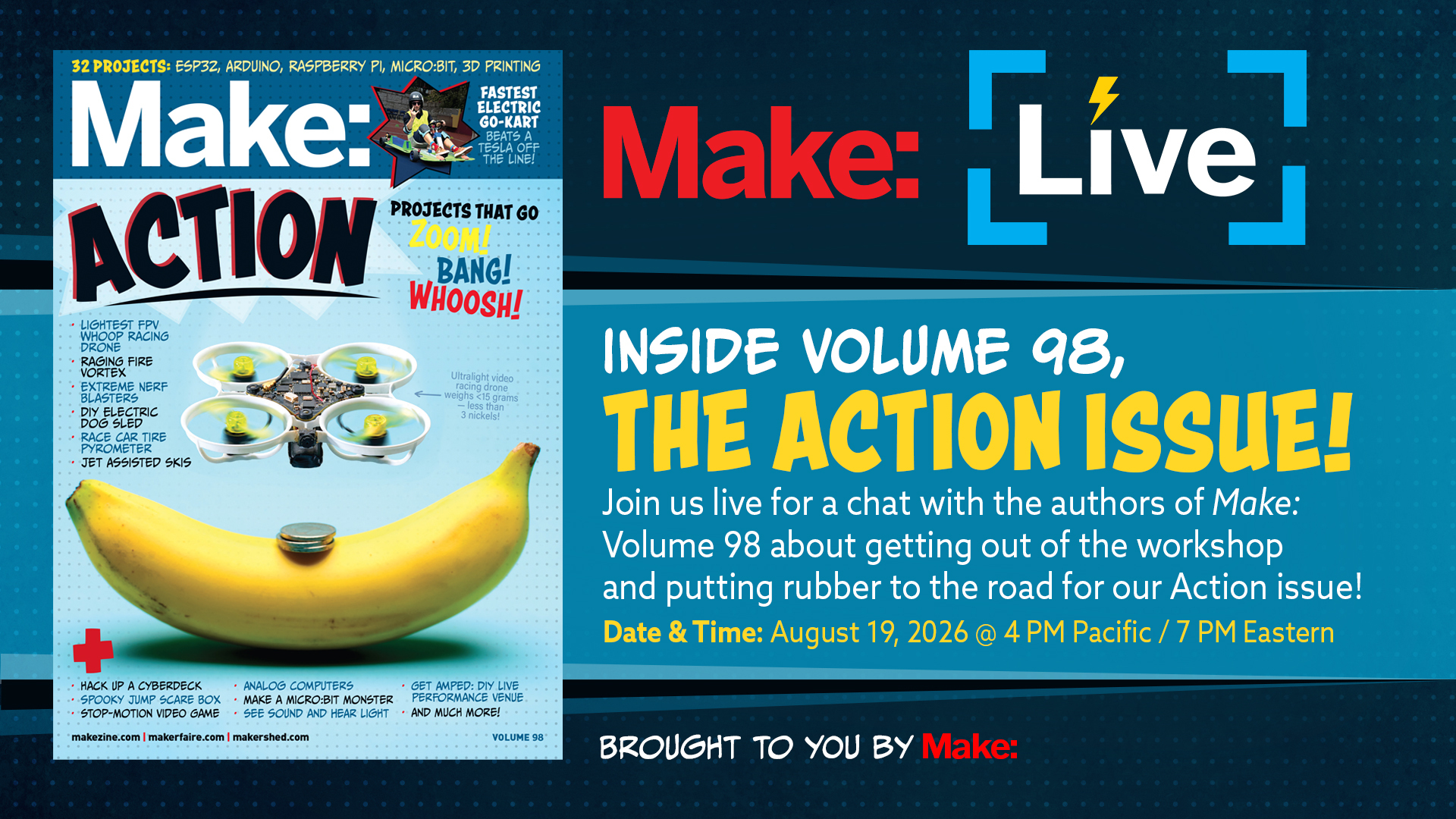
The maker movement continues to push the boundaries of DIY engineering and creative innovation with the upcoming broadcast of Make: Live, a deep dive into the latest installment of the long-running publication, Make: Magazine. Scheduled for Wednesday, August 19, 2026, at 4 PM Pacific Time, this live event focuses on Volume 98, titled "The Action Issue." This specific edition shifts the focus from stationary workshop projects to high-performance, mobile, and kinetic inventions that prioritize speed, propulsion, and outdoor engagement. By bringing together a diverse group of engineers, hobbyists, and performers, the event aims to showcase how the democratization of technology—ranging from electric vehicle (EV) components to 3D-printed ballistics—is redefining personal fabrication in the mid-2020s.
The Philosophy of the Action Issue
For over two decades, Make: has served as the central organ for the global maker community, documenting the transition from simple hobbyist electronics to sophisticated home-based engineering. Volume 98, "The Action Issue," represents a thematic evolution, emphasizing projects that interact with the physical world through movement and energy. The issue moves beyond the "Internet of Things" (IoT) and desktop manufacturing to explore what happens when makers apply their skills to transportation, competitive sports, and high-stakes entertainment.
The live broadcast serves as a bridge between the static pages of the magazine and the dynamic reality of the projects. It provides a platform for the creators to explain the "why" and "how" behind their builds, offering insights into the trial-and-error processes that characterize modern invention. As the maker movement matures, there is an increasing emphasis on high-power applications, such as high-torque electric motors and miniature jet propulsion, which requires a more rigorous understanding of physics and safety than the craft-based projects of the movement’s early years.
High-Performance Electrification: Saul Griffith’s AWD Go-Cart
One of the primary highlights of the upcoming live session is the work of Saul Griffith, a renowned engineer, inventor, and MacArthur "Genius" Grant recipient. Griffith has long been a proponent of electrification as a solution to climate change, but his contribution to Volume 98 focuses on the "fun" side of the green energy transition. He will present his custom-built, all-wheel-drive (AWD) electric go-cart.
The vehicle is more than a simple hobbyist toy; it is a demonstration of the power-to-weight advantages inherent in modern electric drivetrains. Griffith claims the cart can theoretically outperform a Tesla in a short-distance "off the line" acceleration test. This is achieved through the use of high-discharge lithium batteries and high-torque brushless DC (BLDC) motors at each wheel, managed by a sophisticated electronic speed controller (ESC) system.
Griffith’s project underscores a significant trend in the maker community: the accessibility of high-end EV components. A decade ago, building an AWD electric vehicle required salvage from industrial machinery or expensive custom parts. Today, the "Action Issue" demonstrates that these components are readily available to individual makers, allowing for the creation of vehicles that rival commercial performance standards.
The Evolution of Competitive Hobbyism: Ryan Cho and Bay Area Foam Tag
The broadcast will also feature Ryan Cho of Bay Area Foam Tag, representing the rapidly growing "Nerf-style" blaster community. This hobby has evolved far beyond the brightly colored plastic toys found in retail aisles. The "NIC" (Nerf Internet Community) has become a hotbed for mechanical engineering and 3D printing innovation.
Cho will discuss the engineering behind custom-built foam blasters that utilize flywheels, solenoids, and high-pressure air systems to achieve ranges and velocities that far exceed commercial products. These "pro-level" blasters often incorporate:
- CNC-Machined Components: For durability under high spring loads.
- Brushless Motor Systems: For rapid-fire capabilities and instantaneous "rev" times.
- Programmable Microcontrollers: Such as Arduino or ESP32, to manage firing modes, rate of fire, and battery health monitoring.
The inclusion of Bay Area Foam Tag in the "Action Issue" highlights the social and competitive aspect of making. It illustrates how digital fabrication—specifically high-speed FDM (Fused Deposition Modeling) and resin printing—has allowed hobbyists to create a self-sustaining ecosystem of parts and designs that bypass traditional manufacturing supply chains.
Extreme DIY Propulsion: Methodical Maker’s Jet Turbines
Perhaps the most daring project featured in Volume 98 comes from Alex of Methodical Maker. In an era where personal mobility is being reimagined, Alex has taken the concept to an extreme by developing handheld jet turbines designed for use on ski slopes. This project blends the world of model aviation with extreme sports.
Building a functional jet turbine is one of the most demanding tasks a maker can undertake, requiring precision balancing of internal components rotating at tens of thousands of RPMs. Alex’s project focuses on the integration of these turbines into a handheld form factor that provides enough thrust to propel a skier across flat terrain or up inclines.
This segment of the live event is expected to cover the critical safety protocols and engineering tolerances required for DIY jet propulsion. It serves as a case study in "Action" making, where the stakes involve thermal management, fuel delivery, and structural integrity under high thrust loads. The project exemplifies the "Methodical Maker" ethos: applying rigorous engineering standards to seemingly "mad scientist" concepts.
Mechanical Magic and Seasonal Engineering: Bizzaro’s Scare Box
Shifting from high-speed transport to the world of entertainment and "scare-tech," the professional magician and escape room designer known as Bizzaro will showcase a Halloween-themed treasure box. While the other projects in the "Action Issue" focus on speed and power, Bizzaro’s work focuses on kinetic timing and mechanical surprise.

The "treasure box" is a sophisticated piece of stagecraft, utilizing hidden linkages, sensors, and actuators to create a "jump scare" effect. In the context of the maker movement, this represents the "theatrical engineering" niche, which is vital for the multi-billion dollar haunt and escape room industries. Bizzaro’s contribution demonstrates how makers can use relatively simple mechanical principles—cams, levers, and spring-loaded triggers—to create complex emotional responses in an audience.
Chronology of the Maker Movement and the Role of Make: Live
To understand the significance of the Volume 98 launch, one must look at the timeline of the maker movement:
- 2005: Make: Magazine launches, sparking the modern DIY revolution.
- 2012: The "3D Printing Boom" makes rapid prototyping accessible to the public.
- 2018-2022: The rise of powerful, affordable microcontrollers and the democratization of EV technology.
- 2023-2026: A shift toward "Extreme Making," where projects incorporate AI, advanced robotics, and high-energy propulsion.
Make: Live events have evolved alongside this timeline. Initially simple "show and tell" sessions, they have become sophisticated technical forums where the world’s leading "garage innovators" exchange data. The August 19 event represents the latest iteration of this community-building effort, utilizing digital platforms to maintain a global network of creators.
Broader Impact and Technical Implications
The projects featured in "The Action Issue" are more than just impressive feats of individual ingenuity; they reflect broader shifts in technology and society.
- The Democratization of Power: Saul Griffith’s go-cart and Alex’s jet turbines show that high-energy density power sources are no longer the exclusive domain of large corporations or the military. This has profound implications for the future of decentralized innovation.
- STEM Education and Skill Acquisition: The complexity of these projects—involving CAD design, electrical engineering, and fluid dynamics—serves as a powerful educational tool. By engaging with "Action" projects, makers acquire high-level skills that are directly transferable to the modern workforce.
- The Right to Repair and Modify: The maker movement remains a staunch advocate for the "right to repair." By building their own vehicles and tools from the ground up, these makers are asserting their autonomy over the technology they use, countering the trend of "black box" consumer electronics.
- Economic Shift: The "pro-sumer" market for maker tools (high-speed 3D printers, desktop CNCs, laser cutters) continues to grow. Events like Make: Live drive the demand for these tools, fueling a secondary economy of component suppliers and software developers.
Conclusion
The upcoming Make: Live event for Volume 98, "The Action Issue," stands as a testament to the enduring spirit of curiosity and the increasing technical prowess of the global maker community. By highlighting the work of Saul Griffith, Ryan Cho, Bizzaro, and Methodical Maker, the event showcases a spectrum of innovation that ranges from the whimsical to the revolutionary.
As these creators gather on August 19 to share their insights, they provide a roadmap for the next generation of inventors. Whether it is through the silent torque of an AWD electric cart or the roar of a handheld jet turbine, the "Action Issue" confirms that the maker movement is no longer just about building things—it is about moving the world forward, one project at a time. Participants and enthusiasts are encouraged to join the discussion on the official Discord server, further cementing the collaborative nature of this technological renaissance.