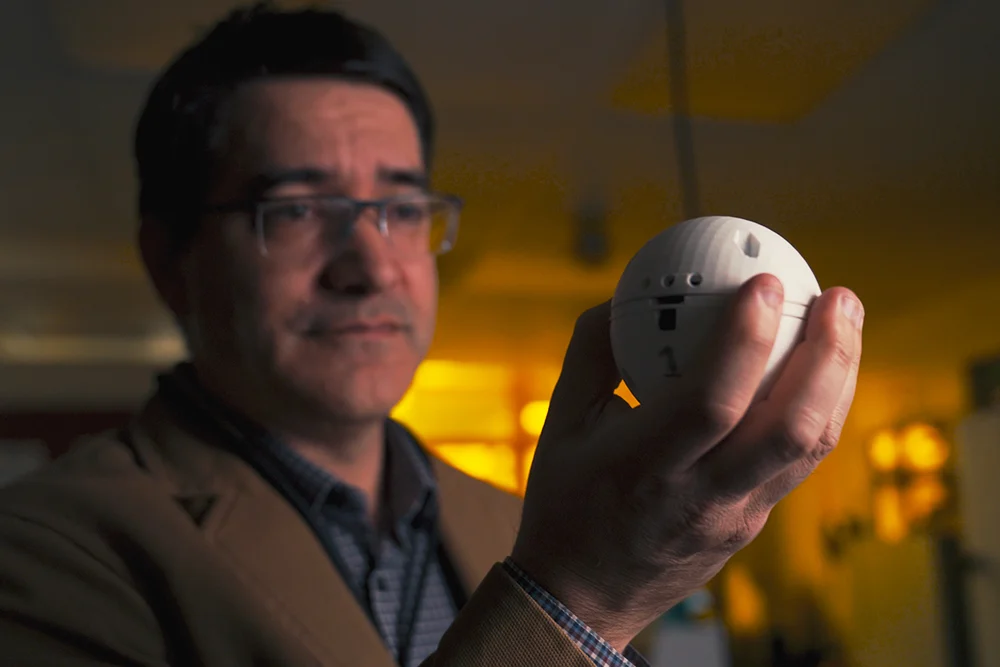
A groundbreaking device, dubbed the Tactical Optical Spherical Sensor for Interrogating Threats (TOSSIT), has been successfully developed at MIT Lincoln Laboratory, marking a significant advancement in the detection of hazardous airborne substances. This innovative, baseball-sized sensor is specifically engineered to provide critical, real-time warnings to military personnel, first responders, and law enforcement agencies regarding the presence of dangerous vapors and aerosols in their immediate environment. Its robust design and intuitive functionality address a long-standing need for rapid, remote, and reliable chemical threat identification, promising to enhance safety and operational effectiveness in a variety of high-risk scenarios. The technology, following extensive field validation, is now being prepared for transfer to the U.S. military, signifying its readiness for operational deployment.
A New Frontier in Chemical Threat Detection
The TOSSIT sensor represents a paradigm shift in the approach to identifying airborne chemical hazards. Traditionally, detecting invisible threats such as nerve agents, industrial chemicals, or highly potent substances like fentanyl dust has been a complex and often perilous task. Existing methods frequently require specialized, bulky equipment, lengthy analysis times, or direct human exposure to potentially contaminated areas. TOSSIT circumvents these limitations by offering a compact, deployable, and low-cost solution that can be introduced into a hazardous zone without endangering personnel. Its core functionality revolves around the ability to remotely sample air and visually identify chemical reactions, thereby providing immediate intelligence on the nature of the threat. This capability is crucial for making informed decisions in rapidly evolving situations, from military engagements to domestic emergency responses.
The Genesis of TOSSIT: Addressing Critical Gaps
The development of TOSSIT at MIT Lincoln Laboratory stems from a recognized imperative within national security and emergency response communities to enhance capabilities against chemical, biological, radiological, and nuclear (CBRN) threats. For decades, researchers have striven to develop sensors that are not only highly accurate but also practical for deployment in dynamic, often hostile environments. Existing handheld detectors often require operators to enter potentially contaminated areas, exposing them to significant risk. Furthermore, many advanced spectroscopic or mass spectrometry-based systems, while highly precise, are often too large, fragile, or expensive for widespread tactical use.
MIT Lincoln Laboratory, renowned for its contributions to advanced technology for national security, identified this critical gap. The challenge was to create a device that could be easily deployed, robust enough to withstand harsh conditions, and capable of providing actionable intelligence quickly and reliably. The vision for TOSSIT was to empower service members and first responders with an initial assessment tool that could rapidly survey an area for unseen dangers, enabling them to establish perimeters, plan safe entry, or initiate evacuation protocols without delay. The focus on "low-cost" also underscored the intention for broad accessibility and scalability across various units and agencies, making it a viable option for routine deployment rather than just specialized operations.
Engineering Innovation: How TOSSIT Works
At the heart of TOSSIT’s innovative design is a sophisticated yet simple detection mechanism. The device, roughly the size and weight of a baseball, is encased in a durable shell, allowing it to be thrown, dropped from a drone, or even launched into an area of concern. Once deployed, TOSSIT actively samples the ambient air. Inside, a removable dye card, impregnated with specific chemical reagents, is exposed to the sampled air. These reagents are engineered to react with target chemicals, causing a visible color change on the card.
An internal camera continuously monitors this dye card. Upon detecting a characteristic color change indicative of a specific hazardous chemical, TOSSIT processes this visual information. The sensor is equipped with an integrated communication module that then transmits an alert to users via a dedicated mobile application or triggers audible/visual alarms directly from the sensor itself. This multi-modal alerting system ensures that users receive timely notifications, regardless of their proximity to the device or ambient noise levels.
The "removable dye card" feature is a particularly ingenious aspect. It allows for easy replenishment and potentially for different dye cards to be used for detecting different classes of chemicals, offering flexibility and cost-efficiency. This method, leveraging established colorimetric chemical reactions combined with modern optical sensing and wireless communication, provides a robust and straightforward approach to detection, minimizing false positives while maximizing detection speed. The spherical form factor also aids in its robust deployment, allowing it to roll and settle in various terrains without critical damage, unlike more fragile, complex instruments.
Rigorous Testing and Field Validation
The journey from concept to operational readiness for TOSSIT involved an extensive and rigorous testing regimen. Researchers at MIT Lincoln Laboratory collaborated closely with military and first responder communities to simulate real-world scenarios, ensuring the device’s efficacy and reliability under diverse and challenging conditions. These tests were crucial in validating TOSSIT’s ability to accurately detect a range of chemical threats, including simulated nerve agents, blister agents, various toxic industrial chemicals (TICs), and fine particulate matter like fentanyl dust.
Field tests were conducted in controlled but realistic environments, mimicking urban combat zones, industrial accident sites, and disaster areas. These trials evaluated not only the sensor’s detection capabilities but also its durability, ease of deployment, communication range, and user interface effectiveness. For instance, tests likely involved deploying TOSSIT into areas with controlled releases of non-toxic chemical simulants, assessing how quickly and accurately the sensor registered the presence of the substances and transmitted alerts. The ability to toss or drone-drop the device was also thoroughly evaluated for accuracy of placement and survivability upon impact. Feedback from military operators and hazmat teams was continuously incorporated into the design, refining its ergonomics, software interface, and overall ruggedness. This iterative development process ensured that TOSSIT would meet the stringent demands of operational use, providing a trustworthy tool in critical moments. The "extensive testing in the field" mentioned by the researchers underscores a multi-year effort involving engineers, chemists, and end-users, meticulously refining the technology to achieve its current state of readiness.
Strategic Deployment and Expert Endorsement
The successful conclusion of TOSSIT’s development and testing phase has paved the way for its critical next step: technology transfer to the U.S. military. This transition is a testament to the device’s proven capabilities and its perceived value in enhancing the safety and operational effectiveness of service members. The military’s adoption of TOSSIT will provide frontline personnel with an unprecedented capability to quickly assess unknown environments, significantly reducing the risk of exposure to hazardous materials.
Richard Kingsborough, the principal investigator for the TOSSIT project, emphasized the unique niche the device fills. "TOSSIT fills an unmet need, providing a low-cost sensing option for vapors and solid aerosol threats — think toxic dust particles — that would otherwise not be detectable by small deployed sensor systems," Kingsborough stated. His remarks highlight two crucial aspects: the device’s affordability, which facilitates broader deployment, and its ability to detect solid aerosol threats, a capability often lacking in smaller, rapidly deployable sensors. The danger posed by microscopic dust particles, such as those from weaponized biological agents or highly potent narcotics like fentanyl, cannot be overstated. A single contact or inhalation event can be fatal, making remote detection absolutely vital for responder safety.
While no direct statements from military officials were provided in the original text, the decision to transfer the technology implies a strong endorsement from defense authorities. This move suggests that TOSSIT has been recognized as a valuable asset that will integrate seamlessly into existing CBRN defense protocols and enhance the protective measures available to troops operating in uncertain or contaminated zones. One could infer that military leadership views TOSSIT as a force multiplier, enabling more aggressive reconnaissance while simultaneously safeguarding personnel.
Broader Implications for National Security and Public Safety
The deployment of TOSSIT carries profound implications for both national security and public safety. For the military, it provides a critical tactical advantage. In urban warfare or reconnaissance missions, soldiers can quickly clear buildings or areas for chemical threats before entry, minimizing casualties from unexpected exposures. The ability to "toss, drone-drop, or launch" the sensor allows for flexible deployment in diverse operational contexts, from clearing a suspect building to surveying a battlefield after a potential chemical attack. This proactive threat assessment capability will undoubtedly save lives and reduce long-term health complications for service members.
In the realm of public safety, TOSSIT stands to revolutionize how first responders, including hazmat teams and law enforcement, approach incidents involving unknown chemical agents. The rise of synthetic opioids like fentanyl has created a new and insidious threat, where even trace amounts can be lethal upon accidental contact. TOSSIT could be invaluable in assessing overdose scenes, clandestine drug labs, or suspicious packages, allowing responders to identify the presence of such dangerous substances remotely and don appropriate protective gear before closer inspection. Similarly, in the event of industrial chemical accidents, the device can provide rapid assessment of vapor plumes, aiding in evacuation decisions and the strategic deployment of emergency personnel.
The "low-cost" aspect is critical for widespread adoption. Equipping numerous units and individual responders with such technology becomes financially feasible, moving advanced chemical detection from a niche, specialized capability to a standard operational tool. This democratizes access to vital threat intelligence, ensuring that more personnel are better protected. Furthermore, the simplicity of its operation means minimal training is required, facilitating rapid integration into existing protocols. The successful deployment of TOSSIT could also inspire further innovations in compact, smart sensing technologies, pushing the boundaries of remote detection across various threat landscapes, including biological and radiological agents in future iterations.
A Timeline of Development and Future Horizons
The announcement of TOSSIT’s readiness for military transfer on July 9, 2026, marks the culmination of a multi-year research and development effort. While specific dates for each phase are not provided, a logical chronology would involve:
- Initial Research and Concept Formulation (Early 2020s): Identifying the unmet need for a compact, throwable chemical sensor, followed by preliminary feasibility studies and design concepts.
- Prototyping and Laboratory Testing (Mid-2020s): Development of initial prototypes, selection of optimal chemical reagents for dye cards, and rigorous testing in controlled laboratory environments to validate detection principles.
- Field Testing and Iteration (Mid to Late 2020s): Extensive trials in simulated real-world conditions, involving collaboration with military and first responder personnel, leading to continuous design refinements based on feedback. This phase would have been crucial for ensuring robustness, accuracy, and user-friendliness.
- Finalization and Technology Transfer Preparation (Late 2020s): Optimization of the TOSSIT design, final validation, and preparation of documentation for technology transfer to the U.S. military.
- Announcement of Readiness (July 9, 2026): Public announcement of TOSSIT’s successful development and readiness for operational deployment.
Looking ahead, the successful transfer of TOSSIT technology to the U.S. military is just the beginning. Future iterations could explore expanding the range of detectable chemicals, integrating artificial intelligence for more sophisticated threat identification, or enhancing communication capabilities for networked sensor deployments. The core principle of a low-cost, throwable sensor offers a versatile platform for adapting to emerging threats and evolving operational requirements. The work at MIT Lincoln Laboratory with TOSSIT not only provides a tangible tool for immediate safety but also lays a foundation for future innovations in critical remote sensing technologies, reinforcing the institution’s pivotal role in safeguarding national and global security.